Parapet walls reshape airflow, soiling patterns in rooftop PV systems

Researchers at the University of Nottingham in the United Kingdom have investigated how parapet height affects dust accumulation on rooftop PV systems. They found that parapet walls substantially alter rooftop airflow, but their effect on particle deposition depends on wind speed and particle size.
“As rooftop solar expands worldwide, soiling is becoming an increasingly important operational issue,” corresponding author Yupeng Wu told pv magazine. “Our work highlights that the building itself can influence that problem. Even a relatively simple feature such as a parapet wall can change the airflow and, therefore, how airborne particles interact with the PV array.
“We found that this effect is not straightforward. A higher parapet does not necessarily lead to more or less particle deposition, because the outcome depends on wind speed and particle size. We also found that the most exposed part of the PV array can shift from the front rows to panels farther downstream under different conditions,” he went on to say.
The researchers combined physical modeling, computational fluid dynamics-discrete phase modeling (CFD-DPM), experimental validation, and mechanistic analysis. Their idealized, full-scale configuration featured an 18-meter-by-18-meter flat-roof building with a height of 10 meters and five PV rows facing the incoming wind.
They modeled parapet heights of 0 meters, 0.5 meters, and 1.5 meters to represent unshielded, partially shielded, and fully shielded configurations, respectively. Atmospheric inlet velocities of 1.3 m/s, 2.6 m/s, and 3.9 m/s represented different wind conditions.
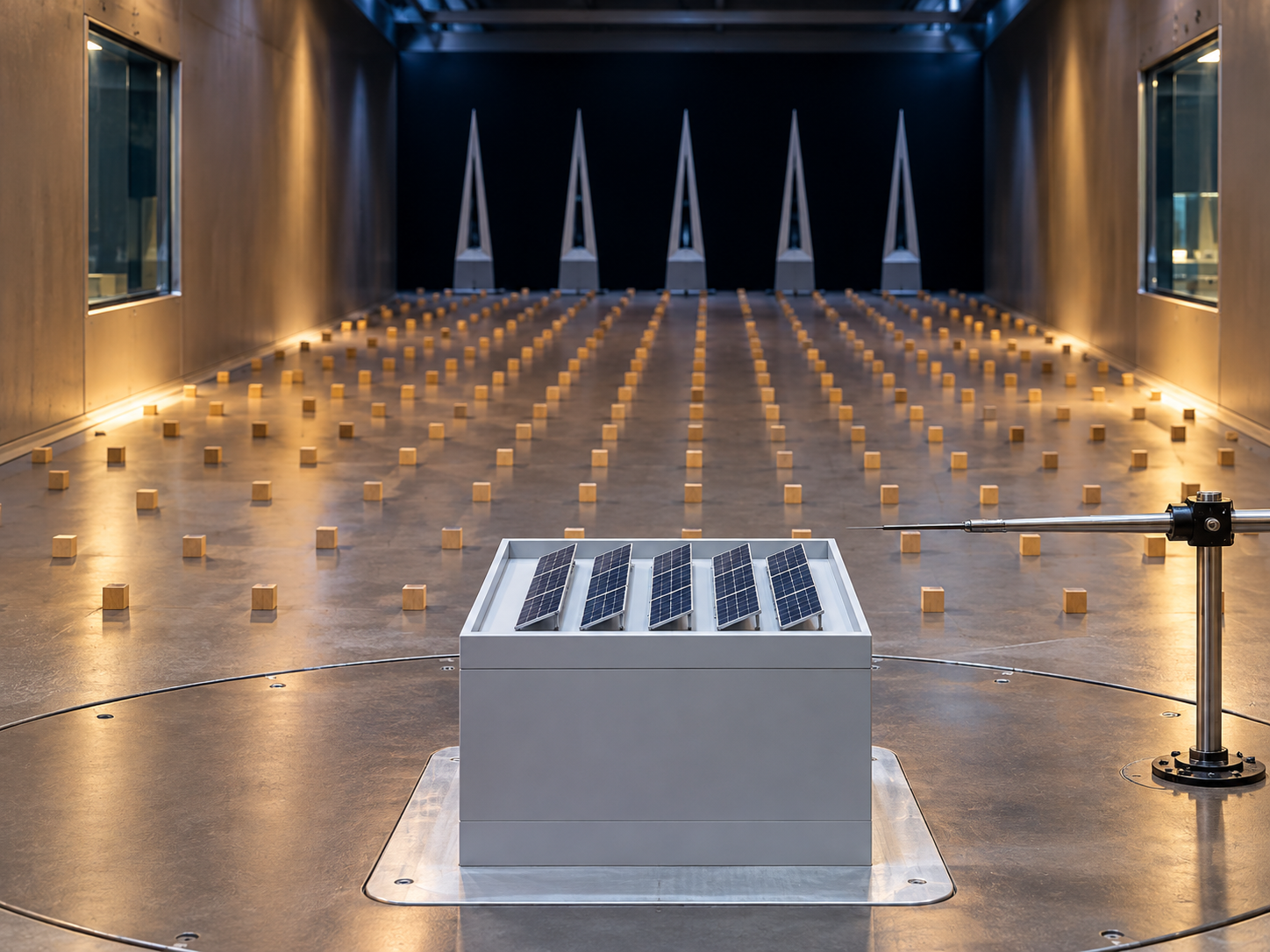
The DPM tracked particle transport and deposition, while a discrete random-walk model represented unresolved turbulent dispersion, particularly for small, low-inertia particles. The researchers validated the airflow model through wind-tunnel tests using an approximately 1:60-scale model. They then used the CFD-DPM framework to assess the effects of parapet height, wind speed, particle size, and PV tilt angle.
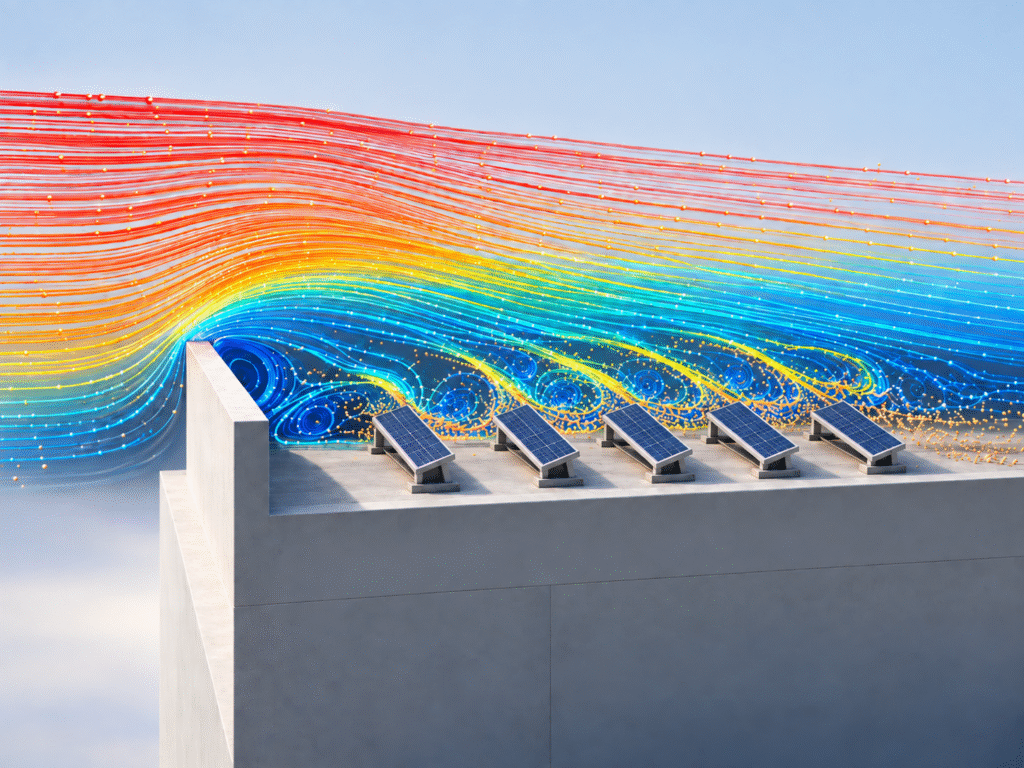
Airflow in rooftop PV systems surrounded by parapet walls
The researchers conducted experiments in a 3.1-meter-by-2.4-meter-by-1.8-meter atmospheric boundary-layer wind tunnel with an 11.5-meter fetch. Sixty pressure taps installed across five PV modules provided additional validation of the CFD-predicted rooftop pressure field. The study considered only normal wind incidence, so the findings do not account for asymmetric airflow and deposition under oblique winds.
The analysis showed that taller parapets suppress rooftop airflow and enlarge low-velocity recirculation zones around PV modules. However, despite reducing near-surface turbulence, tall parapets may shield the panels by directing particles above the array.
Higher wind speeds strengthened vortices and particle transport without substantially changing the geometry-controlled flow pattern. Fine particles followed the airflow and were rarely deposited, while larger particles were increasingly influenced by inertia and gravity.
The tests also showed that windward rows dominated deposition at low wind speeds. At higher speeds, recirculation redirected entrained particles toward downstream rows. PV tilt had a non-monotonic effect, with horizontal panels collecting the most dust and panels tilted at 60 degrees deflecting more particles over the array.
Overall, particle deposition reflected the combined effects of particle delivery, shielding, recirculation, ventilation, settling, and inertia.
“The parapet displaces the roof-edge shear layer and changes particle access to the PV array,” the researchers said. “A shallow parapet can create a partly enclosed recirculation region that promotes local interception for selected particle sizes and wind conditions. A taller parapet can increase shielding and allow more particles to be transported over the array.
“The response reflects competition among recirculation, near-roof ventilation, turbulent transport, inertial impaction, gravitational settling, and penetration between rows. Parapet height therefore does not produce a universally increasing or decreasing deposition rate.”
Particle size was the main factor governing deposition. Fine particles followed the airflow and were rarely captured, while the peak deposition diameter shifted from 100 μm at 1.3 m/s to between 150 μm and 200 μm at 2.6 m/s, and between 200 μm and 300 μm at 3.9 m/s. Coarser particles were deposited mainly on windward rows.
The researchers concluded that parapet height alone cannot reliably predict rooftop PV soiling. They said system design and maintenance planning should account for local wind conditions, airborne particle sizes, panel tilt, and array position, as these factors jointly determine where and how strongly dust is deposited.
Their findings are presented in “Effects of rooftop parapet walls on airflow and dust deposition on photovoltaic arrays: A CFD–DPM study,” published in Building and Environment.
This content is protected by copyright and may not be reused. If you want to cooperate with us and would like to reuse some of our content, please contact: [email protected].

Please login to comment