Shower wastewater heat pump achieves year-round COP of up to 4.1

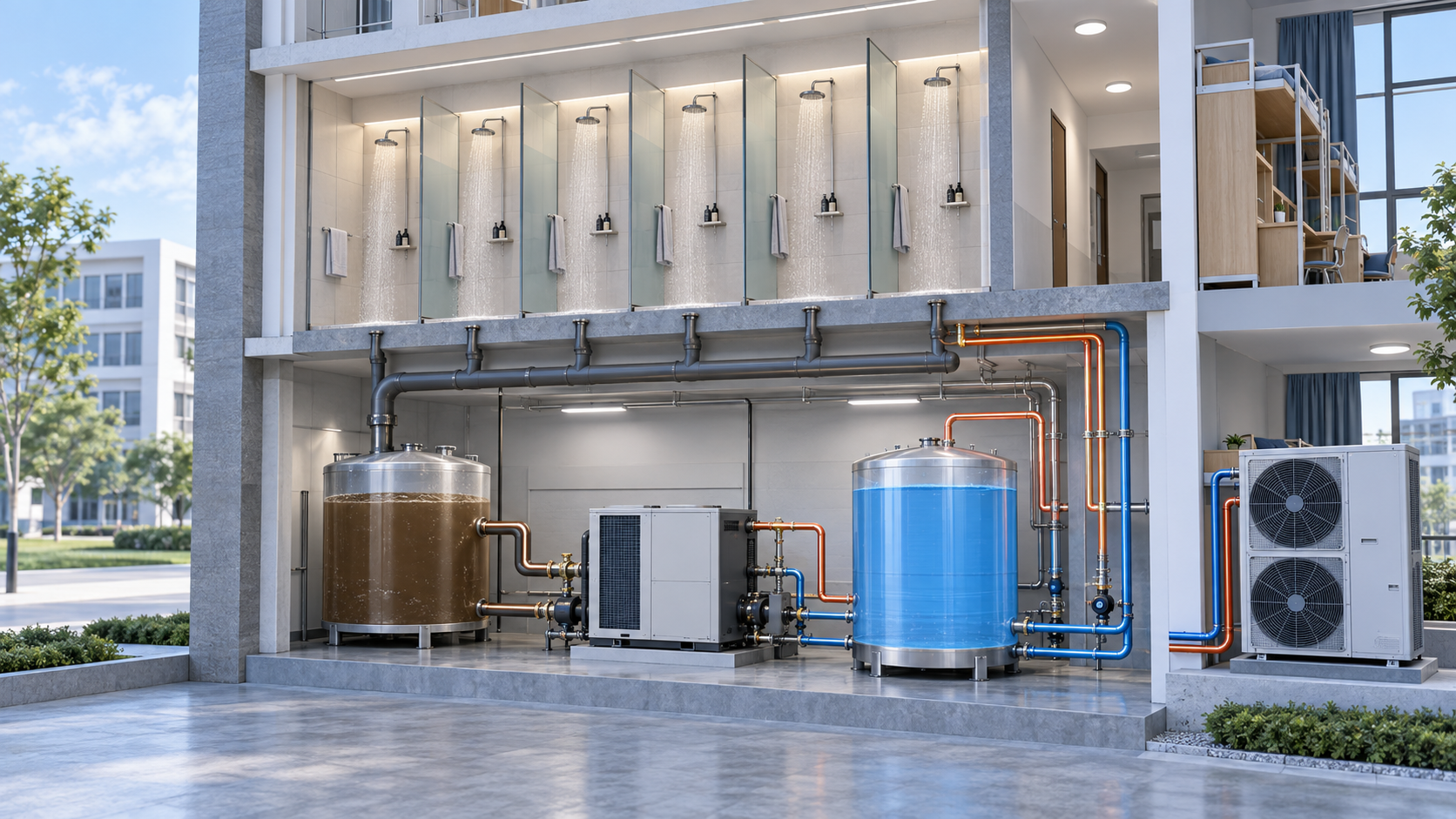
Researchers in China have developed a shower wastewater-source heat pump (WSHP) coupled with an air-source heat pump (ASHP). They monitored the system for one year in university dormitories and assessed its energy performance, life-cycle costs (LCC), and environmental impact.
WSHPs remain a niche technology, although commercial wastewater heat-recovery systems and heat-pump-based products are available for large residential, institutional, and hospitality buildings.
“In this study, a WSHP-ASHP coupled system which recovers heat from shower wastewater and provides an equal amount of shower hot water during the shower process has been introduced,” the researchers said. “Based on one year of actual operational data such as inlet temperatures and flow rates of fresh water and wastewater, tank temperature and system daily power consumption, a dynamic simulation validation and comprehensive benefit analysis have been conducted.”
The researchers installed the system in two student dormitories at the campus of China University of Petroleum in Qingdao, Shandong, China, which accommodate around 2,500 students. It consists of a 200 kW WSHP, a 120 kW ASHP, a 40 m³ hot-water tank, and a 40 m³ wastewater tank.
The WSHP, which includes a preheating heat exchanger and two vapor-compression cycles, serves as the primary heat source. When the shower wastewater reaches a preset level in the storage tank, the WSHP recovers its heat and uses it to warm an equivalent volume of incoming fresh water.
The ASHP provides supplementary heating when insufficient wastewater is available or the WSHP cannot heat the water to the required temperature. Outside the daily shower period, the ASHP maintains the temperature of the hot-water tank.
The system supplies the bathrooms with hot water from 12:00 to 23:00 and is controlled according to the water temperature and available wastewater volume. The researchers used an online monitoring platform to collect hourly operating data, including water temperatures, flow rates, tank temperatures, and electricity consumption.
The group also built a standalone experimental WSHP system to test its performance under different operating conditions. The setup included a preheating heat exchanger, low- and high-temperature heat-pump stages, hot-water and wastewater tanks, pumps, and measuring equipment.
The researchers varied the fresh-water inlet temperature and the flow rates of the fresh water and wastewater. They repeated each operating condition seven times to determine the system’s heating capacity, power consumption, and coefficient of performance (COP).
The group then simulated the complete hybrid system in TRNSYS. The model incorporated measured hot-water demand, wastewater temperatures and flow rates from the dormitories, local weather data, performance curves derived from the standalone WSHP experiments, and manufacturer data for the ASHP.
The researchers validated the model against hourly tank temperatures and monthly electricity consumption recorded by the operating system. They then used it to calculate annual heat production, electricity demand, and seasonal COP.
“The results show that the maximum relative error in hourly tank temperature does not exceed 9%, and the relative errors in monthly power consumption are within 6%,” the researchers said. “The simulation of the WSHP-ASHP in TRNSYS shows that, contrary to the ASHP, the COP of the WSHP is the highest in winter and the lowest in summer. The monthly COP of the WSHP-ASHP is relatively stable over the year, ranging from 3.4 to 4.1.”
The results also showed that the hybrid system offers significant LCC advantages over conventional boilers and records the lowest carbon dioxide emissions. It reduces annual carbon dioxide emissions by 77.77% compared with an electric boiler and by 60.76% compared with a coal-fired boiler.
An LCC-difference contour plot also showed that the WSHP-ASHP system retains an economic advantage over a gas boiler under typical market conditions.
The researchers described the system in “Techno-economic and environmental assessments of a shower wastewater source heat pump assisted by an air source heat pump based on actual operational data validation,” published in Case Studies in Thermal Engineering. The research team included scientists from China’s Xi’an Jiaotong University, the University of Science and Technology of China, and Jiangsu Hengxin Norking Technology.
This content is protected by copyright and may not be reused. If you want to cooperate with us and would like to reuse some of our content, please contact: [email protected].

Please login to comment