UV down-shifting layers could boost TOPCon solar module energy yield by over 4%


Researchers at the University of Ljubljana in Slovenia have investigated whether luminescent ultraviolet down-shifting (UVDS) layers could replace conventional UV absorbers to reduce UV-induced degradation in solar cells based on tunnel oxide passivating contact (TOPCon) technology and have found that the small initial performance penalty associated with UVDS layers could be offset by higher long-term energy yields if UV-induced degradation is effectively suppressed.
Both UVDS layers and conventional UV absorbers are designed to protect solar cells from harmful UV radiation. However, while conventional UV absorbers primarily dissipate the absorbed energy as heat, UVDS layers convert UV radiation into visible light by absorbing high-energy UV photons and re-emitting them at longer wavelengths. The main advantage of UVDS layers is their ability to make part of the absorbed UV radiation available for electricity generation while protecting solar cells from UV-induced degradation, potentially improving long-term energy yields.
“UVDS integration shifts part of the incident photon flux from the ultraviolet region into a spectral range where the external quantum efficiency of silicon solar cells is typically higher,” the scientists explained. “While UVDS concepts have been studied for several decades and across various photovoltaic technologies, their practical implementation remains challenging due to the complex interplay between absorption, photoluminescence, reabsorption, optical trapping, device geometry, and outdoor operating conditions.”
Against this backdrop, the research team developed an optical modeling framework for UVDS layers integrated into realistic photovoltaic devices. “Throughout this work, the investigated UVDS materials are treated as experimentally characterized optical systems defined by their measured absorption, emission, and photoluminescence properties, which constitute the relevant inputs for the proposed modelling approach,” they stressed.
The researchers developed UVDS encapsulant layers using organic photoluminescent dyes dispersed in a polyolefin elastomer (POE) matrix. The layers were fabricated through a twin-screw cast extrusion process, producing films approximately 400 μm thick. The films had thicknesses ranging from 350 μm to 450 μm and a surface roughness of approximately 105 nm. The team also prepared formulations with dye concentrations up to 100 times higher than the reference concentration.
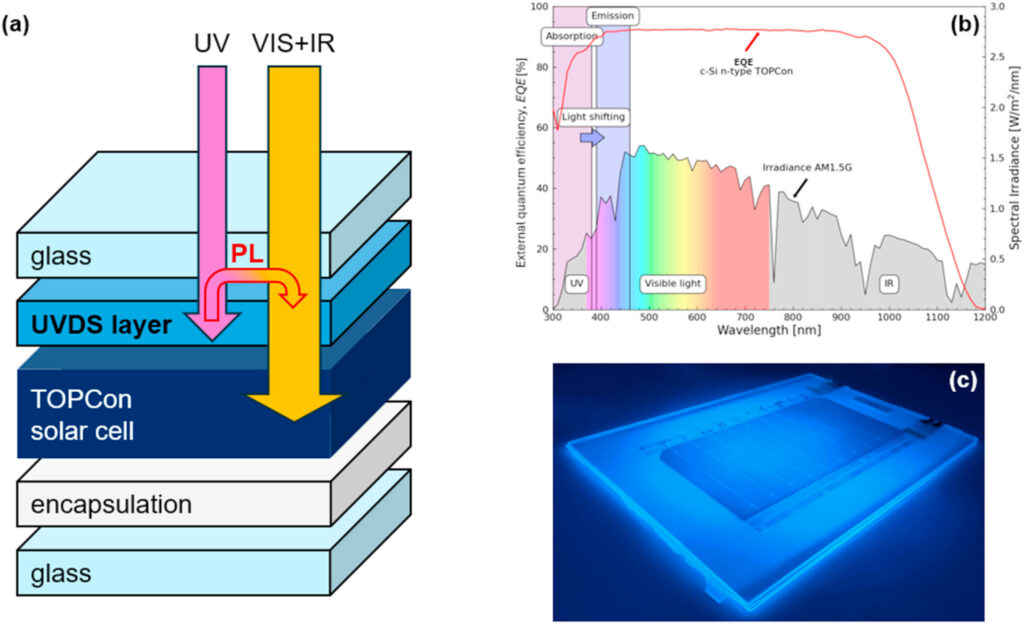
Measurements of reflectance, transmittance, and absorptance were used to calibrate and validate the numerical model. The researchers estimated a photoluminescence quantum yield of approximately 95%, indicating efficient conversion of absorbed photons into emitted light. The UVDS layers were subsequently incorporated into mini-modules based on commercially available TOPCon solar cells. Current-voltage and external quantum efficiency measurements were performed to validate the model’s predictions at the device level.
The model was designed to track incident photons as they pass through the UVDS layer, calculating their absorption and subsequent emission at longer wavelengths. It also simulated the direction of emitted light and the possibility of multiple reabsorption and re-emission events before photons escape or are absorbed elsewhere in the device. The simulations accounted for textured surfaces, material optical properties, and realistic layer thicknesses.
Simulations showed that increasing dye concentration enhanced UV absorption but also increased optical losses, which were partially offset by photoluminescent emission. For a UVDS layer absorbing more than 90% of incident UV photons, the short-circuit current density decreased by 1.77% without photoluminescence, compared with just 0.20% when photon conversion was included. Even the most strongly absorbing UVDS layer limited current losses to 0.34%.
“Furthermore, comparison with hypothetical UV-blocking layers without photoluminescence demonstrated that appropriately designed UVDS layers can recover a substantial fraction of the absorbed UV photon flux, resulting in photocurrent gains exceeding 2% relative to conventional UV-protection approaches with comparable absorption characteristics,” the academics explained.
To assess long-term performance, the team simulated energy production over 10 years in Minneapolis, Minnesota, and Phoenix, Arizona, assuming a 6% voltage loss in unprotected TOPCon cells due to UV-induced degradation. Assuming that UVDS layers completely prevent this degradation, the simulations showed that an initial performance penalty of approximately 1% could be offset by more than 4% additional cumulative energy production over the decade.
The team noted that commercial implementation will depend on manufacturing compatibility, cost-effectiveness, scalability, and the long-term stability of the luminescent materials. The predicted energy-yield gains remain conditional on effective UV protection and the assumed degradation behavior, which has not yet been experimentally validated over the simulated operating period.
“By quantifying the sensitivity of photovoltaic performance to key material properties, including absorption, emission, photoluminescence quantum yield, and degradation, the framework can guide the development and assessment of future UVDS concepts,” the researchers concluded.
Their findings are presented in the paper “Optical modelling and energy-yield assessment of UV down-shifting layers for high-efficiency TOPCon solar modules,” published in Solar Energy Materials and Solar Cells.
This content is protected by copyright and may not be reused. If you want to cooperate with us and would like to reuse some of our content, please contact: [email protected].

Please login to comment