AI predicts wind-uplift resistance of solar PV piles

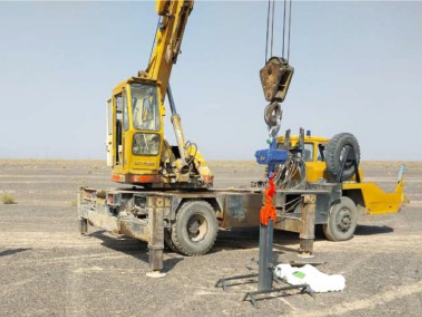
Pile uplift resistance can be a significant geotechnical and design constraint for utility-scale solar PV, particularly for driven steel piles supporting fixed-tilt or tracker systems. PV structures have a large exposed area but relatively little dead weight, meaning wind acting on the modules can generate substantial uplift and overturning forces. These loads must be transferred through the mounting structure to relatively small pile foundations. In weak, loose, saturated, disturbed, or highly variable soils, piles may not develop sufficient shaft resistance to meet uplift capacity requirements.
Pile load testing can therefore be particularly valuable for utility-scale PV projects. Static axial tension and pullout tests can establish actual load-displacement behavior, allowing geotechnical and structural engineers to optimize pile lengths rather than relying solely on conservative correlations.
With this in mind, a group of researchers in Iran has developed an interpretable feedforward artificial neural network (ANN) to predict the uplift capacity of solar PV piles.
“The rapid expansion of ground-mounted solar PV installations demands cost-effective, reliable pile foundations that resist wind-induced uplift,” the researchers said. “However, the uplift capacity of driven steel PV piles is difficult to predict, as conventional static formulas poorly capture the coupled effects of installation dynamics and site-specific soil conditions, often yielding over-conservative or unsafe designs.”
The researchers trained and tested the ANN using data from 130 experimental field load tests conducted at a solar plant in Rafsanjan, central Iran. They installed and tested 130 ST52 steel piles, comprising 79 IPE 140, 31 IPE 160, and 20 IPE 180 profiles.
The scientists also drilled 30 nearby boreholes to characterize the soil and used direct shear tests to determine its internal friction angle.
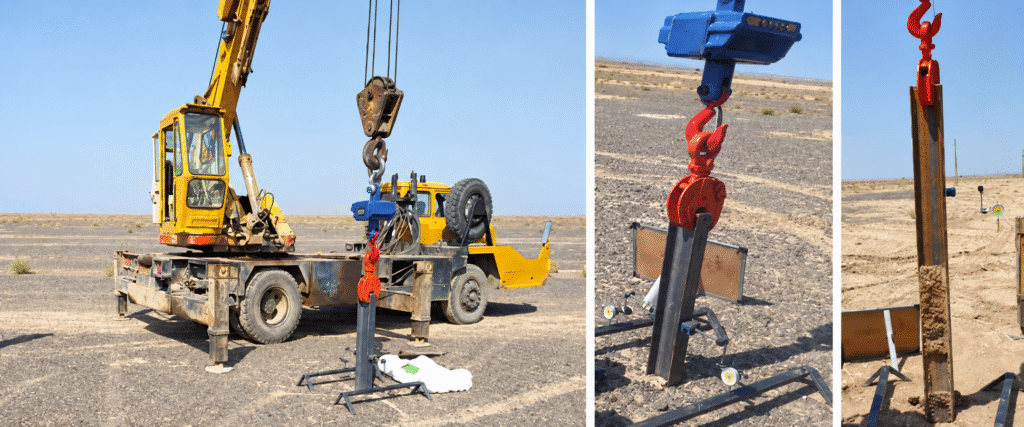
The piles were driven using a hydraulic rig operating at nine to 10 blows per second. The researchers calculated penetration rates from video recordings, reference marks on the piles, and installation times. During uplift testing, they increased the pulling force in 500 kgf increments and measured the resulting pile displacement. They defined uplift capacity as the force recorded at 20 mm of displacement, or the maximum force reached if the pile failed before reaching that threshold.
The researchers then used the results as inputs for the ANN, which was designed to predict pile uplift capacity. The model used four input parameters: pile penetration rate during installation, embedment length (L), soil friction angle, and pile lateral surface area (A).
They trained and evaluated the model using 10-fold cross-validation, while applying dropout and early stopping to prevent overfitting. The ANN achieved a coefficient of determination (R²) of 0.778, a root mean square error (RMSE) of 0.787 tonnes, and a mean absolute percentage error (MAPE) of 7.63%.
“Shapley additive explanations (SHAP) interpretability identified penetration rate (49.8%) and friction angle (47.1%) as the dominant predictors, while geometric parameters (L, A) contributed marginally,” the team said. “Further studies using larger, multi-site datasets and additional soil and installation parameters are required to confirm the generality of these relative contributions.”
The researchers said the trained ANN model, its normalization parameters, and the test dataset will be made available upon request to qualified geotechnical engineers. They also stressed that the model was developed using data from a single location and should therefore be applied cautiously elsewhere.
“Because all experimental data originate from a single sandy site in Rafsanjan, Iran, the model inherently reflects the local soil conditions; consequently, its predictions may not readily generalize to markedly different geological settings, such as clayey, silty, gravelly, or highly layered soils,” they said.
The study, “An interpretable neural network approach for predicting uplift capacity of solar PV piles from installation data,” was published in Results in Engineering. Scientists from Iran’s Islamic Azad University, University of Tehran, and Zaminrun Geotechnical Company participated in the research.
This content is protected by copyright and may not be reused. If you want to cooperate with us and would like to reuse some of our content, please contact: [email protected].

Please login to comment