PV powered desalination is “the most competitive design”

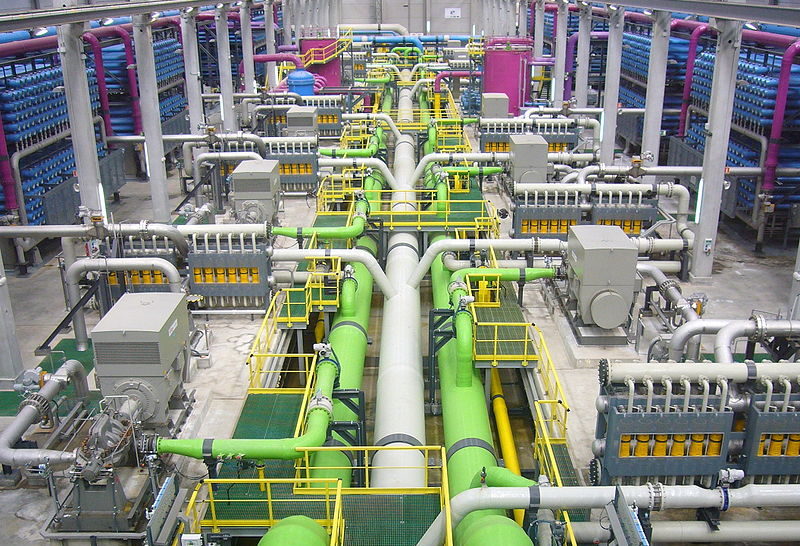
Almost 97% of our planet’s water is found in oceans, yet desalinated saltwater accounts for only 1% of drinking water worldwide, according to the International Water Association. One reason for this has been the high energy requirements, and thus high cost, of desalination.
But improved technologies, as well as the need for water in arid regions, have led to increasing development of both thermal and renewables powered desalination. One of the largest projects announced to date is the Chtouka Ait Baha, planned in the Souss Massa region of Morocco. The plant will have a daily capacity to produce 275,000 cubic meters of water, which could be extended to 400,000 before 2030.
A group of scientists led by the French Alternative Energies and Atomic Energy Commission took the specifications from the Chtouka Ait Baha project as the basis for a case study comparing available technologies for desalination. The study compared photovoltaics, concentrating solar power (CSP), and desalination powered by a (mainly fossil fuel) grid, with further analysis on the possibility of integrating energy storage as well.
The study, Techno-economic assessment of solar energy coupling with large-scale desalination plant: The case of Morocco, published in the journal Desalination, concludes that today PV alone is the most cost-competitive way to power desalination, noting that in the Morocco case study CSP is held by back the need for a high voltage transmission line connecting the desert where the CSP can be built, to the coast where the saltwater is found.
The study took in a prospective analysis up to 2030, finding that PV would remain the most economical option to this point. But other options should not be excluded, the authors conclude – noting that scaling up desalination projects could make high voltage transmission lines viable and that CSP’s ability to store heat could add important flexibility. “Both PV and CSP technologies may be part of the game of RO desalination in a quite short future,” the paper states.
And for Morocco, the group concludes, the best path to ensuring water security would be to immediately launch a program of PV powered desalination projects, and begin preparing a CSP program for the future.
This content is protected by copyright and may not be reused. If you want to cooperate with us and would like to reuse some of our content, please contact: [email protected].

Please login to comment

[…] PV powered desalination is “the most competitive design” https://www.pv-magazine.com/2020/10/30/pv-powered-desalination-is-the-most-competitive-design/ […]

Excellent experiment. To supply freshwater for drinking and irrigation and industrial purpose,desalination should get top most priority and then rain water harvesting.
PV technology is excellent since NO GHG. with time costs will decrease with new technology.

When I look at the complexity of the technology, it is impressive but must the process be such an overkill? The maintenance alone is daunting and costly for sure.
One question. Why not just use the sun directly to flash the sea water to steam and have a giant cooling tower to condense the purified water into potable water. It may require some fine post flash filtering as any municipal water district would do now. I seen with my own eyes how St louis takes muddy and probably polluted water from the missouri river and turn it into clear potable water. If we can build commercial scale solar towers that focus the sun onto a target spot that then is directed to keep molten salt molten for power, electricity, production night and day. It seems this approach would be more cost effective than the reverse osmosis process discounting the efficiency gained by using solar to power it but then only for the day shift for desalinating salt water. I’m probably being overly simplistic so feel free to roast me. I learn that way.

As far as I know, you can’t run reverse osmosis desalination in batch mode so how would a PV solution deal with that alone short of using storage? It seems something is being left out of this article like maybe they just decided it was okay to simply rely on natural gas or other resources at night? That part was not clearly explained in the article or else I didn’t read it carefully enough.
This does seem to be key to the issue of whether PV or CSP is the better, as in completely renewable, solution when CSP has integrated storage.
[…] start-up Genius Watter has developed a desalination solution that is powered exclusively by photovoltaics and is claimed to be an ideal solution for rural areas […]