Myanmar extends deadline for 1 GW PV tender

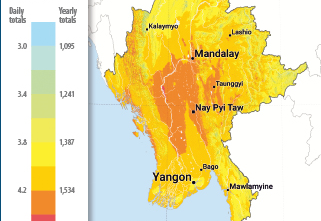
Myanmar’s Ministry of Electricity and Energy (MOEE) has announced that the bid submission date for the 1 GW PV tender it launched in May has been extended to October.
The previous deadline had been set for August 21. The MOEE has not explained the reasons for postponing the deadline. Myanmar has been under military rule since February, when the military took power through a coup d’état.
Through the procurement exercise, the government wants to build ground-mounted solar power projects on an independent power producer (IPP) and build-own-operate (BOO) basis.
The MOEE concluded, in September 2020, a 1 GW PV tender launched in May 2020 by allocating all of the procured capacity. Final prices ranged from $0.0348/kWh to $0.051/kWh. The biggest winners of the procurement exercise were Chinese inverter maker Sungrow and China Machinery Engineering Corp (CMEC), with nine and eight projects, respectively.
According to the latest statistics from the International Renewable Energy Agency, the country reached an installed PV capacity of 84 MW at the end of 2020.
This content is protected by copyright and may not be reused. If you want to cooperate with us and would like to reuse some of our content, please contact: [email protected].

Please login to comment

[…] Bangladesh and Myanmar, the volume of connected off-grid solar generation capacity actually fell last year, with […]
[…] Gold Energy.In June 2021, the MOEE launched a second 1 GW PV tender and a few months later it postponed the deadline to submit the bids for unspecified reasons.According to the latest statistics from the […]