Cooling PV modules with hydrogel-coated paper

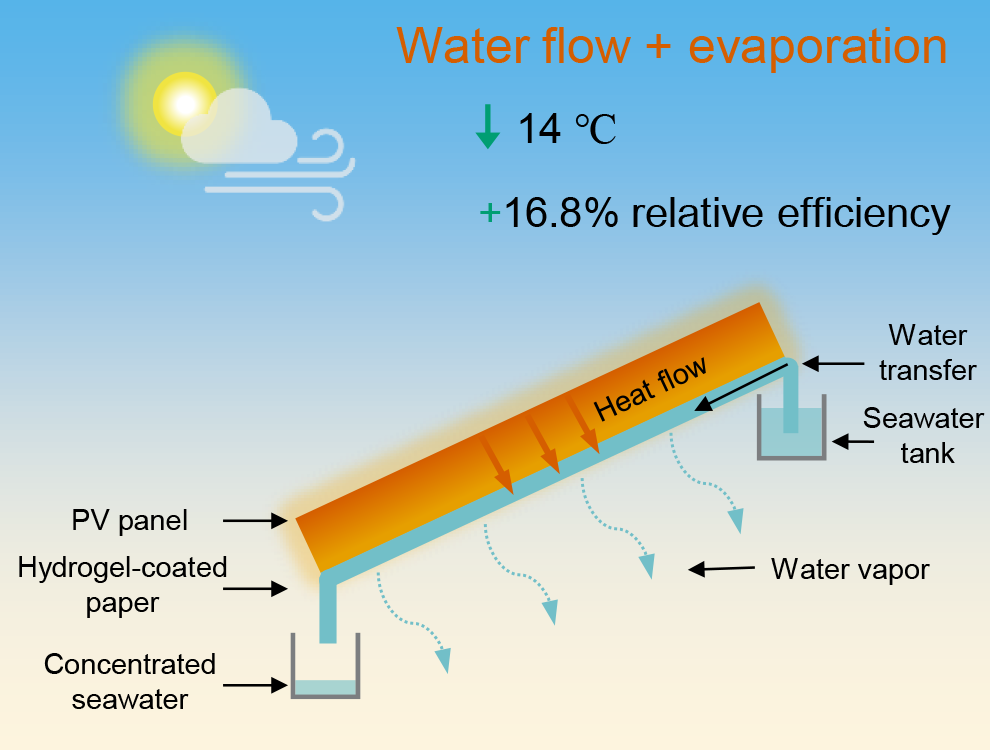
A research group in Vietnam has proposed a novel passive cooling technique for PV modules that relies on hydrogel-coated paper as the cooling medium. The approach enables convective heat transfer through flowing water, while latent heat is dissipated via interfacial evaporation. The system was tested under real outdoor conditions against a reference module without cooling.
“The novelty of our research lies in developing a simple and low-cost passive cooling strategy based on hydrogel-coated paper that combines water flow and interfacial evaporation,” corresponding author Vanthan Nguyen told pv magazine. “Unlike conventional hydrogel systems, our design uses a thin, porous structure that minimizes thermal resistance while maintaining efficient water transport. This enables effective cooling under real outdoor conditions, including stable operation even with natural seawater.”
To produce the hydrogel-coated paper, the team first froze flattened airlaid paper at −20 C for four hours. Meanwhile, the hydrogel solution was prepared by dissolving polyvinyl alcohol (PVA) in water at 95 C for three hours, followed by the addition of glutaraldehyde, SDS, and HCl. The paper was then blade-coated on one side with the solution and frozen again at −20 C for 20 hours. Finally, it was thawed and washed several times.
The system was first evaluated in an indoor experiment using epoxy polycrystalline solar panels measuring 5.5 cm × 6.0 cm. The wet papers were attached to the panels, covering approximately two-thirds of the surface area. The remaining edges of the paper were immersed in two water tanks, creating water transport from the upper to the lower tank through the paper. Experiments were conducted under one-sun irradiation using both distilled water and natural seawater with a salinity of approximately 32 ppt.
For the outdoor experiments, two identical panels were installed on the rooftop of a building in Ho Chi Minh City. One 5.5 cm × 6.0 cm panel was left uncooled, while the other incorporated the hydrogel-coated paper system. The coated area measured 4.0 cm × 5.5 cm, matching the indoor setup. Both panels were mounted at a 25° tilt angle relative to the horizontal plane, facing south, and each was connected to a 35 Ω resistor.
The tests showed that, under one-sun illumination, the system lowered the PV panel temperature by 7 C in still-air conditions and by 14 C under a wind speed of 1 m/s. These reductions translated into relative electrical efficiency gains of 12.8% and 16.8%, respectively. The hydrogel-coated paper also showed strong long-term stability when tested with natural seawater in both indoor and outdoor environments.
“One of the most surprising findings was the strong performance under real outdoor conditions,” said Nguyen. “We achieved up to a 14 C temperature reduction, resulting in a 16.8% relative efficiency improvement and approximately a 14.6% increase in energy generation without any external energy input. The system also operated stably with seawater, preventing salt accumulation while enabling seawater concentration.”
The new technique was presented in “Passive photovoltaic cooling via water flow and interfacial evaporation using hydrogel-coated paper,” published in Solar Energy. Researchers from Vietnam’s Van Lang University, Ngo Quyen University, the Vietnam Institute for Tropical Technology and Environmental Protection, the Vietnamese German University, Dong Thap University, and Phenikaa University have participated in the study.
They are currently working on scaling up the system to improve its long-term durability for real-world use. “Future research will focus on optimizing materials for different climates, enhancing corrosion protection, and integrating this approach into large-scale solar systems. We also aim to further explore the combination of energy generation and water treatment in a single platform,” Nguyen said.
This content is protected by copyright and may not be reused. If you want to cooperate with us and would like to reuse some of our content, please contact: [email protected].

Please login to comment
Doe not seem practical as illustrated, but I’m just a dumb engineer.
This is shown as an open system and ppen systenms require constent resupply.
The places where PV pane;s could be deployed in the largest quantities without disrupting microclimates are deserts and there are few of them that have salt or water supplies.
Fresh water, which is what is distributed in most system is a precious resouce, so the candidates for this are like middle eastern countries adjacent to salt water bodies.
It’s doubtfukt that hydrogel paper would survive being repeatedly baked and chilled every day.
So to make this practical it would need to be made into a closed loop water system.
But that ignores that if salt water passes though a medium and water evaporates it leaves behind salt winch is a thermal insulator.