U.S. solar panel manufacturers need to learn to solder

From pv magazine USA
Intertek CEA’s Global PV Manufacturing Quality Report 2026 suggests there is much work to be done to improve the quality of solar module manufacturing. The report states that more than 70% of factories were rated in the lowest two tiers — C or D — in 2025 factory audits, and none achieved an A+.
Source – Intertek CEA
One of the report’s central points is that most issues arise during factory ramp-up after construction, and again during capacity expansions. Solar panel re-work, a process in module manufacturing, is hiding these issues though. Typical re-work rates are around 10-15%, but outlier factories pushed far higher: an Indian facility hit 56% in 2024, and a U.S. facility reached 62% in 2025.
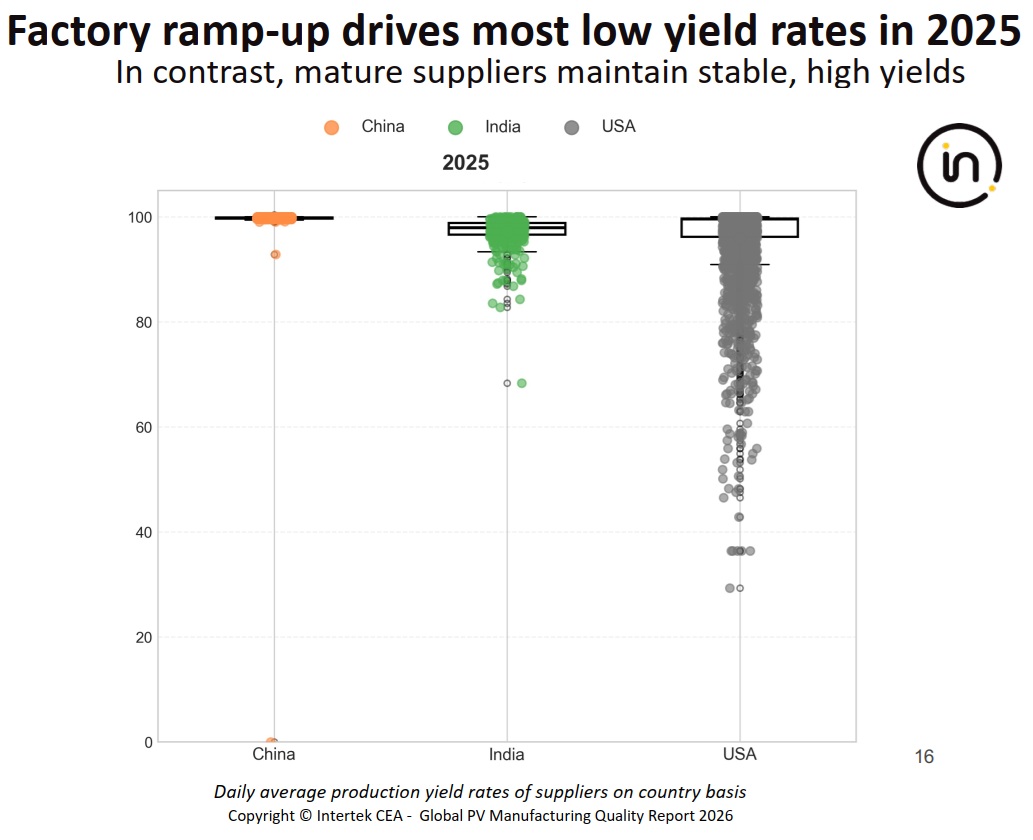
Overall, the U.S. has the highest critical issue rate of any surveyed country. While certain Chinese manufacturing facilities are yielding near 100%, some U.S. factories fall in the 30-60% yield range.
CEA explicitly noted:
U.S. capacity expansion is exposing early-stage execution risks.
Source – Intertek CEA
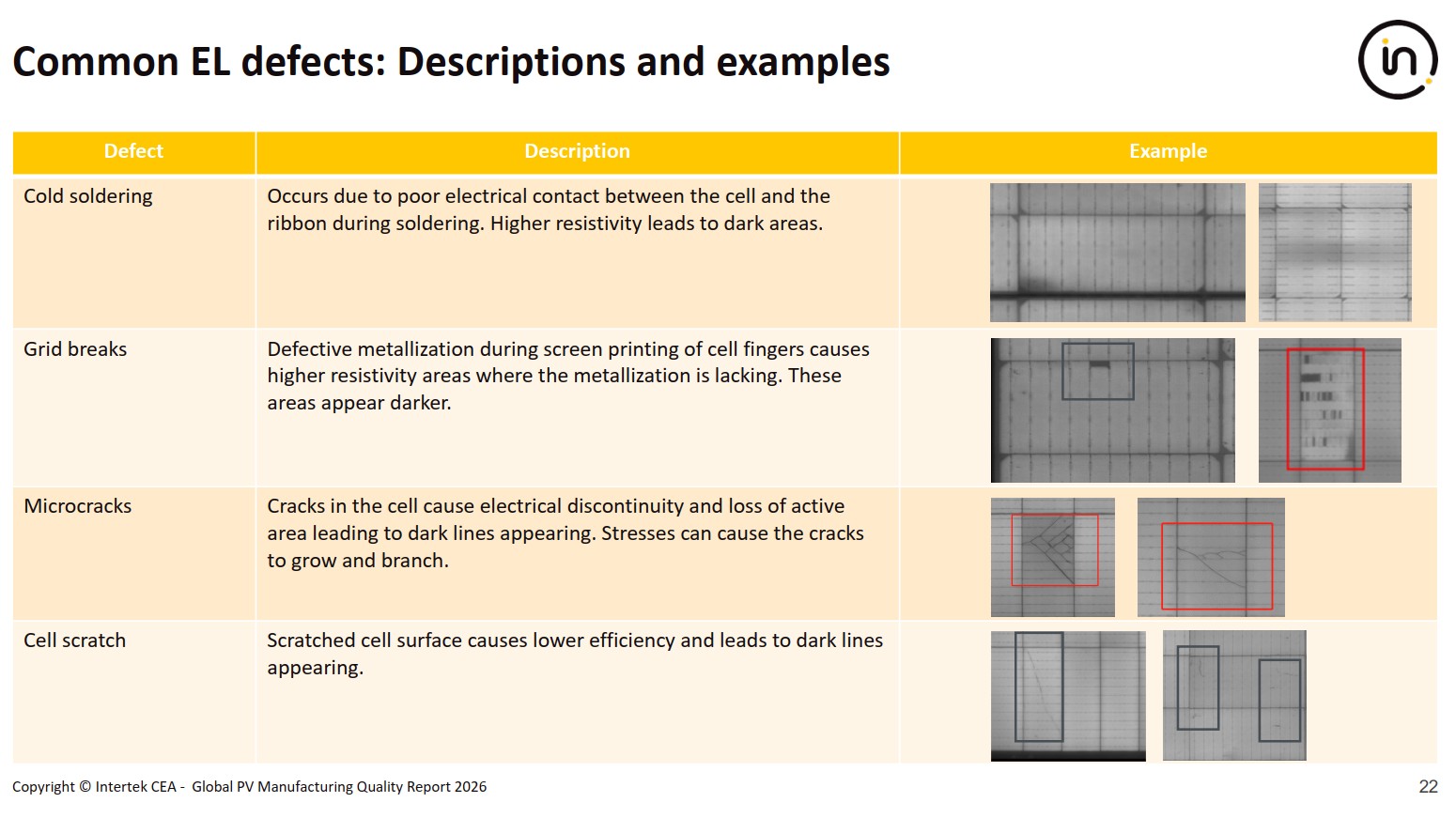
The number-one defect category is soldering — both within solar cells and between them. The trend is being driven by increasing busbar and ribbon counts, which shrink contact areas and make soldering more prone to defects. Electroluminescence (EL) imaging – a now-standard QA technique that uses an applied current to reveal internal cell defects invisible to the eye – is the primary tool catching these issues.
CEA notes that the ability to re-work modules and fix issues catches most problems before shipment. But stable average re-work rates can mask wide factory-level variability – meaning a fleet-wide number that looks fine may hide individual facilities running far above the norm.
The specific issues EL imaging reveals include cold soldering, grid breaks (gaps in the screen-printed metallization on the cell), oversoldering, and cell scratches. Cold soldering – when soldering temperature, time, or pressure are insufficient to fully bond the cell-to-ribbon connection – is a particular concern because the joint can look intact while the metal structure underneath is incomplete, leaving a weak connection that can fail in the field.
Source – Intertek CEA
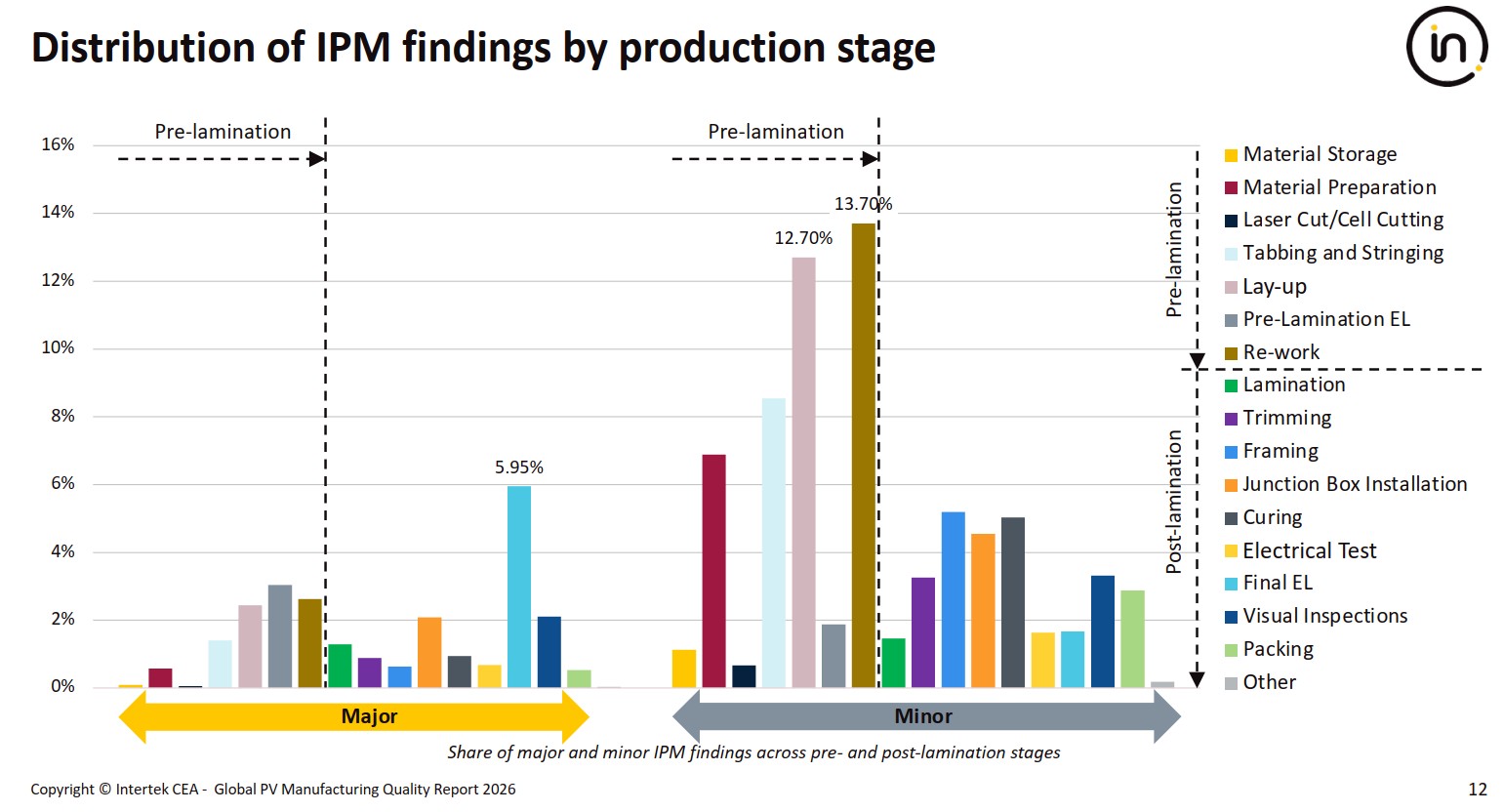
Other issues exist both before and after EL scanning.
The first is the lay-up process, where the components of the module – front glass, encapsulant, cell strings, bussing ribbons, back encapsulant, and backsheet or rear glass – are stacked in order before lamination fuses them together. Common findings here include encapsulant misalignment, cell string spacing errors, ribbon misalignment, foreign material trapped in the stack, and cell handling damage.
The second is packaging and delivery. Damaged packing is by far the most common finding during container loading inspections, accounting for 47% of issues – pallet damage, torn fixing ties, and damaged outer wood shingling. Missing labels and incorrect fixing each account for another 19%. Factory location can compound the problem: bumpy roads leaving the facility can shift pallets in transit and damage modules before they ever leave the country.
This content is protected by copyright and may not be reused. If you want to cooperate with us and would like to reuse some of our content, please contact: [email protected].

Please login to comment

I’m not even near to being an expert in the matters of solar panels,but as an electronics repair guy I know that solder isn’t what it once was. Limiting lead content and increasing the tin makes for a very poor solder. Not only that, there’s the issue with tin whiskers.

How long are solar panels being used, surely they should have perfected how to solder them by now?
Solder problems are the number one failure cause of ALL electronics. No one can consistently solder on a mass scale. Even China can’t, and you see that when you buy products direct and not through a brand that demands or performs QC on the products.
Soldering is the largest failure cause. And it’s what causes things to burn out too. The root cause, once you actually drill down into it, is nearly always something solder related. 90% of electronics failures would stop overnight if manufacturers could consistently and properly solder well.
This happens at the macro scale and at the micro scale. ICs regularly fail because they weren’t packaged correctly, and almost always from an internal solder, or similar, failure. Just everywhere there is a splice and connection point between any wires. Manufacturers of any country just cannot figure out how to mass produce consistently good solder joints. And nowadays there’s just so many that any improvements there still results in more failures because there’s even more solder to put down now.