Researchers test accuracy of simulation tools for floating PV

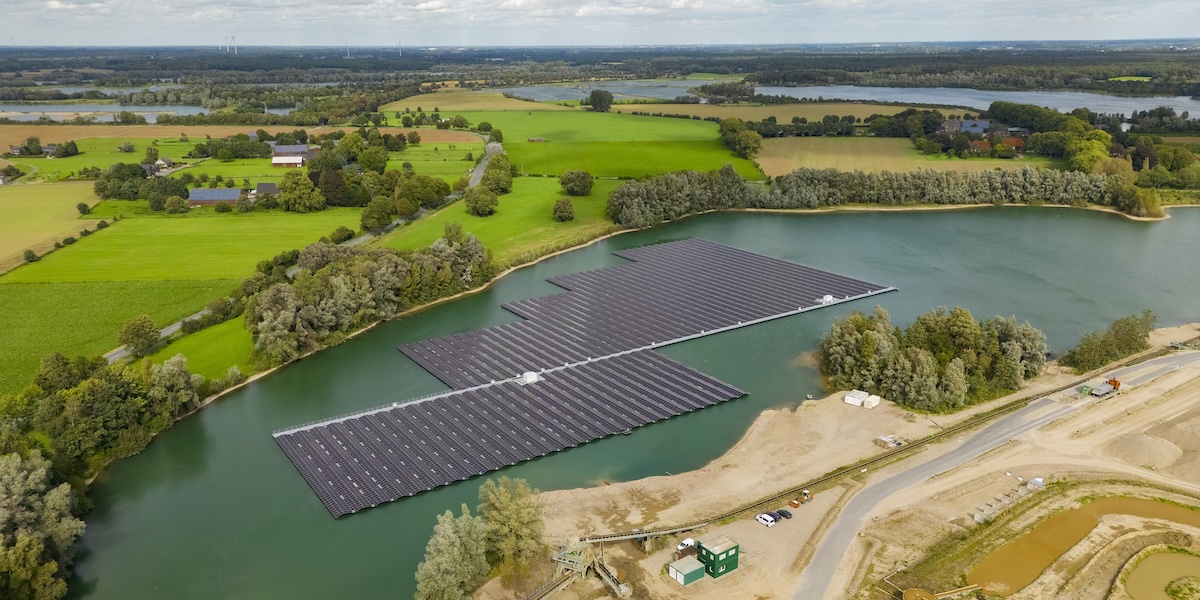
A research team from India has evaluated the accuracy of three widely-used simulation tools in the solar industry – PVsyst, PV*SOL and SAM – in predicting the performance of a floating PV (FPV) system.
The team created a simulation of a real 20 MW FPV system located in Uttar Pradesh, India. The system consists of 49,639 modules with a capacity of 495 W each and 5,974 modules with a capacity of 490 W each. Their arrangement involves 29 modules connected in series, with two sets of 29 series modules connected in parallel. The tilt angle for the modules is set to 5°, and the azimuth angle is 25° south. A total of seven types of floats support the structure.
Weather and performance parameters were recorded throughout 2023. The results from the experimental recording were then compared to those of three simulation programs. Each simulation tool was configured using standard system parameters, including module specifications, inverter characteristics and system losses.
“Default temperature models available within each software were used, with adjustments made to account for site-specific conditions where applicable,” the research team explained. “Albedo values were selected based on typical water surface reflectivity, and standard loss assumptions, such as wiring losses, inverter losses, and soiling losses, were applied consistently across all simulations.”
According to the results, the annual energy outputs predicted by PVsyst, SAM, and PV*SOL were 1,194,979.0 kWh, 1,329,352.3 kWh, and 1,337,658.7 kWh. This compared to the measured output of approximately 1,270,395.5 kWh.
The annual average capacity utilization factors (CUFs) predicted by PVsyst, PV*SOL, and SAM were 14.80%, 16.89%, and 16.78%, compared to the CUF estimated from real data of 22.34%.
The research team said their results indicate that while all three tools provide reasonable first-order estimates of FPV system performance, PV*SOL demonstrates relatively closer agreement with measured energy yield and system efficiency.
“This improved agreement may be attributed to its ability to incorporate floating-specific parameters such as water surface albedo, enhanced cooling effects, and 3D system modeling.” they added.
The team went onto say that the research “aims to raise awareness within the FPV research field regarding the limitations of existing simulation tools and the need for specialized tools tailored to FPV modeling.”
The study also explored surface water evaporation estimation with and without FPV, with observations from the 20 MW system revealing that the FPV had significantly reduced surface water evaporation.
The FPV installation, covering 48% of the reservoir, led to an annual water saving of approximately 741,725.04 m³, which could enable an additional 66.07 MWh/year of hydroelectric generation. In terms of environmental impact, the FPV system achieved an annual CO2 mitigation of 2,007.22 tons.
The research findings are presented in the paper Performance evaluation and water evaporation mitigation of a floating PV plant installed on a reservoir, published in Results in Engineering.
Scientists from India’s University of Lucknow, Chitkara University, Marwadi University, and Manipal University Jaipur.

Please login to comment