Using a bird’s structural-color trick to color solar modules

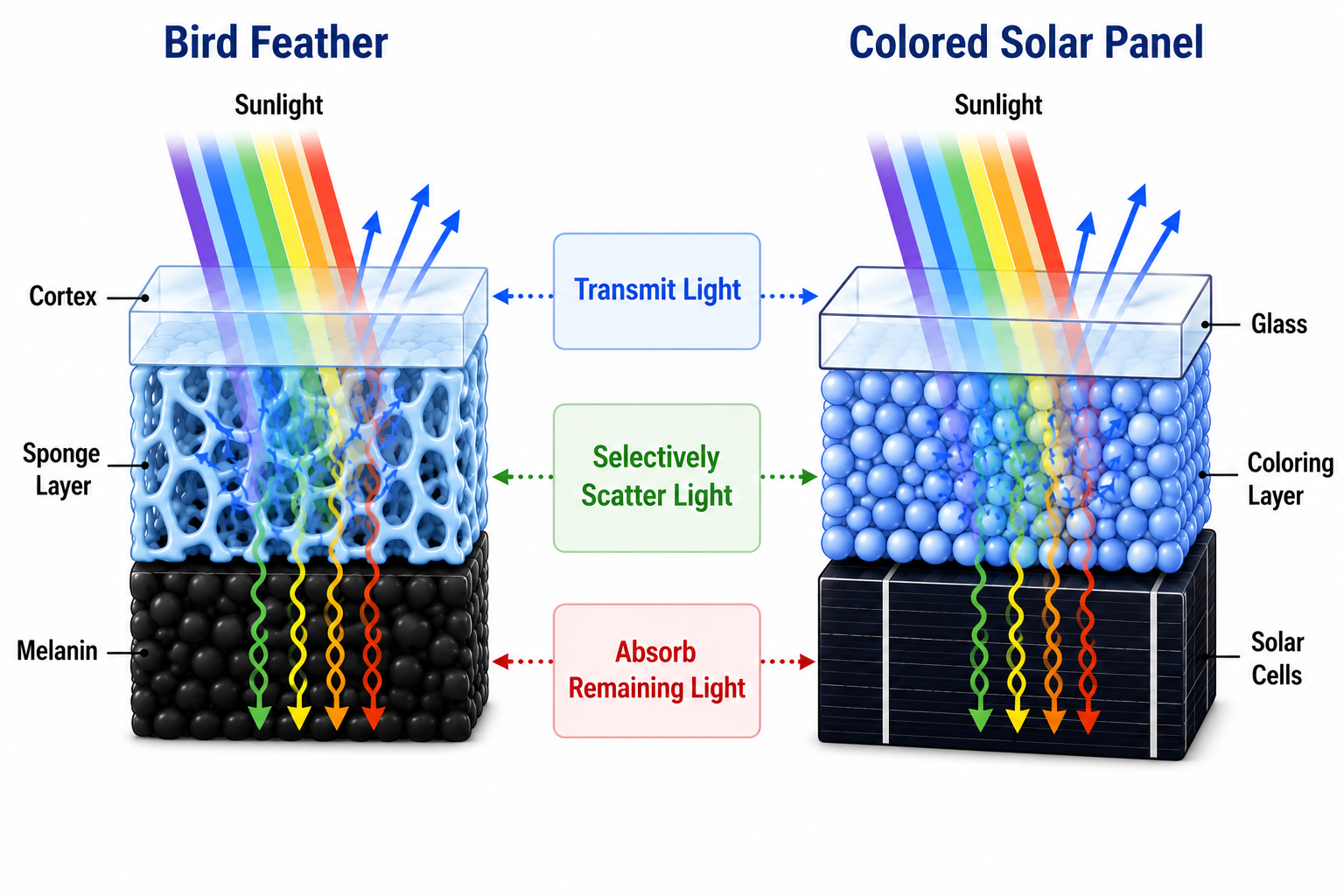
A research group in China has developed a method for coloring PV modules using quasi-ordered photonic pigments instead of conventional absorbing dyes. Unlike traditional dyes, which create color by absorbing part of the incoming sunlight, the new pigments generate color through selective light scattering, allowing more solar radiation to reach the underlying solar cells and reducing efficiency losses.
“Inspired by the blue feather combining a keratin-air network with black melanin to create structural color, we herein demonstrate the coloring of PV modules by placing quasi-ordered photonic pigments atop solar cells,” the researchers said. “These pigments, composed exclusively of silica microspheres and polyacrylates, enable selective and diffuse reflection of visible light while negligible absorption of solar radiation.”
The team explained that blue-feathered birds such as the Eurasian jay produce their coloration without blue pigments. Instead, sunlight passes through a transparent outer cortex and reaches a sponge-like nanostructure of keratin and air that selectively scatters blue wavelengths while transmitting the remaining wavelengths. The transmitted light is then absorbed by an underlying layer of dark melanin granules, leaving only the scattered blue light visible.
To replicate this mechanism, the researchers developed what they call a silica-polyacrylate structural color (SPSC) pigment. They first synthesized highly uniform silica microspheres with diameters ranging from approximately 174 nm to 247 nm. The microspheres were densely packed and infiltrated with a liquid acrylate resin, which was then polymerized under UV light to lock the spheres in place. The resulting solid material was ground into fine pigment particles and sieved to obtain a particle size suitable for coatings and printing processes.
The pigment particles were subsequently dispersed in a transparent UV-curable resin to form the coloring layer, which was applied to the inner side of the front glass cover above the solar cell. The researchers tuned the color by varying both the diameter of the silica microspheres and the refractive index of the acrylates used as the binder. Pigments made with 174 nm microspheres produced blue colors, 195 nm microspheres generated cyan to light-green shades, and 247 nm microspheres yielded grayish-white appearances.
The colored modules were compared with a reference black PV module and evaluated at both laboratory and industrial scales. The laboratory-scale devices measured 52 mm × 52 mm. The industrial-scale modules were manufactured using standard processes and commercially available components, including tempered glass, EVA encapsulants, interdigitated back-contact (IBC) solar cells, and a black backsheet. The researchers also conducted simulations of building-integrated photovoltaics (BIPV) using the colored modules on buildings worldwide.
“In comparison with the black module with a power conversion efficiency (PCE) of 22.40%, the light blue, light cyan, and grayish-white PV modules achieved PCEs of 21.21%, 20.25%, and 19.99%, respectively,” the scientists said. “The resulting colored PV modules exhibit a remarkable enhancement of over 50% in PCE compared with modules employing traditional absorbing pigments, showcasing an even more vibrant color.”
Based on these findings, the researchers said conventional PV modules could be transformed into visually appealing products with an average relative PCE loss of less than 10%.
According to the simulation results, colored PV modules integrated into south- or north-facing facades could deliver nearly 79% of the energy yield of conventional installations in high-latitude locations such as Beijing and London. In lower-latitude regions, including Hong Kong and São Paulo, the energy yield remained above 50%. Colored BIPV systems installed on east- and west-facing facades achieved approximately 40% to 60% of conventional power generation capacity.
The new approach was presented in “Structural coloring of solar photovoltaics with quasi-ordered photonic pigments,” published in Nexus. Scientists from China’s Shanghai Jiao Tong University and the Hong Kong Polytechnic University have contributed to the research.
This content is protected by copyright and may not be reused. If you want to cooperate with us and would like to reuse some of our content, please contact: [email protected].

Please login to comment