Pylontech launches 8 MWh storage system with 426 Wh/L energy density

From ESS News
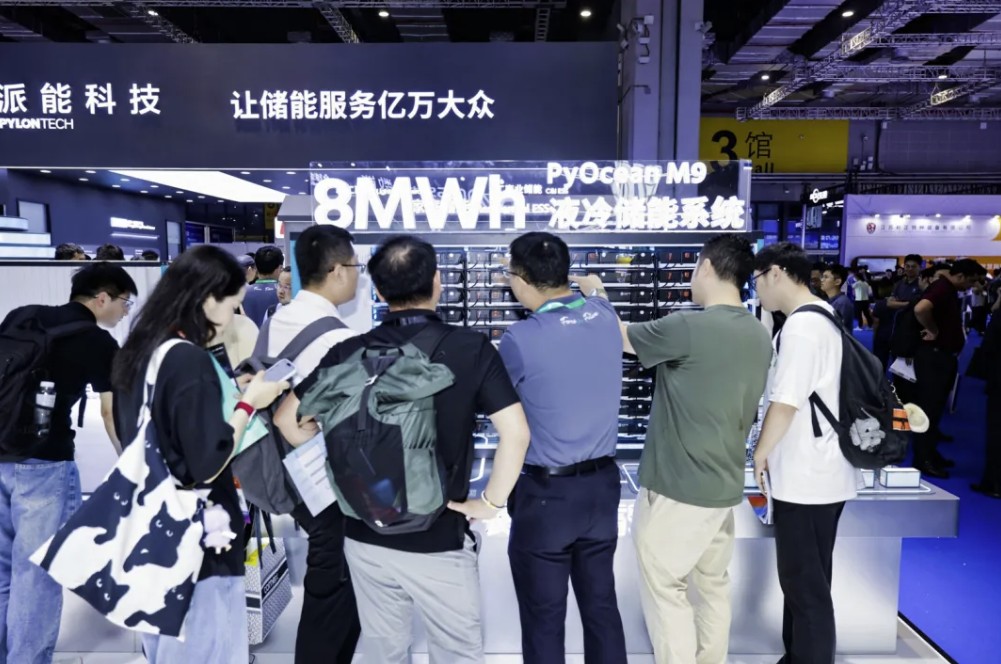
Pylontech has introduced its PyOcean series of liquid-cooled battery energy storage systems at SNEC 2026 in Shanghai, targeting grid-side storage, large C&I projects, and emerging AI data center applications.
The company first unveiled the PyOcean platform at the ESIE energy storage exhibition in Beijing in April. At SNEC, it formally presented the system to the wider solar-plus-storage market, positioning it as an “asset-return-oriented” storage product designed around project economics rather than capacity alone.
The PyOcean series includes two main configurations. The PyOcean-M7-6250 offers 6.25 MWh of DC capacity and uses Pylontech’s 588 Ah LFP cells. The larger PyOcean-M9-8000 provides 8.0 MWh of DC capacity and is based on the company’s 601 Ah LFP cells. Pylontech said the system reaches an energy density of up to 426 Wh/L. The 601 Ah cell is rated for more than 12,000 cycles and a round-trip efficiency of 96.5%.
According to the company, the M9 system is designed for large-scale storage projects where land use, civil works, and long-term returns are key considerations. Pylontech claims that the use of larger cells and a more integrated system architecture reduces component count by 50%, land use by 38%, and installation workload by 10%. For an 800 MWh storage project, the company said the PyOcean-M9-8000 can reduce direct investment by more than 10% compared with conventional designs.
The series is based on Pylontech’s full-stack development model. The company designs and manufactures its own cells, battery management systems, and energy storage systems, enabling optimization of cell chemistry, battery management system (BMS) algorithms, thermal management, and system architecture. The PyOcean platform uses state of charge (SOC) estimation algorithms with accuracy within 1%, full-domain balancing technology, and multi-cluster direct current (MCDC) cluster balancing to mitigate circulating currents and SOC deviation in parallel operation.
Safety and operational efficiency are also key design priorities. The system features liquid cooling, three-layer fire protection, low-noise and low-heat operation, and low-power consumption design. Pylontech said the product is compatible with centralized and string PCS architectures and is designed to support grid-forming requirements under Chinese standards.
At SNEC, the company also presented PyOcean-based solutions for solar-plus-storage plants and AI data centers. For AIDC applications, Pylontech highlighted lithium–sodium hybrid storage concepts intended to support millisecond-level response and virtual inertia requirements for AI training loads.
Pylontech said it signed strategic cooperation agreements with several large energy groups and AI companies during the exhibition, but did not disclose details. The company expects first deliveries of the PyOcean system to begin in the third quarter of 2026.
This content is protected by copyright and may not be reused. If you want to cooperate with us and would like to reuse some of our content, please contact: [email protected].

Please login to comment