Phenogy unveils modular sodium-ion storage solution

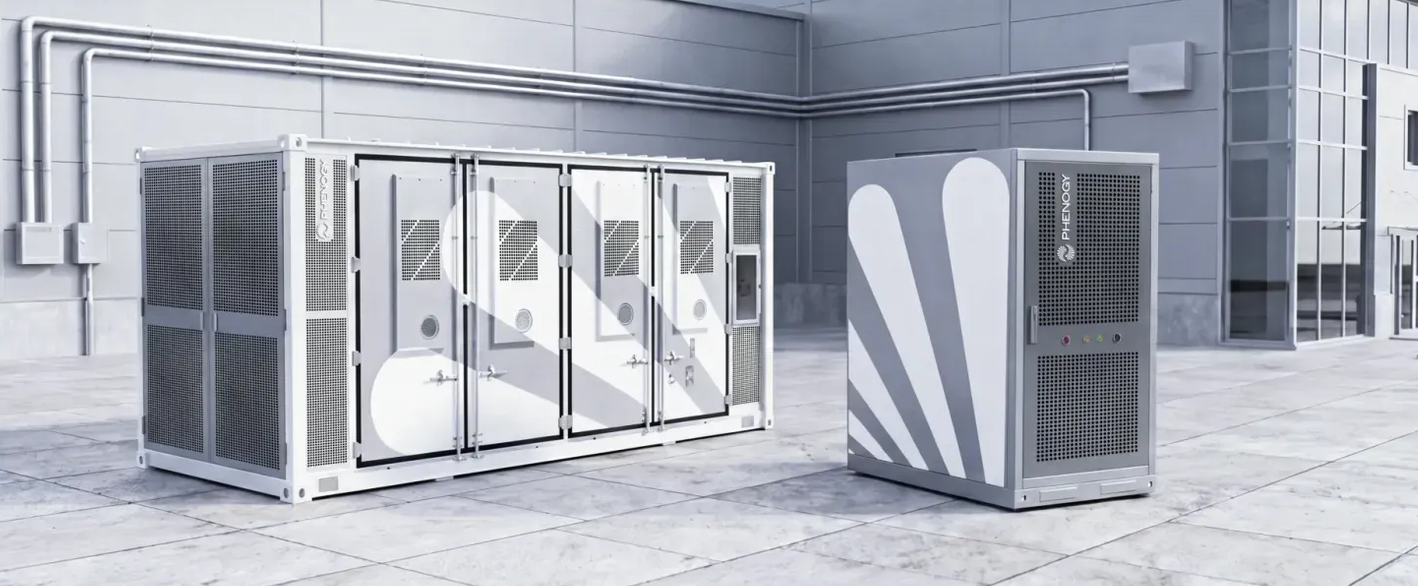
Swiss sodium-ion battery provider Phenogy has unveiled today a modular storage solutions for commercial and industrial (C&I) applications at the Smarter E trade show in Munich, Germany.
“The launch of the Phenogy 1.1 follows the company’s deployment of Europe’s largest operational sodium-ion energy storage system—a 1 MWh installation operating in island mode near Bremen Airport in Germany,” a spokesperson from the company told pv magazine.
The storage system is described by the manufacturer as a flexible, modular system allowing for scalable capacity configurations, making it suitable for a wide range of applications, including peak shaving to reduce demand charges and operating costs, backup power and UPS functions for critical infrastructure, EV charging support through load buffering, and energy arbitrage by storing low-cost renewable electricity and dispatching it during periods of higher market prices.
The new product measures 2,200 mm x 1,120 mm x 2,015 mm and weighs 2,580 kg. It features a nominal capacity of 100 Ah, a nominal power of 50 kW, a rated grid voltage of 400 V, and a rated grid frequency of 50 Hz.
The system supports installation at altitudes of up to 2000 m and is protected to IP54 ingress protection level. Thermal management is based on an air-cooling system, supported by an integrated safety architecture that includes gas sensors, heat sensors, smoke detection, and aerosol-based fire suppression.
At the cell level, the system uses sodium-ion chemistry with a rated capacity of 170 Ah per cell and a nominal voltage of 2.85 V. The battery configuration is 1P208S, delivering a nominal DC system voltage of 592 VDC with an operating voltage range of 374–718 VDC. The system is designed for a cycle life of at least 6000 cycles under specified operating conditions.
For integration into existing solar installations and energy management environments, the system uses the SI50-20 inverter provided by German manufacturer SMA as its primary communication interface. Through the SMA Data Manager, Phenogy 1.1 supports standard industrial communication protocols such as Ethernet, Modbus TCP, and RS485. This enables centralized control for aggregators and facility operators, facilitates structured data exchange, and ensures compatibility with higher-level energy management systems as well as grid operator interfaces, the manufacturer said.
The company also said a key differentiator of the new system lies in its safety and thermal performance. “We avoid risks like overheating with a safer system design, active monitoring and intelligent protection mechanisms,” the spokesperson went on to say. “The increased thermal stability of the battery cells is safer and ideal for the use of air cooling.”
The system is also designed to operate across a broad temperature range, reportedly maintaining stable performance under both low winter temperatures and high summer heat conditions, which supports reliable operation during peak demand periods and overnight cycles.
From a compliance perspective, the system meets key international standards including IEC 62619, IEC 62477, and IEC 63056 for battery safety and power conversion systems, as well as IEC 61000-6-2 and IEC 61000-6-4 for electromagnetic compatibility.
This content is protected by copyright and may not be reused. If you want to cooperate with us and would like to reuse some of our content, please contact: [email protected].

Please login to comment