Paving the way for lithium–nitrogen batteries, one hurdle at a time

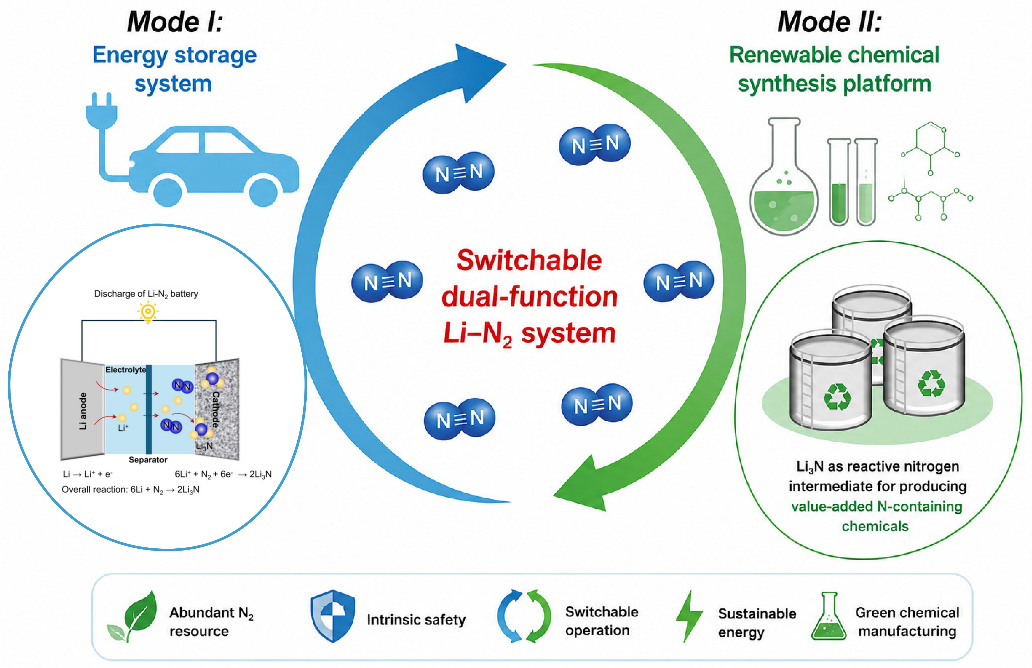
A research group from Belgium and China has presented a roadmap for the development of lithium–nitrogen (Li–N₂) batteries.
In these batteries, lithium reacts electrochemically with nitrogen gas to form lithium nitride (Li₃N) during discharge and, ideally, regenerates lithium and nitrogen during charging. Although the first reversible Li–N₂ battery was demonstrated nearly a decade ago, practical development of the technology has remained limited.
“Our work provides the first comprehensive roadmap for the practical development of Li–N₂ batteries,” corresponding author Yu Li told pv magazine. “Rather than focusing on a single catalyst or material, we identify the fundamental barriers limiting reversibility and long-term stability, from reaction mechanisms and characterization methods to electrolytes, separators, and cell architecture.”
Li said the team also introduced a flow-type battery concept and proposed rigorous testing standards.
“More broadly, the work highlights Li–N₂ batteries as a new electrochemical platform that can function not only as a rechargeable battery but also as a route for producing value-added nitrogen-containing chemicals, creating opportunities beyond conventional energy storage technologies,” he said.
In their paper, the researchers argue that the development of Li–N₂ batteries is hindered by poor reversibility, limited cycling stability, and sluggish nitrogen activation kinetics. Additional challenges include electrolyte and electrode degradation, parasitic reactions caused by moisture, oxygen, and gas crossover, inadequate separator designs, and a lack of rigorous methods to verify true N₂-to-Li₃N conversion.
To address these issues, the researchers propose a roadmap that includes more stable electrolytes, catalysts specifically designed for nitrogen activation, and ion-selective, gas-blocking separators. They also recommend improved battery architectures, including a flow-field-assisted flow-type cell to enhance nitrogen transport, as well as advanced in situ characterization techniques and isotope-labeling experiments to verify reaction mechanisms.
The roadmap further calls for standardized testing protocols to enable reliable performance comparisons and the use of artificial intelligence to accelerate materials discovery and battery optimization.
“One surprising conclusion is that catalyst design alone is unlikely to solve the challenges facing lithium–nitrogen batteries,” Li said. “Our analysis shows that often-overlooked factors such as cell configuration, gas purity, separator properties, and verification protocols may be just as important.
“We were also excited to find that Li–N₂ batteries could serve not only as rechargeable batteries but also as platforms for producing valuable nitrogen-containing chemicals, potentially connecting renewable electricity, energy storage, and green chemical manufacturing in a single technology.”
Li said his team is currently working to experimentally verify the true reversibility of Li–N₂ batteries. Ongoing efforts include the development of advanced electrocatalysts, such as iron-based nanocatalysts, optimization of battery architecture and cell components, and implementation of advanced in situ characterization techniques.
“What excites us most is that some of our preliminary results are already showing encouraging signs that reversible lithium–nitrogen electrochemistry may be achievable under carefully designed conditions,” he said.
“While the work is still in progress, we believe these findings could help answer some of the key questions that have limited the field for nearly a decade. Ultimately, our goal is to move Li–N₂ batteries from a promising concept to a scientifically validated, practically relevant technology for both energy storage and sustainable nitrogen conversion. We look forward to sharing these results with the community in the near future.”
The was presented in “Lithium–Nitrogen Battery: Promise and Development Roadmap,” published in Angewandte Chemie International Edition. Scientists from Belgium’s University of Namur and China’s Wuhan University of Technology have contributed to the development of the roadmap.
This content is protected by copyright and may not be reused. If you want to cooperate with us and would like to reuse some of our content, please contact: [email protected].

Please login to comment