Photovoltaics for metro stations

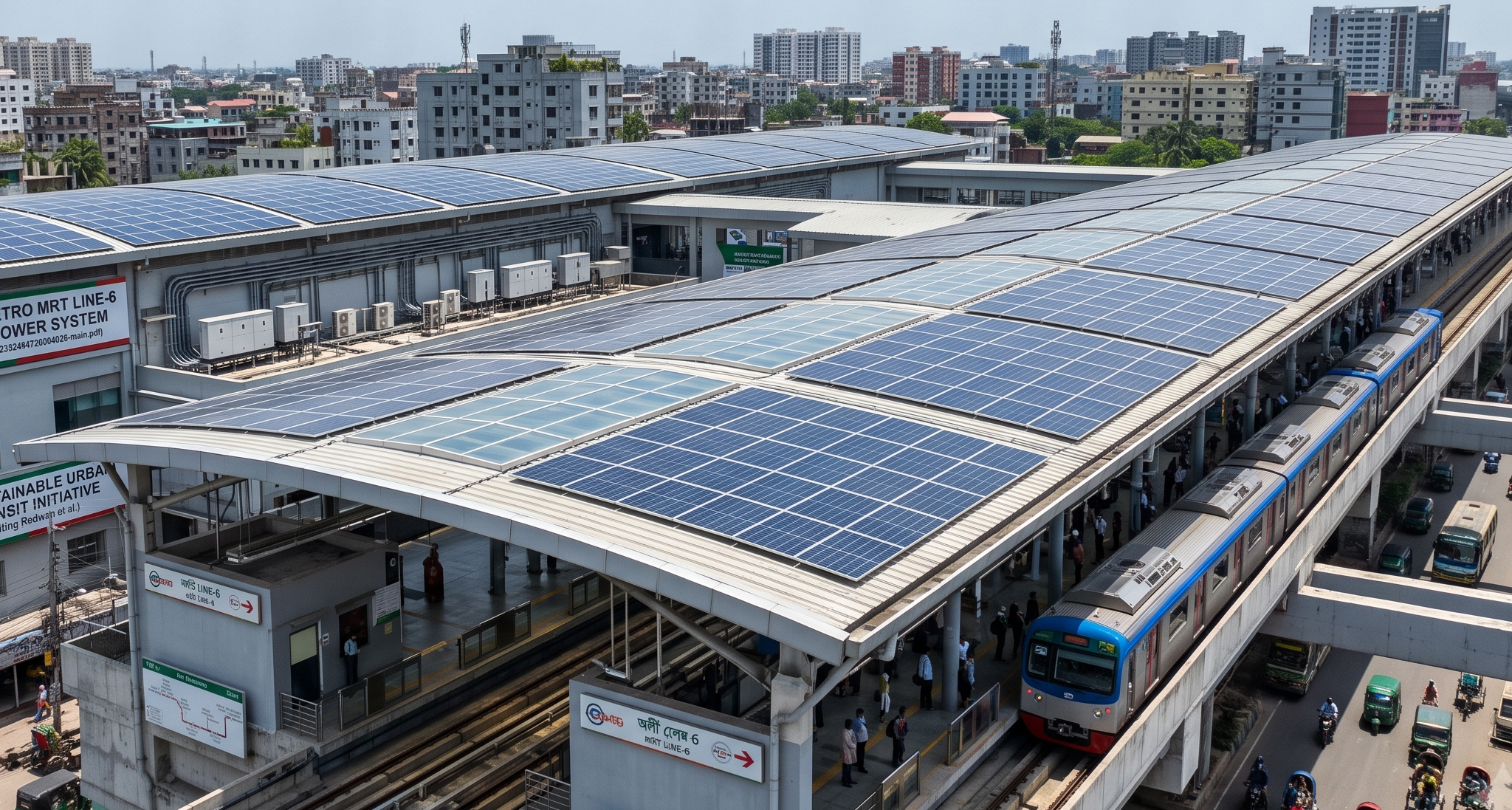
Bangladeshi researchers have modelled the technical and economic potential of integrating rooftop solar PV across Dhaka Metro Rail’s MRT Line 6, finding that a 20.38 MW system could significantly offset auxiliary electricity demand while delivering strong financial returns.
The line, which entered service in late 2022 as Bangladesh’s first metro system, spans 21.26 km. It runs on an elevated alignment from Uttara North in the north of Dhaka to Motijheel in the south, serving 16 stations.
“This study combines two complementary simulation approaches: PVsyst for high-resolution, station-by-station technical modelling across all 16 stations and five depot facilities, and HOMER Pro for techno-economic optimization of hybrid PV–grid–battery systems,” corresponding author Rahat Redwan told pv magazine. “To our knowledge, this is the first study to pair detailed station-level PV design with zone-based hybrid optimization and a full sensitivity analysis for a South Asian metro system.”
Redwan added that the team plans to extend the work in several directions. “First, we plan to incorporate actual measured load data from operating stations rather than the assumed operational schedules used here, which is a limitation we have explicitly acknowledged,” he said. “We are also exploring trackside and elevated-guideway PV integration alongside the rooftop systems modelled in this study, and plan a deeper techno-economic comparison of battery chemistries and second-life battery options for metro applications in Bangladesh.”
Using PVsyst, the group modelled all 16 elevated stations and five depot buildings at at the Diabari depot in Uttara, northern Dhaka. Rooftop availability was determined after accounting for transparent roof sections and a 10% area loss. In total, 250,469.61 m² of rooftop area was assessed, including 60,347 m² across stations and 67,052.8 m² across selected depot buildings. The team used commercially available 595 W monocrystalline PV modules and modelled module orientation, inverter configuration, shading effects, and system losses to estimate annual energy yield, performance ratio, and overall system efficiency.
The simulations incorporated site-specific meteorological data for Dhaka, including global horizontal irradiance (GHI), direct normal irradiance (DNI), diffuse horizontal irradiance (DHI), ambient temperature, relative humidity, wind speed, and Linke turbidity. The proposed system was designed as a grid-connected installation with lithium iron phosphate (LiFePO₄) battery storage, bidirectional power flow, prioritized self-consumption, and electricity export to the national grid under feed-in tariffs. A project lifetime including 2% annual PV degradation was assumed.
The modelling resulted in a 20.38 MW solar PV system distributed across 21 sites – 16 stations and 5 depot buildings – generating more than 25.5 GWh annually. The system offsets a significant share of metro auxiliary demand and delivers substantial environmental benefits, avoiding approximately 235,297 tonnes of CO₂ emissions over 20 years.
“We were struck by how strong the economics turned out to be for a public transport application: a six-year payback period, 234.1% return on investment (ROI), and a net present value (NPV) of $20.05 million, despite the project being fully self-financed with no debt,” said Redwan.
A zonal optimization was then conducted using HOMER Pro, dividing the metro corridor into three regions: Zone A (Uttara), Zone B (Agargaon, Shewrapara, Kazipara), and Zone C (Motijheel, University of Dhaka, Secretariat). This enabled localized system design tailored to specific load profiles and environmental conditions. Zone B emerged as the most cost-effective, with the lowest NPV at $1.63 million and a levelized cost of electricity (LCOE) of $0.063–0.125/kWh. Zone C, while slightly more expensive, delivered higher emissions reductions due to stronger renewable integration.
“Zone C achieved the highest renewable fraction of 70% despite having no battery storage at all – it relies entirely on PV and grid interaction, yet still delivers the best emissions performance of the three zones,” added Redwan. “The sensitivity analysis showed how strongly grid sellback tariffs and solar irradiance interact in determining whether a battery-inclusive or battery-free configuration is optimal – small tariff shifts could completely change the preferred system architecture.”
The research findings were published in “Towards sustainable urban transit: Design of a solar-powered metro rail system,” in Energy Reports. Researchers from Bangladesh’s Ahsanullah University of Science and Technology (AUST), the European University of Bangladesh, Bangladesh University of Business and Technology (BUBT), Rajshahi University of Engineering and Technology, and the Military Institute of Science and Technology have contributed to the study.
This content is protected by copyright and may not be reused. If you want to cooperate with us and would like to reuse some of our content, please contact: [email protected].

Please login to comment