Five decades of research leads to solar PV’s emergence as the world’s dominant energy source

As the world aims to limit global warming well below 2 C, the defossilization of energy systems hinges on two technologies above all others: solar PV and wind power. Solar PV has found its way into the energy system faster than any electricity source in the history of humankind, propelled by plummeting costs, near-universal availability, and diversified system applications. Yet one question runs persistently through the modeling literature: just how dominant will solar PV become and why do studies disagree so sharply on the answer?
A new study by researchers from Leibniz University Hannover and LUT University, Prospects for solar photovoltaics in highly renewable energy transition scenarios towards a dominant future energy source, sets out to resolve that question. The systematic review covers 60 peer-reviewed energy transition studies, each covering at least the power, heat, and transport sectors while reaching at least 95% renewable energy supply by 2050. Beyond the conclusions drawn by the reviewed studies, an emphasis lies on the assumptions driving their results.
In a second study by researchers from LUT University, Leibniz University Hannover, Joint Research Centre of the European Commission, and Technical University of Denmark covering a Review of the progressing role of solar photovoltaics in energy transition scenarios over five decades of 100% renewable energy systems research, the authors investigated the core question which major milestones in 100% renewable energy systems studies enabled the rise of solar PV from a niche application to the dominant source of energy for humankind over the five decades of this research field.
Key drivers influencing solar PV supply shares
The central finding pairs broad agreement with striking variance. Most studies place the combined share of solar PV and wind power in electricity generation between 80% and 99% by 2050. Such a finding is also known from global energy transition studies. But the solar PV share alone spans a large range from 5% to 98%. According to the study, this spread is governed by the solar full load hours available in a country, the techno-economic assumptions built into each model, and the complexity of the modeling.
Cost assumptions are frequently out of date. Across the reviewed studies, capital expenditures (capex) figures for utility-scale solar PV in 2050 range from €151 ($174.1) to €720 /kW. Around 18% of studies still assume more than €500 /kW, a level that solar PV has already undercut in the real world today. Because solar PV costs have fallen faster than almost any scenario expected, models carrying these legacy figures systematically understate the future role of solar PV.
Technology representation matters just as much as cost. About a third of the studies model a single, generic solar PV power technology, ignoring the expanding toolbox of PV system applications: single-axis tracking, bifacial modules, floating PV, agrivoltaics, and rooftop prosumers, to name a few. Modeling choices compound the effect: coarse temporal resolution, such as representative time slices instead of hourly simulation, can significantly distort results for a resource as variable as solar PV, whereas 80% of all studies in the field are carried out at hourly resolution. The study shows that models combining a rich set of solar PV technologies with full sector coupling consistently report the highest and arguably most realistic solar PV shares.
With sector coupling, solar PV’s reach extends well beyond the power grid. Power-to-X routes convert cheap solar electricity into hydrogen, e-fuels, e-chemicals, e-materials, e-food, clean water, and e-forests, serving the hard-to-electrify segments of transport, industry, that would otherwise depend on biofuels or fossil imports. Typically bioenergy-dominated carbon dioxide removal experiences unprecedented opportunities for climate restoration. Just over half of the reviewed studies include at least one e-fuel route, and wherever these routes appear, the value of solar PV for the system rises. The effect is pronounced enough that the energy systems can be described as an emerging Power-to-X Economy, in essence often a Solar-to-X Economy.
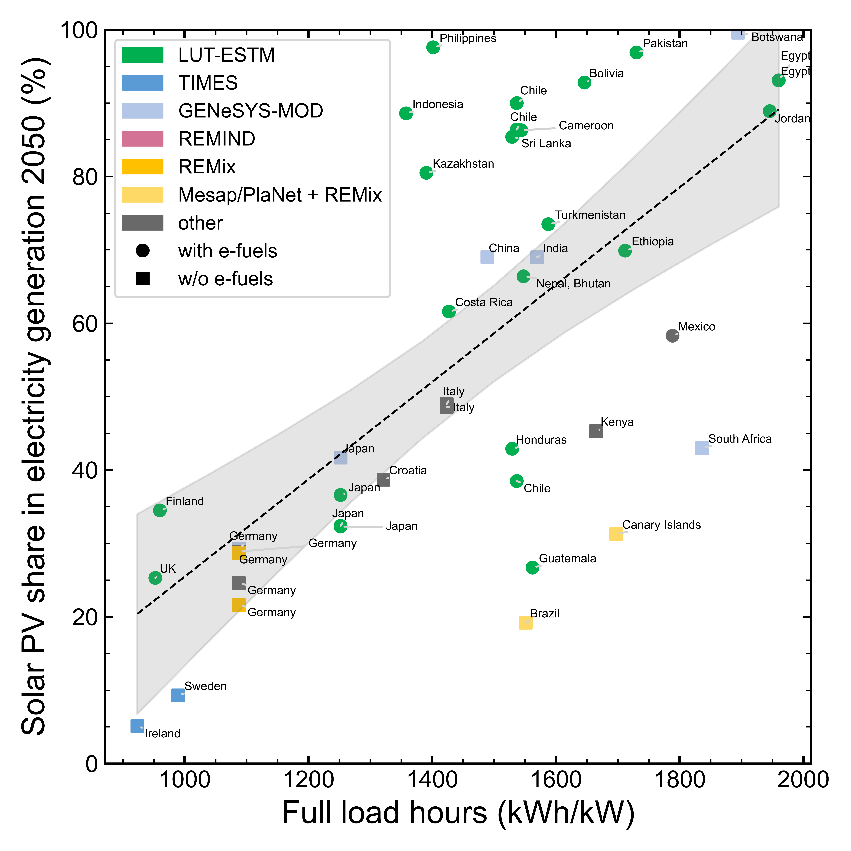
Solar PV share for global energy supply
The study derives an empirical relationship between a country’s solar full load hours and its expected solar PV share. Applied across the globe and weighted by population, that relationship yields a cross-study estimate of solar PV supplying roughly 61% of the world’s electricity by 2050. Crucially, this figure is not the output of any single model but a synthesis of dozens of independent teams and methodologies. Single studies can reach 70% on a global scale or even more, which has been taken up by the global PV community for a 75 TW target by mid-century.
The result echoes a broader shift. Independent economic projections have suggested that a global “solar tipping point” may already have passed, with solar gradually coming to dominate electricity markets even in the absence of further climate policy. With about 3 TW of PV installed worldwide by 2025 and close to 700 GW added in that single year, the trajectory is already well under way. In 2025, about 70% of all newly installed power capacity globally was solar PV, finally the Dawn of the Solar Age.
The future role of solar PV is routinely underestimated, such as from the International Energy Agency and the studies used for the Intergovernmental Panel on Climate Change, and correcting for outdated costs and oversimplified modeling reveals solar PV as the dominant energy source of the coming decades. For modelers, the message is to retire pessimistic cost curves and represent the full breadth of available PV technologies. For policymakers, it is a reminder that planning around yesterday’s assumptions risks building the energy system of the past, rather than the one that is already arriving.
Milestones in 100% renewable energy systems research revealing the role of solar PV
Since the mid-1970s studies for 100% renewable energy systems have been investigated, with a typically negligible solar PV share in early research, whereas in recent studies a range of 60-80% in global solar PV supply can be found. Based on a database of over 1000 articles on 100% renewable energy systems analyses, a new study investigated which major milestones led to the development from a niche technology to dominatie the global power markets.
Within the database, 29 milestone articles have been identified that introduced a new element for the role of solar PV within the research field. These milestones were reached in all decades, and the four largest groups are (i) around visionary scoping of the role of PV, (ii) advances in PV system applications, (iii) expanding economic insights, and (iv) methodological advancements leading to more realistic descriptions of PV in energy-industry systems. In most advanced 100% renewable energy system analyses, solar PV can be described in up to eight PV system applications, in hourly resolution, and in interconnected multi-node study designs. In addition, such analyses can cover all sectors, spanning power, heat, transport, industry, desalination, and carbon dioxide removal, with comprehensive power-to-X routes, and broad flexibility portfolios, such as grids, storage and demand response with diversified sector coupling, and energy conversion routes. However, even a basic PV system differentiation of ground-mounted, utility-scale and rooftop PV is far from standard, as only 16% of all studies include this differentiation. On a global level, studies increasingly find a PV share of 60%–80% in total energy supply around mid-century or beyond, with a 61% projected average across transition studies.
The 29 milestones are composed of 13 with visionary scoping, 16 with PV system application advances, 15 expanding the economic insights, 13 with methodological advances, and 4 with particular other contributions, whereas single articles can address more than one category. In the 1970s, the visionary scoping dominated. The 1980s to 2000s were faced with limited research activities in the field, whereas in the 2010s a broad diversity of methodological advancements laid the basis for the modern 100% renewable energy systems analyses. In the 2020s, almost all milestones expanded the methods, the economic insights, and the diversity of PV systems.
Important milestone articles widened the view to very high solar PV shares, in the late 1970s on a conceptual basis and in the mid-1990s on a quantitative analysis. The advancement toward hourly resolution marks the possibility for detailed technical feasibility analyses. The value of distributed rooftop PV was early identified and could be finally quantified as part of a least-cost energy system solution, despite the fact that utility-scale PV systems reach lower electricity generation cost. Implementing a broad diversity of power-to-X routes and flexibility options in combination with optimization models aiming for cost minimization for given technical and societal constraints revealed the solar PV contribution potential between 60-80% for all the energy demand of humankind.
The recent five decades of 100% renewable energy systems research laid the basis for the milestones for comprehensive analyses with a projected 61% PV share or more and to investigate the role of solar PV to establish a sustainable civilization, the rise of the Solar Age.
Authors: Dennis Bredemeier, Dominik Keiner, and Christian Breyer
This article is part of a monthly column by LUT University.
Research at LUT University encompasses various analyses related to power, heat, transport, industry, desalination, and carbon dioxide removal options. Power-to-X research is a core topic at the university, integrated into the focus areas of Planetary Resources, Business and Society, Digital Revolution, and Energy Transition. Solar energy plays a key role in all research aspects.
The views and opinions expressed in this article are the author’s own, and do not necessarily reflect those held by pv magazine.
This content is protected by copyright and may not be reused. If you want to cooperate with us and would like to reuse some of our content, please contact: [email protected].
Please login to comment