Chinese scientists achieve record-breaking 24.0% efficieny for large-area perovskite solar modules

A group of researchers led by China’s Nanjing University and PV perovskite specialist Renshine Solar has fabricated a perovskite solar module with an aperture area of 810 cm2 and a record-breaking power conversion efficiency of 24.0%. “This result represents a world record for this perovskite module format,” corresponding author Ke Xiao told pv magazine. “It was confirmed by TÜV SÜD in China.”
The perovskite cells used in the modules were passivated with chemically stable lead carboxylate passivators (LCPs) based on lead dioleate (Pb(OA)₂), which the scientists said improved charge-carrier transport. They explained that conventional ammonium halide passivators (AHPs), used in combination with slot-die coating followed by vacuum chamber drying (VCD), often suffer from chemical, thermal or interfacial instability.
Unlike LCP-treated films, AHP treatment resulted in non-uniform deposits, macro-scale defects and pronounced photoluminescence (PL) heterogeneity, according to the researchers. By contrast, LCP treatment produced uniform, hydrophobic films with enhanced resistance to moisture, thermal stress and ultraviolet degradation.
The LCPs were applied to a perovskite film with a formamidinium iodide (FAI)-enriched surface. This enabled the formation of a chemically bonded, well-defined passivation layer that provided environmental protection while maintaining efficient charge extraction. X-ray photoelectron spectroscopy (XPS) confirmed chemical bonding between the LCP and FAI-rich surface, while photoluminescence (PL) measurements showed that the carrier lifetime increased from 264 ns to 706 ns, indicating reduced carrier trapping and improved passivation.
The researchers used cells fabricated with this passivation approach to build the 810 cm² module, although they did not disclose technical details about its architecture.
Under standard test conditions, the module achieved a champion power conversion efficiency of 24.2%, while independent certification confirmed the above-mentioned efficiency of 24.0%. It also achieved an open-circuit voltage of 53.46 V, a short-circuit current of 0.436 A and a fill factor of 83.40%.
“It also maintained a stable 19.4 W output under maximum power point tracking (MPPT),” Xiao stated. “This marked the first perovskite solar module exceeding 800 cm² to surpass 24% efficiency.”
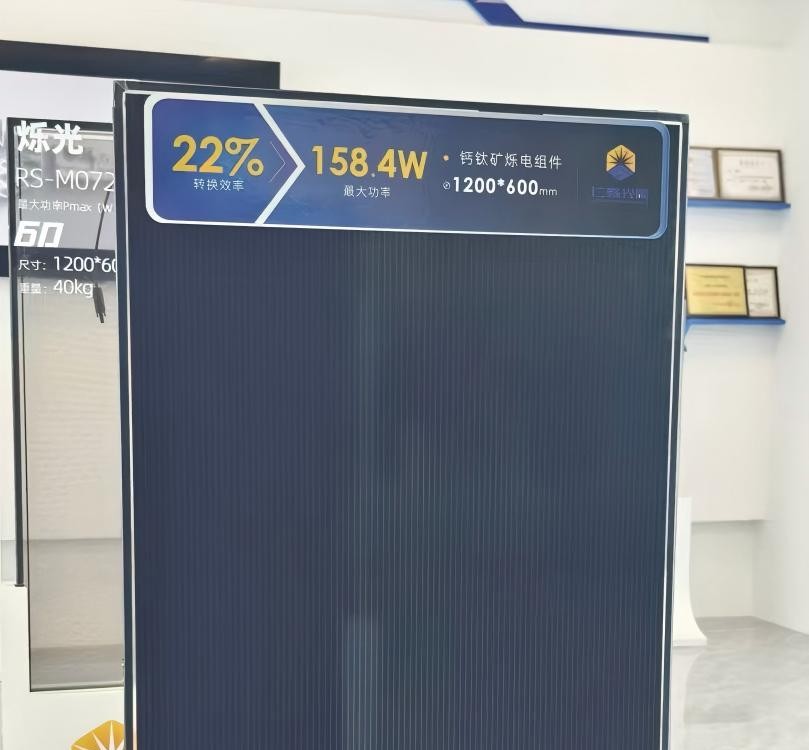
The research team also fabricated 150 modules with an area of 0.72 m², achieving an average power output of 144 W. The champion module reached a certified efficiency of 22.0% and an output of 158.4 W, representing a meter-scale efficiency record. It also maintained a stable output above 158 W for more than two hours under MPPT.
“We also found that, beyond efficiency, LCP dramatically enhanced module durability under standardized International Electrotechnical Commission (IEC) testing,” Xiao added. “After 1,300 hours of damp-heat exposure, LCP modules lost only 2% of their initial efficiency, compared with 39% for ammonium halide passivator (AHP) modules. LCP modules also showed negligible degradation after 300 thermal cycles and retained 96% of their initial efficiency after 2,200 hours of MPPT operation. Under ultraviolet aging, they retained 95% of their initial performance, confirming strong resistance to multiple environmental stressors.”
The researchers also found that all LCP-modified modules surpassed the reliability requirements of IEC 61215. Field monitoring further showed higher specific energy yields than silicon tunnel oxide passivated contact (TOPCon) modules. “Overall, combining high-saturated-vapor-pressure (SVP) processing with chemically stable LCP passivation provides an industry-ready route to efficient, durable and scalable meter-scale perovskite photovoltaics,” they concluded.
The novel manufacturing process was described in “Lead carboxylates passivation for meter-scale perovskite solar modules,” published in nature.
This content is protected by copyright and may not be reused. If you want to cooperate with us and would like to reuse some of our content, please contact: [email protected].

Please login to comment