Battery boom brings round-the-clock solar closer, Ember says


A study by British energy think tank Ember suggests that the prospect of round-the-clock solar photovoltaic (PV) availability is drawing closer. Solar PV generated just over 10% of global electricity in the first half of 2026, up from 8.9% in the same period of 2025. Its share has nearly doubled from the 5.6% recorded in the first half of 2023.
Over the past three years, solar PV generation has grown seven times faster than total electricity generation. While global electricity generation rose by 12% between the first half of 2023 and the first half of 2026, solar generation more than doubled, from 769 TWh to 1,564 TWh.
However, this growth remains heavily concentrated around midday. On an average day in the first half of 2026, solar met more than 25% of global electricity demand between 11:00 and 14:00, before falling to near-zero levels between 20:00 and 05:00.
In markets with higher levels of solar PV penetration, this concentration is even more pronounced. In Chile, where solar met 26% of electricity demand in the first half of 2026, its contribution reached 71% at midday but had virtually disappeared by 21:00. In the Netherlands, solar met 58% of demand at 13:00, while in Germany it covered 55% at midday. In both markets, however, solar’s contribution fell to zero a few hours later.
Fossil-fuel generation maintains its position after sunset
The expansion of solar PV is displacing fossil-fuel generation during the day, but hours without sunlight remain a key domain for conventional generation. Between the first half of 2023 and the first half of 2026, average fossil-fuel generation between 11:00 and 14:00 fell from 86 GW to 69 GW. During the evening peak, between 19:00 and 21:00, however, the decline was much smaller, from 106 GW to 101 GW.
New battery storage installations in 2026 are projected to reach 459 GWh, up 50% from the 307 GWh added in 2025. According to Ember data, this capacity could theoretically shift 34% of new daily solar generation to non-solar hours.
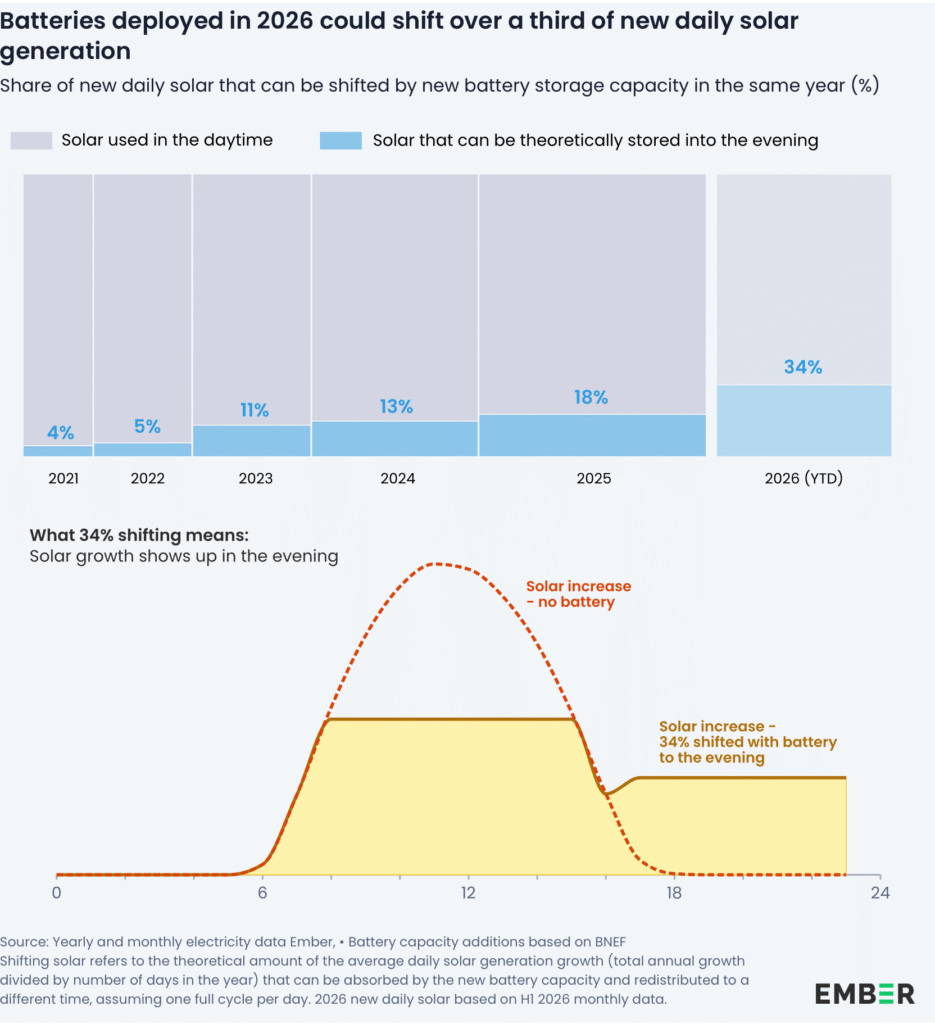
This proportion is nearly double the 18% estimated for batteries installed in 2025 and compares with just 4% five years earlier, in 2021.
Falling battery installation costs have been a key driver of this progress. Average global costs fell by 95% between 2010 and 2025, from $2,634/kWh to $140/kWh.
Bulgaria and Chile lead the rollout
While batteries installed globally in 2025 could shift the equivalent of 18% of new daily solar generation, some countries achieved significantly higher shares.
Bulgaria installed enough storage to shift 77% of its new daily solar generation, followed by Chile at 76% and Australia at 60%.
Bulgaria’s growth has been particularly rapid. The country went from virtually no battery storage capacity in 2023 to adding around 3 GWh in 2025. By May 2026, installed capacity had surpassed 8.6 GWh.
Chile followed a similar trajectory, adding 4 GWh of battery storage in 2025 and bringing its installed capacity to 7.6 GWh. Most of the new storage was installed alongside solar plants, helping to reduce curtailment and shift solar generation into the evening hours.
The United States added 58 GWh of storage in 2025, enough to shift approximately one-quarter of its new daily solar generation.
The European Union, meanwhile, added 27 GWh of battery storage in 2025, equivalent to shifting 16% of new daily solar generation and below the global average.
Solar power begins to extend into the evening
In California, the combination of solar and battery storage met more than a quarter of electricity demand during the evening peak, between 19:00 and 21:00, on an average day in the first half of 2026. In the first half of 2023, the figure stood at 6.8%.
In the first half of 2026, batteries enabled solar energy to meet more than 10% of evening electricity demand in Chile. In Bulgaria, solar and storage together covered nearly a quarter (24%) of electricity demand between 19:00 and 21:00 and supplied an average of 10% of demand between 19:00 and 07:00.
However, developing solar generation capable of supplying electricity beyond daylight hours will require more than additional battery capacity. Electricity markets must also enable batteries to participate effectively and operate where they provide the greatest value to the power system.
Ember concludes that batteries do not eliminate the need for a diversified electricity mix. Wind, hydropower, nuclear power, and long-duration energy storage will continue to play significant roles, particularly during extended periods of low solar or wind generation.
This content is protected by copyright and may not be reused. If you want to cooperate with us and would like to reuse some of our content, please contact: [email protected].

Please login to comment