Optimized semi-transparent PV greenhouse design increases energy output by 20.1%


A research group led by scientists from Qatar University has proposed a new design for a semi-transparent photovoltaic (STPV) greenhouse. The researchers optimized the greenhouse geometry to increase electricity generation while maintaining constraints such as total floor area and STPV coverage.
“This study introduces a novel greenhouse design that focuses on maximizing solar energy capture on the south-facing sections and wall surfaces, specifically tailored for the climatic conditions of Qatar,” the researchers said. “The new design is evaluated and compared with common greenhouse configurations, while maintaining constraints such as equal total floor space and STPV area. This ensures that the proposed design effectively optimizes solar energy reception without compromising space requirements.”
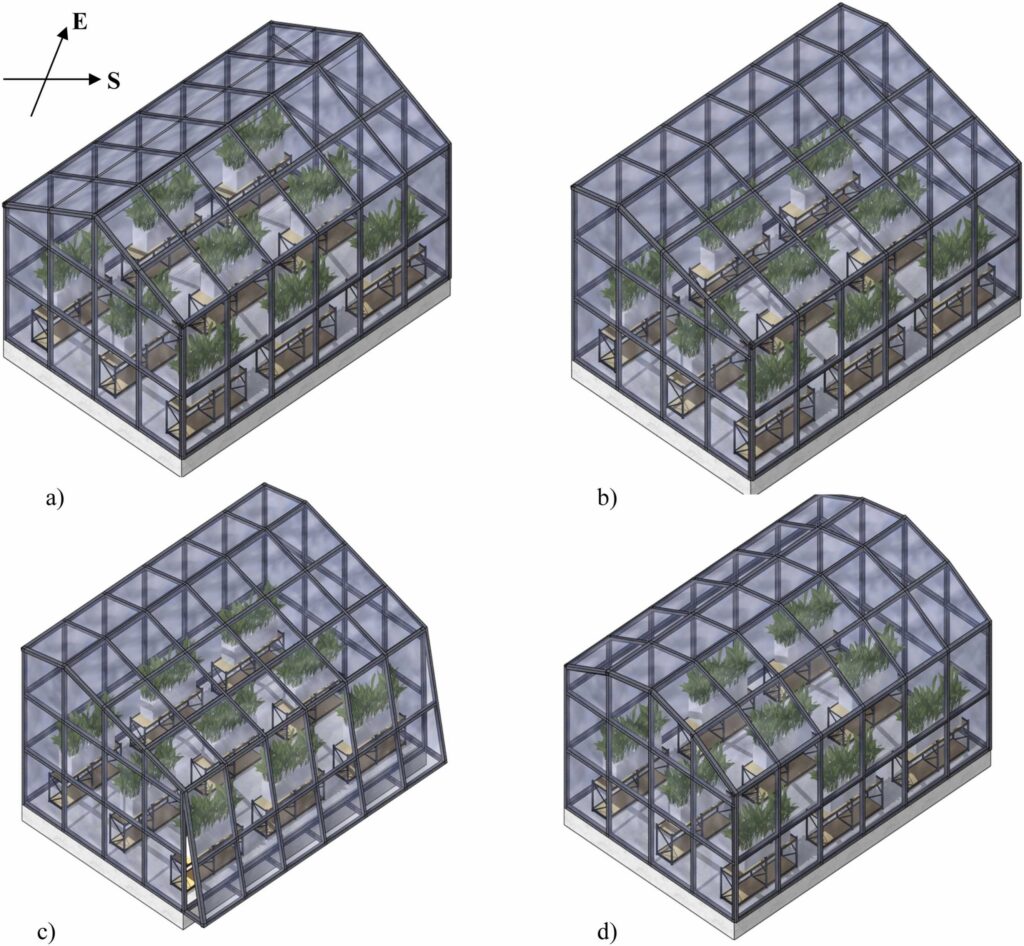
The scientists assessed the energy performance of five greenhouse geometries: even-span, uneven-span, vinery, modified-arch, and their proposed design, which assigns a larger share of the STPV surface to south-facing roof sections and vertical walls.
They modeled all five configurations using the same 280 W p-type bifacial, double-glass semi-transparent PV modules. Each greenhouse had a floor area of 24 m² and an effective installed STPV area of 71 m².
The researchers assessed the four conventional greenhouse designs using fixed, non-optimized geometries and compared their performance with that of the proposed configuration. They then optimized the new design using an improved mean-variance mapping optimization (IMVMO) algorithm, a metaheuristic optimization method.
The algorithm varied the greenhouse length, width, maximum height, and roof and wall tilt angles, with the objective of maximizing annual electricity generation.
“This study advances the mean-variance mapping optimization (MVMO) algorithm by developing an improved version (IMVMO),” the researchers explained. “The enhanced algorithm introduces mechanisms to avoid premature convergence and falling into local optima, a common limitation in many metaheuristic methods. This improvement makes IMVMO more robust and efficient in solving complex optimization problems, ensuring superior performance in optimizing greenhouse designs.”
In terms of total energy production, the proposed design consistently outperformed the four conventional greenhouse configurations with the same structural dimensions. Compared with the vinery design, it achieved an energy gain of 56.86%. The gains over the even-span and modified-arch designs were 25.14% and 24.60%, respectively, while the improvement over the uneven-span configuration was 6.03%.
The researchers said the walls played a significant role in electricity generation under the new design, contributing 7,518.3 kWh, compared with 5,493.5 kWh from the roof. The non-optimized configuration measured 6 m long and 4 m wide, with a maximum height of 3 m and a roof tilt angle of 50 degrees. Following optimization, the dimensions changed to 4 m by 6 m, with a maximum height of 2.5 m and a roof tilt angle of 26 degrees. The optimized geometry increased annual energy output by 20.1%.
“This optimization approach emphasizes the importance of strategic parameter selection in achieving energy-efficient greenhouse designs,” the team concluded. “Overall, this study highlights the possibility of design optimization to significantly improve greenhouse energy efficiency, offering practical insights for integrating renewable energy solutions into modern agriculture.”
The researchers presented their findings in “Optimizing semi-transparent PV-integrated greenhouse: A novel design for enhanced solar energy harvesting,” published in Energy Reports. The research team included scientists from Qatar University, BRAC University in Bangladesh, and Shanghai Maritime University in China.
This content is protected by copyright and may not be reused. If you want to cooperate with us and would like to reuse some of our content, please contact: [email protected].

Please login to comment