Photovoltaic-thermal heat pump based on bio-based surface coating achieves 77.32% overall efficiency

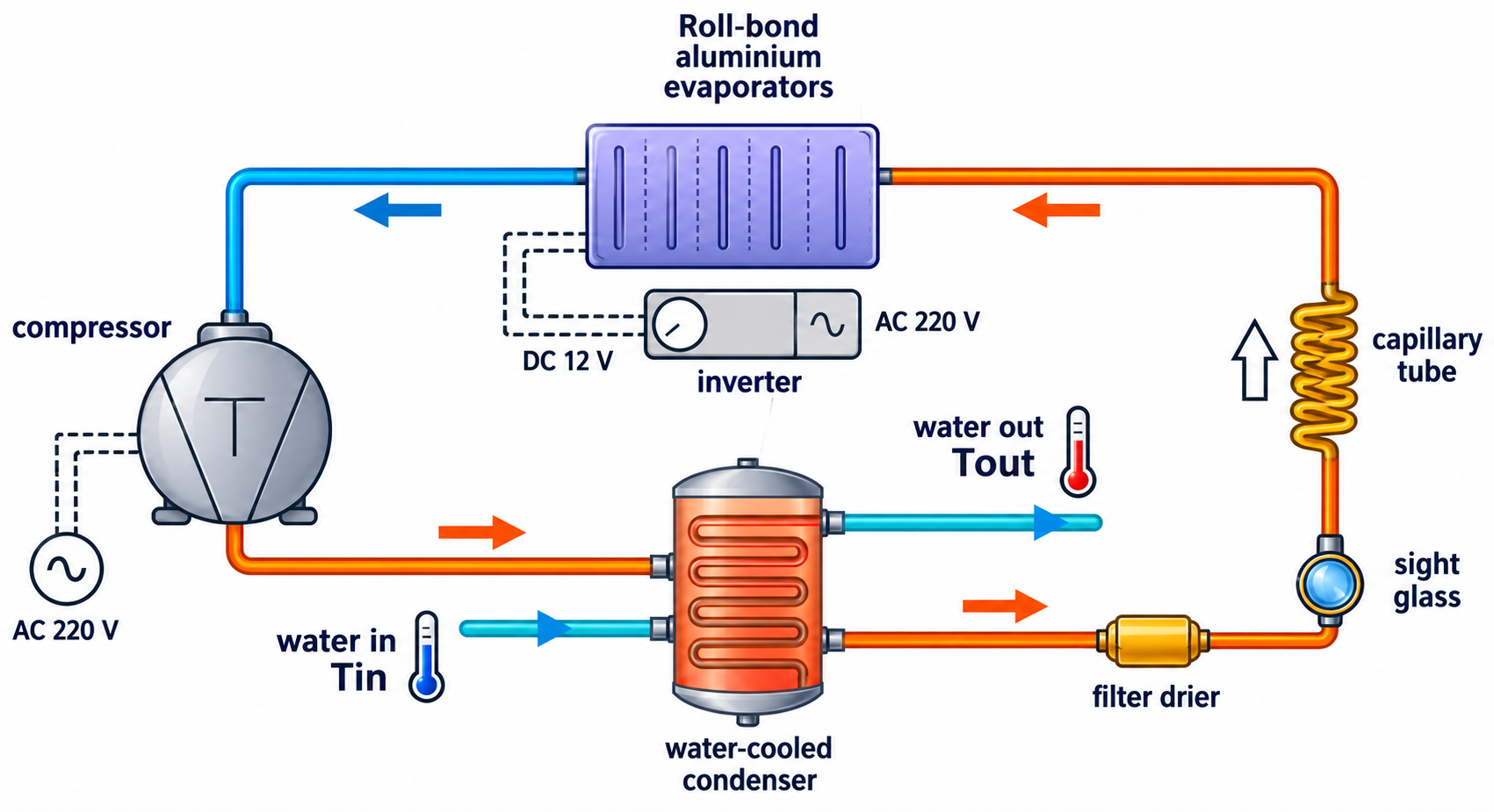
A research group in Iraq has developed a direct-expansion photovoltaic-thermal (PVT) heat pump system featuring a bio-based titanium dioxide (TiO₂) and linseed oil coating.
“The scientific gap addressed in the present work is not the individual use of PVT, heat pumps, refrigerants, or TiO₂-based materials, but the experimentally resolved interaction between passive face thermal regulation, active refrigerant-based heat extraction, and seasonal refrigerant response within the same PV/T–HP platform,” the researchers said.
The experimental system combined a 1.0064 m² monocrystalline PV module rated at 150 W with a 120 W vapor-compression heat pump. A 1.30 m × 0.40 m roll-bond aluminum plate installed behind the PV module served as the heat pump’s evaporator, extracting heat from the panel. A water-cooled condenser recovered the heat to produce hot water.
The refrigerant circuit also included a compressor, filter-drier, sight glass, and capillary tube with an inner diameter of 0.787 mm and an outer diameter of 1.803 mm. The researchers tested the system with three refrigerants – R134a, R600a, and R1234yf – both with and without a 100 nm bio-based surface coating composed of 15% TiO₂ nanoparticles and 85% linseed oil by mass.
The three refrigerants have different environmental and safety characteristics. R134a is a nonflammable hydrofluorocarbon (HFC) with a relatively high global warming potential, while R600a, or isobutane, is a low-global-warming-potential hydrocarbon that is highly flammable. R1234yf is a hydrofluoroolefin (HFO) with a very low global warming potential and is classified as mildly flammable. In the tests, R600a delivered the best results in spring, summer, and autumn, while R1234yf performed best in winter.
The academics conducted the outdoor tests in Kirkuk, northern Iraq, during four representative months in 2025: January, March, August, and October. For each condition, they collected hourly measurements from 07:00 to 17:00 over three representative clear-sky days.
The researchers compared the separate and combined effects of the coating and heat pump cooling. They measured maximum PV power, panel temperature, electrical and thermal efficiency, useful heat delivered to the water, compressor energy consumption, and the heat pump’s coefficient of performance (COP).
“Across all seasons and refrigerants, adding the coating to the PV/T–HP increased combined efficiency,” the researchers said. “The best seasonal cases were 64.93% overall efficiency in winter with R1234yf, and 76.59%, 71.51% and 77.32% in spring, summer and autumn with R600a, respectively.”
Peak COP occurred near solar noon, reaching 2.65 in winter with R1234yf and 3.78, 4.27, and 3.85 in spring, summer, and autumn, respectively, with R600a.
Compared with the baseline configuration, the integrated system reduced peak PV surface temperatures by 17 C in winter, 19 C in spring, 34 C in summer, and 24 C in autumn. The researchers said the lower operating temperatures accounted for the observed gains in electrical performance.
“These results indicate the potential practical feasibility of the proposed PVT–HP system by relying on commercially available components with a low-cost, easy-to-apply bio-nano coating without complex manufacturing modifications,” the group concluded. “The system achieves significant reductions in panel temperature and noticeable improvements in electrical and thermal efficiency, especially in hot and high radiation environments.”
The researchers described the system in “Performance enhancement of photovoltaic/thermal systems with heat pump units using alternative refrigerants and nanoparticle TiO2 with linseed oil cooling coating,” which was recently published in Results in Engineering. The research group included scientists from Iraq’s Northern Technical University and Al-Kitab University.
This content is protected by copyright and may not be reused. If you want to cooperate with us and would like to reuse some of our content, please contact: [email protected].

Please login to comment