Predictive control cuts costs in buildings combining PV, heat pumps, EVs, thermal storage

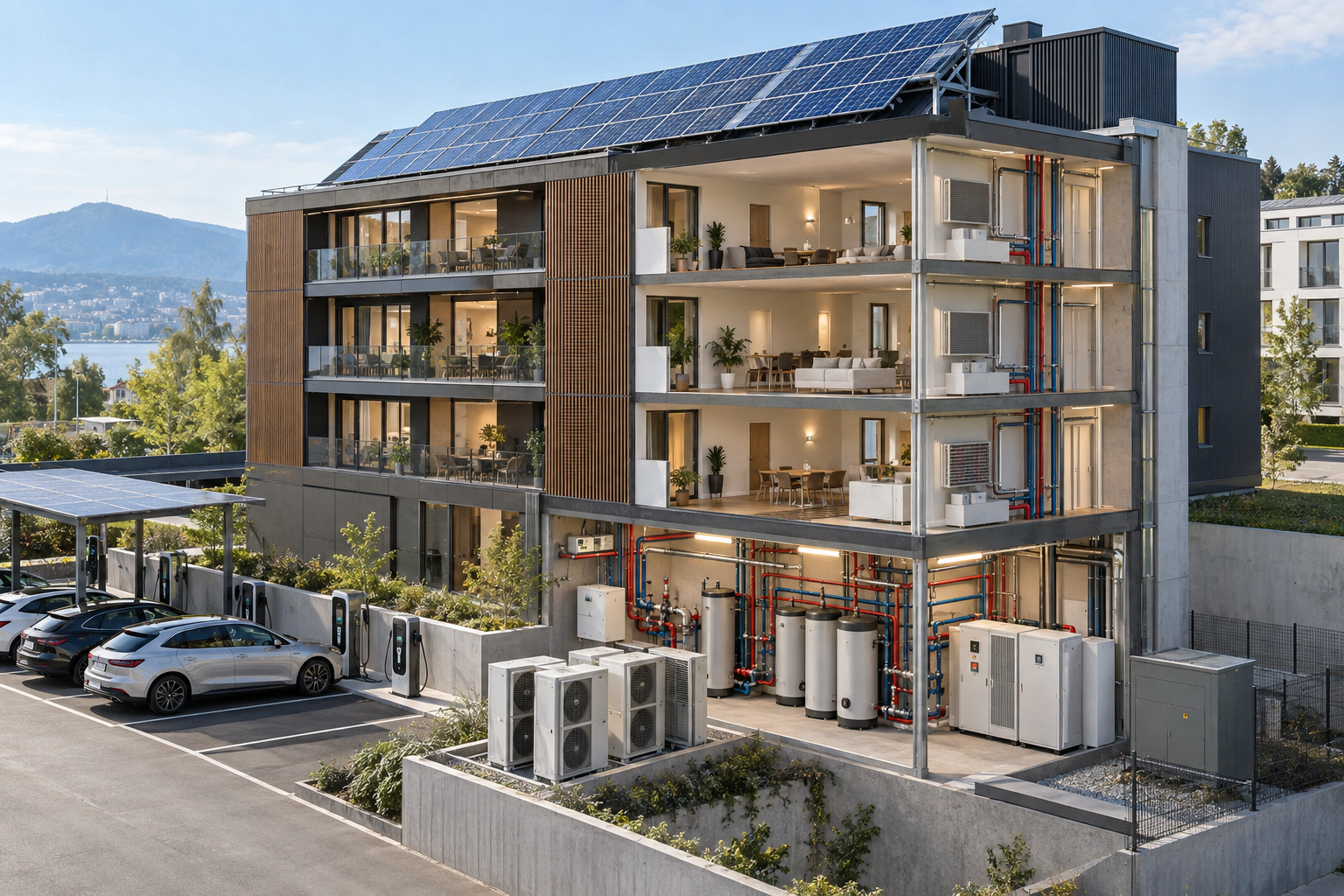
A research team led by scientists at China’s Hunan University has developed a predictive rule-based control (PRBC) strategy for integrated building energy systems combining PV, heat pumps, thermal tanks (TTs), and electric vehicles (EVs).
“By using forecasts of weather conditions, building load, and photovoltaic generation, the proposed strategy transforms the multi-device control problem into the determination of the optimal charging/discharging power and energy states of storage units for different tariff periods, and then determines the control actions of all devices based on the actual states of the storage units and system energy balance,” the researchers said.
The scientists compared the strategy with conventional rule-based control (RBC) and model predictive control (MPC).
The proposed method uses forecast data to optimize the charging and discharging power and target state of charge (SOC) of the thermal tank and EVs for each electricity tariff period. At each 15-minute time step, it compares the storage units’ actual SOC with the optimized targets to determine whether they should charge, discharge, or remain idle, while accounting for real-time energy demand, PV output, equipment constraints, and grid exchanges.
To account for real-world forecast uncertainty, the researchers introduced zero-mean truncated Gaussian errors that increase with the forecast horizon, reaching maximum standard deviations of 10% for outdoor temperature and 15% for solar irradiance.
The researchers tested the PRBC strategy through simulations of a three-story, 5,546.88 m² office building in an unnamed hot-summer, cold-winter climate region, focusing on summer cooling operation.
The modeled energy system included 910 south-facing 175 W PV modules installed at a 25-degree tilt, a variable-frequency air-source heat pump with 550 kW of rated cooling capacity, a 1,000 kWh thermal storage tank, and five EVs, each equipped with a 180.86 kWh battery. The system could buy electricity from and sell electricity to the grid.
The researchers compared PRBC with RBC and MPC over a seven-day test period and conducted a separate one-month simulation to assess longer-term operation. RBC operates the system according to predefined rules based on the current tariff period and system state, without using forecasts or optimization. MPC uses forecasts to optimize device-level control actions over a rolling 24-hour horizon, repeating the optimization at every 15-minute time step.
“The results show that PRBC performs significantly better than RBC and approaches the performance of MPC. Over the seven-day operating period, the cumulative total operating costs of PRBC, MPC, and RBC are 2,176.37 CNY ($324.32), 2,034.95 CNY, and 3,446.93 CNY, respectively, corresponding to cost reductions of 36.86% and 40.96% for PRBC and MPC relative to RBC,” the researchers said. “The peak-period results further show that PRBC can substantially reduce system dependence on grid electricity purchases.”
On typical weekdays, the share of electricity supplied through grid purchases during peak periods fell from about 70% under RBC to about 20% under PRBC, compared with about 12% under MPC. The researchers said analyses of typical-day operation and longer-term performance also showed that PRBC could coordinate thermal storage and EV operation in response to load variations, improving system regulation while maintaining strong economic performance.
The researchers also found that PRBC significantly reduced optimization complexity and computational requirements compared with MPC. Each PRBC optimization involved 18 decision variables and was performed once per day, while MPC required 1,056 decision variables per optimization and performed 96 rolling optimizations per day.
“Under the adopted formulations and solvers, the average computation times per control action for RBC, PRBC, and MPC are 0.18 s, 0.27 s, and 239.81 s, respectively,” the researchers said. “These results indicate that the adopted PRBC implementation achieves operating performance close to that of MPC with only a marginal increase in computational time relative to RBC.”
The scientists described the strategy in “A predictive rule-based control strategy for integrated building energy systems with photovoltaic, heat pump, thermal tank and electric vehicles,” published in Energy and Buildings. Researchers from China’s Hunan University and the Technical University of Denmark participated in the study.
This content is protected by copyright and may not be reused. If you want to cooperate with us and would like to reuse some of our content, please contact: [email protected].

Please login to comment