Scientists create waterproof, wearable photovoltaics

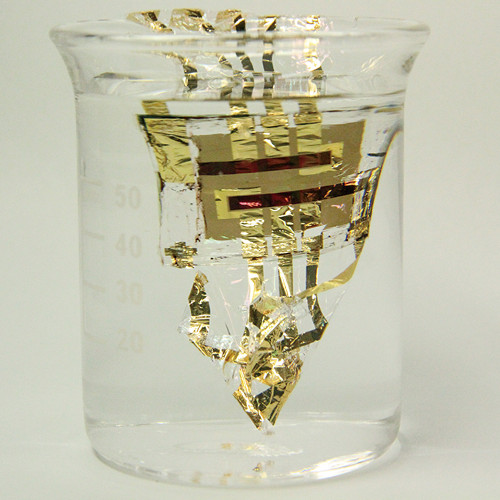
Scientists from Japanese research institute RIKEN and the University of Tokyo have developed ultra-thin photovoltaics wrapped in stretchable and waterproof films, which can continue to generate solar electricity even after being soaked in water or being exposed to mechanical stress, such as cleaning in a washing machine.
As ultra-thin and stretchable material that can be woven into wearable textiles is often permeable, the scientists have come up with a coating made of acrylic-based elastomer, which prevents water infiltration, while allowing light in.
The researchers have subjected the photovoltaics to a variety of tests, finding first that it had a strong energy efficiency of 7.9 %, producing a current of 7.86 mW/cm², as the current density was 13.8 mA/cm² at 0.57 V, based on a simulated sunlight of 100 mW/cm².
The efficiency of double-side-coated devices decreases only by 5.4% after immersion in water for 120 minutes. Furthermore, the efficiency of the devices remains at 80% of the initial value even after 52% mechanical compression for 20 cycles with 100 minutes of water exposure, read the research findings published in the journal Nature Energy,
The extremely thin and flexible organic photovoltaic cell is based on material called PNTz4T, which the scientists had developed in earlier work.
According to Takao Someya, the leader of the research group, these cells could be used to provide power to health monitors woven into clothing, which are able to record heartbeats and body temperature, and provide early warning of medical problems.
These healthcare textile-implantable devices need a steady power supply of several milliwatts or more to continuously collect data, and the new textile-compatible photovoltaics would be able to cater to the need.
“We were very gratified to find that our device has great environmental stability while simultaneously having a good efficiency and mechanical robustness. We very much hope that these washable, lightweight and stretchable organic photovoltaics will open a new avenue for use as a long-term power source system for wearable sensors and other devices,” says Kenjiro Fukuda of the RIKEN Center for Emergent Matter Science.
This content is protected by copyright and may not be reused. If you want to cooperate with us and would like to reuse some of our content, please contact: [email protected].

Please login to comment

[…] Im Jahr 2022 hatte eine andere Forschungsgruppe des CEMS wärmeschrumpfende Polymere zur Laminierung organischer Solarzellen auf gekrümmten Oberflächen entwickelt. Eine „waschmaschinenfeste“ organische Solarzelle, allerdings mit weitaus geringerer Belastbarkeit und niedrigerem Wirkungsgrad, hatte das Riken gemeinsam mit der Universität Tokio zuerst 2017 vorgestellt. […]
[…] Riken Center for Emergent Matter Science researchers in Japan have developed an organic-inorganic halide perovskite compound that chemically stores NH3 through dynamic structural transformation. The compound undergoes a structural change upon NH3 uptake, allowing for efficient uptake and extraction. “X-ray diffraction analysis reveals that reversible NH3 uptake/extraction originates from a cation/anion exchange reaction,” they wrote in American Chemical Society. “This structural transformation shows the potential to integrate efficient uptake and extraction in a hybrid perovskite compound through chemical reaction.” […]
[…] Riken Center for Emergent Matter Science researchers in Japan have developed an organic-inorganic halide perovskite compound that chemically stores NH3 through dynamic structural transformation. The compound undergoes a structural change upon NH3 uptake, allowing for efficient uptake and extraction. “X-ray diffraction analysis reveals that reversible NH3 uptake/extraction originates from a cation/anion exchange reaction,” they wrote in American Chemical Society. “This structural transformation shows the potential to integrate efficient uptake and extraction in a hybrid perovskite compound through chemical reaction.” […]

This kind of inventions makes me happy.
[…] researchers at the Riken Center for Emergent Matter Science in Japan recently fabricated a waterproof and flexible OPV solar cell that can be used in wearable […]