Tuning out the defects for more powerful perovskite solar cells

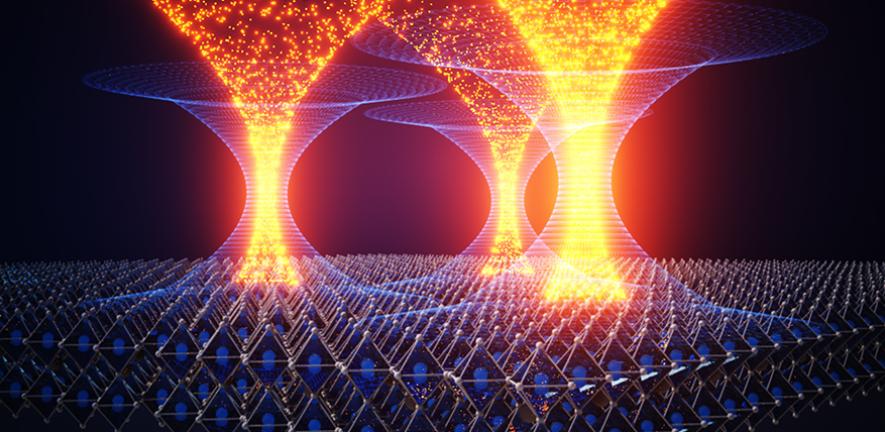
Perovskite solar cells have already shown huge potential for low-cost, high efficiency solar energy, and scientists around the world are hard at work ironing out the last few issues – particularly with their long-term stability – that still hold the material back from widespread commercial application.
This was the aim of a collaboration between scientists at Cambridge University in the UK and Japan’s Okinawa Institute of Technology (OIST). The group used various imaging techniques to observe the structure of perovskite films at the nanoscale, and the mechanisms at work when the light hits the film.
“Illuminating the perovskite films over time, simulating the aging of solar cell devices, we find that the most interesting dynamics are occurring at these nanoscopic trap clusters,” said Stuart Macpherson from Cambridge’s Cavendish Laboratory. “We now know that the changes we see are related to photodegradation of the films. As a result, efficiency-limiting carrier traps can now be directly linked to the equally crucial issue of solar cell longevity.”
The group found that defects in the material, which were previously known to create “traps” for charge carriers that limit device efficiency, are also involved in structural changes that reduce device performance over time. By focusing on the removal of these defects during the manufacturing process, the group states that improvements in both performance and longevity should be achievable. “We reveal that performance losses and intrinsic degradation processes can both be mitigated by modulating these defective phase impurities, and demonstrate that this requires careful tuning of local structural and chemical properties,” they explain.
Scaling up
Methods for altering chemical composition and process parameters should be quickly applicable to larger scale processing of the materials, and the observation techniques developed here could be applied to other semiconductor materials as well.
“We now understand that any residual unwanted phases – even tiny nanoscale pockets remaining from the processing of the cells – will be bad news for the longevity of perovskite solar cells,” said Cambridge University scientist Sam Stranks. “The manufacturing processes need to incorporate careful tuning of the structure and composition across a large area to eliminate any trace of these unwanted phases – even more careful control than is widely thought for these materials. This is a great example of fundamental science directly guiding scaled manufacturing.”
The researchers presented their findings in the paper Local Nanoscale Phase Impurities are Degradation Sites in Halide Perovskites, published in Nature.

Please login to comment

[…] PV Magazine, “Tuning out the defects for more powerful perovskite solar cells” ↩︎ […]
[…] na całym świecie byli “eliminowanie wad” ogniw słonecznych z perowskitu i są teraz znacznie bliżej produkcji trwałych, tanich, […]
[…] around the world have been ‘tuning out the defects’ of perovskite solar cells, and are now much closer to manufacturing long lasting, cheap, high […]
[…] around the world have been ‘tuning out the defects’ of perovskite solar cells, and are now much closer to manufacturing long lasting, cheap, high […]
[…] PV Magazine, “Tuning out the defects for more powerful perovskite solar cells” ↩ […]