Australian startup develops PV-hydrogen standalone power system
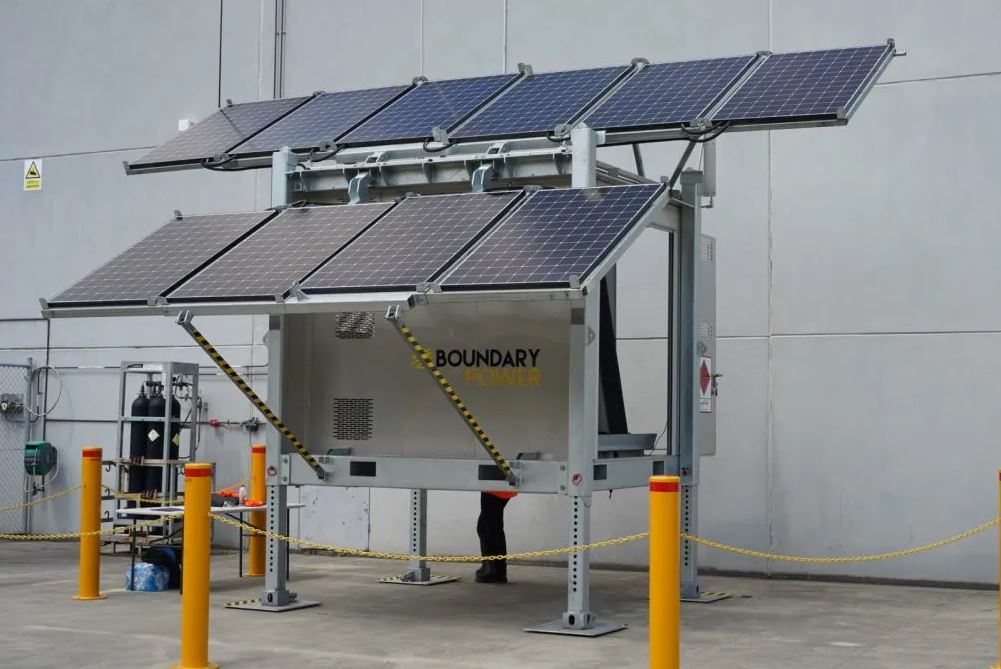
Boundary Power, a union between West Australian regional utility Horizon Power and Victoria-based electric engineering company Ampcontrol, has officially launched a standalone power system (SAPS) that uses solar power and a renewable hydrogen hydride battery to store and generate electricity when required.
Adam Champion, business development manager for renewables at Ampcontrol, said while the Hydrogen Integrated Stand-Alone Power System (HiSAP), is not yet commercially available, it has been created to explore technical factors across design, integration and operation.
“We will be using these learnings as input into our future renewable energy products,” he said.
The first of the HiSAPS, developed in conjunction with Sydney-based hydrogen energy storage system specialist Lavo and Melbourne-headquartered inverter manufacturer Selectronic Australia, has been installed at Ampcontrol’s LED manufacturing facility at Ringwood in Victoria.
Boundary Power General Manager Simon Duggan said the system uses the company’s Solar Qube, an integrated, foldout, solar-battery-generator combination. However, the traditional diesel generator has been swapped out for a self-contained hydrogen power system developed by Lavo.
“Through the collaboration with Lavo and Selectronic we’ve been able to come up with a uniquely designed solution that paves the way for what we can do in the future with standalone powers systems and renewable energy generation,” he said. “It allows us to demonstrate the capabilities of this Solar Qube unit being powered by a hydrogen electrolyser and storage system rather than using your traditional diesel generator. This is a really, really, really exciting time.”
The demonstration unit includes two systems. The standalone SAPS comprises a 4 kWp rack-mounted solar array, a 16 kWh battery energy storage system and a 7.5 kW inverter. This is coupled with a 20 kWh metal hydride hydrogen energy storage system (HESS) with an additional 6 kWp solar array (part of a rooftop array at the Ringwood facility) and 5 kWh of battery storage. The HESS also incorporates its own 2.3 kW electrolyser and 3 kW fuel cell to ensure all hydrogen used is renewably created on site.
“One of the unique things about the HiSAPS unit compared to standard stand-alone power systems is that it generates its own fuel internally,” Ampcontrol Research Engineer Thomas Steigler said. “It’s generating hydrogen and storing that within the unit.”
The entire system, including communications equipment for integration into metering and reporting systems, is contained within a weatherproof enclosure.
The newly unveiled demonstration unit will supply solar power to Ampcontrol’s Ringwood facility during daylight hours to meet daytime energy demand. Excess energy will be used to charge the battery energy storage system (BESS) and then the HESS. The BESS will be discharged to meet the power demand at night and during peak periods. The HESS will meet energy demand gaps where solar and BESS energy are not available.
pv magazine print edition
The project was partly funded by the Department of Energy, Environment and Climate Action (DEECA) Victoria as part of the state government’s Renewable Hydrogen Commercialisation Pathways Fund.
Duggan said the project has offered an insight into the technology required to build hydrogen systems to store and provide electricity and the demonstration plant will provide crucial insight into the technical, regulatory and safety aspects of integrating hydrogen systems into a standalone power system.
“The funding allowed us to collaborate with experts in the field to design an innovative solution to demonstrate real-world application, paving the way for future commercialisation of HiSAPS,” he said.
This content is protected by copyright and may not be reused. If you want to cooperate with us and would like to reuse some of our content, please contact: [email protected].

Please login to comment

[…] Stand Alone solar power is an essential move toward a greener, more sustainable […]
[…] in a 5kw Stand-Alone Solar System with solar panels not only saves you money on your energy bills and reduces your carbon footprint […]

Necessity is the ” mother ” of invention 🙂 .Lets all continue with our ” greener objectives ” , for the benefit of our decendants.
[…] Da pv magazine Global […]
[…] ¶ “Australian Startup Develops PV-Hydrogen Standalone Power System” • Boundary Power, a union of West Australian utility Horizon Power and Victorian electrical engineering company Ampcontrol, launched a standalone power system that uses solar power and a renewable hydrogen hydride battery to store and generate electricity as needed. [PV Magazine] […]
[…] Minute 38 ¶ “Australian Startup Develops PV-Hydrogen Standalone Power System” • Boundary Power, a union of West Australian utility Horizon Power and Victorian electrical engineering company Ampcontrol, launched a standalone power system that uses solar power and a renewable hydrogen hydride battery to store and generate electricity as needed. [PV Magazine] […]
[…] energy technologies, offering a viable alternative to fossil fuels. The deployment of a 5kW Stand-Alone Solar System not only delineates a path towards energy self-sufficiency for homeowners but […]