Radiative cooling for PV modules – challenges and prospects

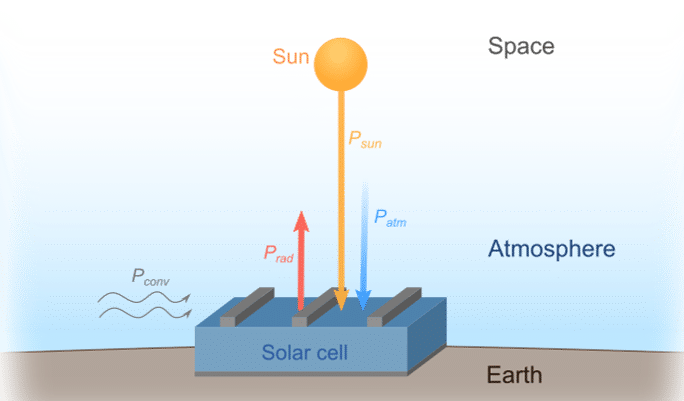
“The incorporation of radiative cooling into solar panels is still in the research stage and will take some time to reach commercial maturity,” researcher Yuehong Su told pv magazine.
Su and his colleagues have noted the importance of using radiative cooling as a cooling agent for solar panels, but also to extend the operation of PV-thermal modules at night.
“The thermal-to-power efficiency of a solar thermal power plant can be increased by dropping the condensing temperature with an additional radiative cooling strategy,” they explained.
The researchers identified all useful radiative cooling strategies for PV cooling. They stressed the importance of the cooler in reducing a solar cell’s operating temperature without affecting its overall power conversion efficiency. However, several radiative cooling techniques use radiative coolers atop the solar cells, which results in optical losses, they said.
They highlighted the need to evaluate the performance of radiative cooling in solar cells by comparing it with the original encapsulated solar cell. They also noted the importance of setting clear comparison benchmarks.
“Simply comparing the PV efficiency, thermal efficiency, and radiative cooling flux reported in different studies is unfair and insignificant since the material, environmental, and operating conditions are different,” they said. “For instance, radiative cooling is preferable in arid and high-altitude areas, involuntarily resulting in a greater cell-temperature reduction for a PV cell or a higher net radiative cooling flux for a PT-RC collector in these regions.”
They looked at the accessibility, scalability, and reliability of the materials used in radiative cooling systems and found that the polyethylene film used in PV applications may not be resistant enough for long-term outdoor operation.
“Future researches should attach primary importance to alternative cover with better mechanical strength and weatherability,” they said.
They presented their findings in “Applications of radiative sky cooling in solar energy systems: Progress, challenges, and prospects,” which was recently published in Renewable and Sustainable Energy Review. The research group includes academics from the University of Nottingham in the United Kingdom and the University of Science and Technology of China.
Radiative cooling occurs when the surface of an object absorbs less radiation from the atmosphere and emits more. As a result, the surface loses heat and a cooling effect can be achieved without the need for power. Radiative cooling was recently applied to solar panel cooling by researchers from Shanghai Jiao Tong University in China, Purdue University in the United States, the Catalan Institute of Nanoscience and Nanotechnology and the Instituto de Ciencia de Materiales in Spain, and the Jordan University of Science and Technology and the Australian College of Kuwait.
This content is protected by copyright and may not be reused. If you want to cooperate with us and would like to reuse some of our content, please contact: [email protected].

Please login to comment

[…] from the University of Science and Technology of China have looked at how agrivoltaic installations could help to reduce evaporation rates on water […]
[…] from the University of Science and Technology of China have looked at how agrivoltaic installations could help to reduce evaporation rates on water […]
[…] from the University of Science and Technology of China have checked out how agrivoltaic installations may assist to cut back evaporation charges on water […]
[…] From pv magazine […]
[…] Read More […]
[…] international research team has developed a novel radiative cooling method for vertical solar panels that uses V-shaped mirrors tailored for the thermal management on […]