IPVF demonstrates 16.8%-efficient mini bifacial perovskite solar module

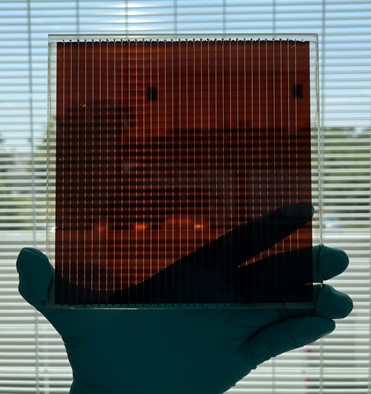
France’s Institut Photovoltaïque d’Île-de-France (IPVF) has announced the achievement of bifacial perovskite PV devices with 18.1% power conversion efficiency measuring 2 cm x 2 cm, and 16.8% for 10 cm x 10 cm mini solar modules.
The IPVF told pv magazine that the result was enabled by its ability to drive new technology development at different levels of maturity in-house.
“These results mark a decisive breakthrough in IPVF’s mission to transform laboratory innovation into industrial reality. What truly sets this achievement apart is reaching these performance levels through manufacturing processes ready for mass production today,” said Roch Drozdowski-Strehl, IPVF CEO, in a statement.
For the solar cell, the researchers used a novel passivation at the interface of the perovskite layer and the n-type contact after identifying the optimal molecule combination in their research program. This was transferred internally to an IPVF development program focused on process and performance improvements to support compatibility with industrial manufacturing processes.
Specifically, the lab-scale devices were made with spin coating, then via a slot die coating ambient process. Outcomes were improved by applying vacuum quenching to dry the layer deposited by slot die coating.
A wide bandgap hybrid perovskite cell technology was used as it has a “high compatibility” with tandem applications. The plan is to internally scale up in size to 60 cm x 30 cm to be combined with silicon PV modules in a four-terminal, two-wire (4T2C) perovskite-silicon tandem design. These will be produced on a new prototyping line scheduled to be operational early next year.
The IPVF works with partners to accelerate technology transfer, combining “world-class research with industrial expertise,” according to Drozdowski-Strehl.
Recently, IPVF took delivery of a solar simulator with advanced electroluminescence (EL) analysis from Italy’s Ecoprogetti for testing perovskite solar cells and modules. It also has an ongoing collaboration focused on perovskite-silicon tandem solar panels with French solar manufacturer Voltec Solar.
This content is protected by copyright and may not be reused. If you want to cooperate with us and would like to reuse some of our content, please contact: [email protected].

Please login to comment