Oxford PV says tandem solar could add up to 5 km to daily EV range

Oxford PV Oxford PV has joined SUITE, a vehicle‑integrated solar consortium led by Nissan Technical Centre UK, saying its tandem technology could materially increase the solar contribution to electric‑vehicle range.
The company claims its perovskite‑on‑silicon tandem technology could deliver 20% to 30% more power per unit area than conventional silicon in vehicle‑integrated applications.
A roof‑integrated silicon PV system typically provides 10 km to 15 km of daily range for an efficient electric vehicle under northern European conditions, according to Oxford PV.
CTO Ed Crossland told pv magazine that the higher efficiency of tandem devices would add a further 3 km to 5 km – taking the total solar contribution to roughly 15 km to 20 km per day.
As efficiencies approach 30%, solar could meet the full daily energy needs of up to 50% of drivers on many vehicles, he added. Oxford PV is targeting 27% efficiency in standard modules by 2027 and 29% by the end of the SUITE project in 2029.
The project aims to reach technology readiness level 7 (TRL 7), producing demonstrator vehicles fitted with operational Oxford PV panels. The path to commercial production would involve Oxford PV supplying cell and interconnection technology to partners who are already key suppliers into original equipment manufacturers for integration into glass, Crossland said.
Early work on vehicle‑integrated PV (VIPV) is focused on roof‑integrated, rigid, and well‑sealed module designs, where mechanical loading and moisture exposure can be tightly controlled.
“VIPV is subject to high‑cycle mechanical strain, rapid thermal cycling, and repeated humidity‑freeze exposure that are significantly more demanding than the stress profiles encountered in stationary PV,” said Crossland.
Module architecture and tandem‑cell integration are therefore the central engineering challenges, he said.
On shading resilience, Crossland said Oxford PV’s two‑terminal tandem design means “the damaging effects of reverse bias are avoided,” unlike some other perovskite‑silicon approaches. “The company has demonstrated cell interconnection technologies which are very resilient to partial shading and avoid hot‑spot formation,” he added.
SUITE is delivered by Innovate UK in partnership with the Advanced Propulsion Centre and the Department for Business and Trade. The consortium includes Nissan Technical Centre UK, specialist engineering firms, and several UK universities.
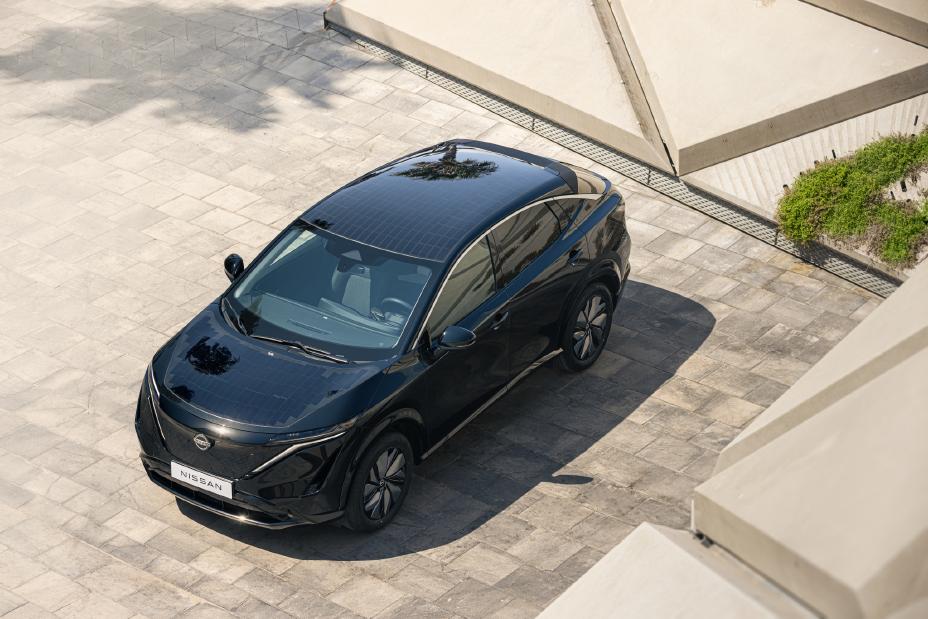
In January, Nissan presented an electric car integrating 3.8m² of unspecified high-efficiency solar panels across the hood, roof, and tailgate. The company said real-world testing demonstrated the PV system can deliver up to 23 km of additional range per day under optimal sunlight conditions.
“In cities with high solar exposure – such as Barcelona – the vehicle can generate an average of 17.6 km of daily solar driving range Year‑round averages show significant gains globally: 10.2 km/day in London, 18.9 km/day in New Delhi, and 21.2 km/day in Dubai Drivers can reduce their charging frequency by 35–65%, depending on usage A two‑hour, 80 km journey can produce 0.5 kWh of clean energy, adding up to 3 km of free, zero‑emission range,” said Nissan.
Even short trips contribute to efficiency, enabling the recovery of meaningful energy that translates into several extra kilometers of range, according to the company.
This content is protected by copyright and may not be reused. If you want to cooperate with us and would like to reuse some of our content, please contact: [email protected].

Please login to comment