SNEC 2026 wrap-up: Storage, AI and back-contact are reshaping solar

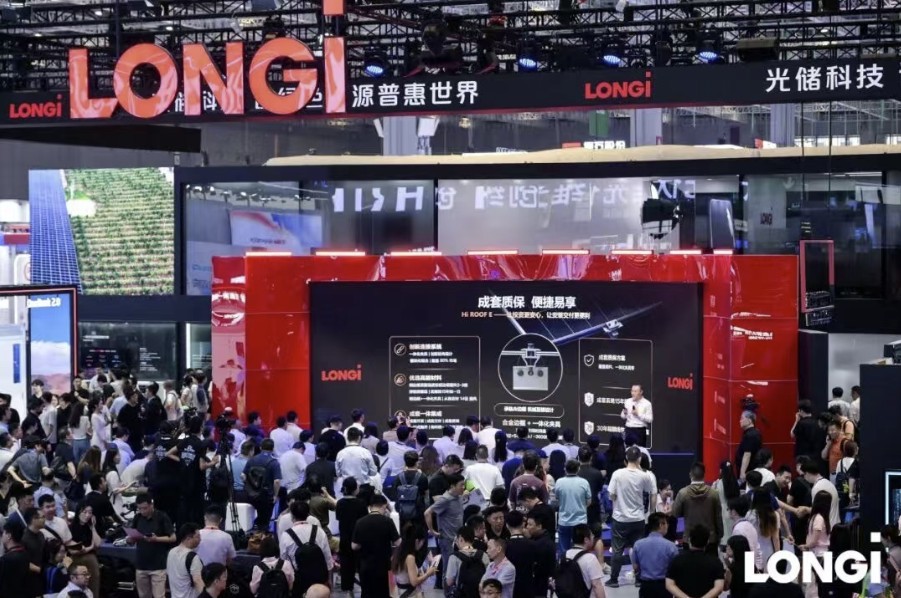
For anyone who has followed SNEC for more than a few years, the basic rhythm of the show is familiar: bigger booths, louder launches, higher module wattages and increasingly confident claims about the next phase of solar. SNEC 2026 felt slightly different.
The solar segment was still vast. Major Chinese manufacturers showcased new modules, efficiency gains, cell roadmaps and carefully staged glass displays. TOPCon remained ubiquitous, and high-power modules continued to dominate headlines and booth graphics. Yet the underlying message was no longer simply that modules are getting more powerful. That narrative is now largely established.
Instead, PV was increasingly framed as part of a broader system conversation: storage, dispatchability, AI, grid stability, differentiated applications and, at the margins, even space-based use cases. In short, SNEC 2026 reflected an industry still focused on efficiency gains, but increasingly aware that efficiency alone will not define the next cycle.
Here are five trends that stood out.
Solar-plus-storage moves to the center
Storage has shifted from the periphery of PV discussions to a core design element. This does not diminish solar’s role; it redefines it.
For years, the industry’s central promise was simple: cheaper electricity. That promise has largely been delivered on the generation side. The challenge now is less about cost and more about value — how electricity is absorbed, shifted, dispatched and integrated into constrained grids.
This was evident across SNEC, where many PV players no longer positioned themselves as module suppliers alone.
Longi highlighted this shift with its Longi ONE platform, positioning it as an integrated solar-plus-storage system spanning utility-scale, C&I, microgrids, power conversion systems and intelligent dispatch. Founder and CTO Li Zhenguo described the move into storage not as diversification, but as an “extension of capability” — framing storage as the next layer of value beyond high-efficiency PV.
JinkoSolar took a similar approach, pairing its Tiger Neo 5.0 module with scenario-specific PV products and the SunTera G5 storage system. The message was clear: module supply alone is no longer sufficient for customer needs.
Across markets, buyers are increasingly asking for more than low module prices. They want higher self-consumption, reduced curtailment, grid compliance, output smoothing and improved long-term project returns. That shifts procurement logic: modules remain essential, but system value is becoming decisive.
BC technology advancing
Back-contact (BC) technology was one of the most visible themes at SNEC. It is still not a mass-market replacement for TOPCon, which remains the dominant volume platform, but BC is clearly moving beyond niche status.
Companies including Longi, Aiko, TCL Zhonghuan, Skyworth PV and SolarSpace all used SNEC to expand BC-related product narratives.
BC removes front-side metallization, reducing shading and improving aesthetics — a key factor in residential and C&I rooftop markets. But positioning at SNEC went beyond appearance, emphasizing higher current density, improved shading response and greater design flexibility.
Aiko’s G4 INFINITE Ultra module was among the most prominent examples, with reported peak efficiency of up to 26% and a 690 W format. Skyworth PV showcased an 825 W BC module, while TCL Zhonghuan presented a BC platform exceeding 710 W and 26% efficiency.
Longi framed BC more broadly as a scalable platform technology, compatible with multiple cell architectures and differentiated module designs, including anti-dust, lightweight and anti-glare variants.
The key takeaway is not a near-term replacement of TOPCon, but the emergence of BC as a premium platform for distributed and high-value applications, while TOPCon remains the industry’s volume backbone.
AI now embedded in the PV value chain
AI was omnipresent at SNEC, though not all claims carried equal technical weight. Still, beneath the marketing layer, a clear direction is emerging: AI is becoming a functional layer across design, manufacturing, operations and energy management.
Huawei Digital Power offered one of the clearest articulations of this shift. At its SNEC launch, the company emphasized grid-forming technologies and AI as “pervasive” system elements. It also introduced FusionSolar Agent, an AI-driven system designed for lifecycle management of renewable assets.
The relevance for PV lies in increasing system complexity. A solar plant is no longer just modules and inverters, but a multi-variable system involving forecasting, dispatch, grid compliance, maintenance and increasingly energy trading — especially as storage penetration rises.
AI applications also extended into manufacturing and O&M, including defect detection, yield forecasting, predictive maintenance and carbon asset management tools.
The next phase will depend less on AI positioning and more on measurable outcomes: higher availability, improved yield prediction, lower O&M costs and better dispatch accuracy. Differentiation will come from integration depth, not branding frequency.
From standard modules to scenario-specific design
The one-size-fits-all module concept is steadily fading. SNEC 2026 featured a wide range of application-specific designs targeting data centers, desert environments, offshore installations, transport corridors, C&I rooftops and low-load structures.
JinkoSolar illustrated this shift with a diversified product matrix, including anti-glare, dust-resistant, lightweight and high-safety modules, alongside its AIDC and desert-focused designs.
Industry observers such as EnergyTrend noted a broader shift: module differentiation is no longer only about peak wattage, but about application fit and lifecycle performance.
Tongwei’s TNC 3.0 platform reflected similar priorities, with emphasis on temperature coefficients, bifaciality, low-light performance and degradation control. CTO Xing Guoqiang also pointed to weaker demand conditions ahead, driven by policy changes in China, trade restrictions and grid constraints in overseas markets — reinforcing the need for higher system value per project.
The industry narrative is shifting from “more watts” to “better fit and lower risk,” with increasing focus on LCOE optimization under specific operating conditions.
Aerospace PV
One of the more unexpected themes at SNEC was the visibility of space and aerospace PV concepts. This remains far from a commercial mainstream segment, but its presence signals the industry’s search for higher-value frontiers.
Risen Energy presented Risen Flex Nova, a lightweight, ultra-thin heterojunction-based concept targeting satellite and low-Earth orbit applications. Reported features included ultra-thin wafers, flexible structures and radiation resistance.
While volumes will remain limited, the technology direction overlaps with terrestrial trends: thinner wafers, material reduction, lightweight modules and high-efficiency architectures such as HJT and tandem concepts.
Space PV is best understood as a long-horizon exploration rather than a near-term market. Its significance at SNEC is less commercial and more symbolic: it reflects how far PV companies are pushing the boundaries of application environments.
The broader signal
SNEC 2026 did not suggest that the industry’s structural challenges are easing. Overcapacity, pricing pressure, trade barriers and grid constraints remain firmly in place. If anything, they were more visible, as companies sought to justify value beyond cost reductions.
But the direction of travel was clear.
Solar is still a manufacturing industry, but it is increasingly becoming a systems industry: integrated with storage, enabled by software, shaped by applications and constrained by grid realities. Future competition will still depend on efficiency and cost, but also on dispatchability, system integration, service capability and lifecycle performance.
That shift makes the industry more complex to describe — and more interesting to follow.

Please login to comment