Korean scientists build shingled solar module for thermoelectric generators

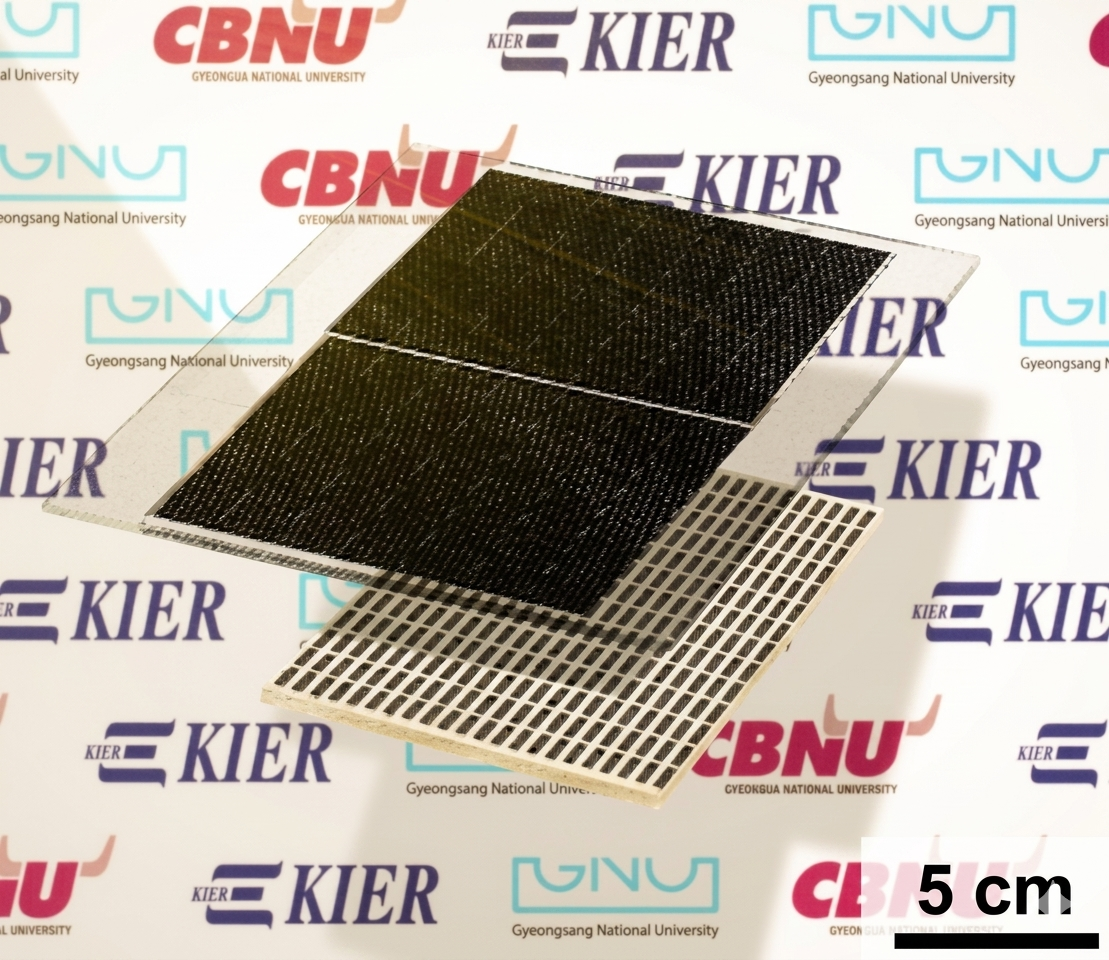
Researchers from the Korea Institute of Energy Research (KIER) and Chungbuk National University (CBNU) have fabricated a shingled photovoltaic module that can be combined with thermoelectric generators (TEGs) and allow efficient PV–TEG waste-heat energy recovery.
TEGs can convert heat into electricity through the “Seebeck effect,” which occurs when a temperature difference between two different semiconductors produces a voltage difference between two substances. The devices are commonly used for industrial applications to convert excess heat into electricity. However, their high costs and limited performance have thus far limited their adoption on a broader scale.
The shingled cell technology replaces conventional ribbon-based interconnections by connecting solar cell strips directly in series, which eliminates soldered ribbons. This design increases the active area available for light absorption while also reducing thermal and mechanical stresses within the module. As a result, it improves both efficiency and long-term reliability compared with standard interconnection approaches.
For module assembly, the researchers used PERC solar cells supplied by South Korea’s Shinsung E&G as the starting material. The cells were first divided into narrow strips using a 1,064 nm infrared laser scribing process, followed by mechanical cleaving. Shingled modules comprising three, five, or seven strips were fabricated with a total active area of 100 cm², whereas the 14-strip configuration had an increased area of 170 cm². The corresponding strip dimensions were 100 × 38.83 mm, 100 × 21.70 mm, 100 × 16.07 mm, and 85 × 16.07 mm for the three-, five-, seven-, and 14-strip modules, respectively.
Electrical interconnection between adjacent strips was formed by series assembly using CA 3556HF conductive adhesive. The structures were then hot-pressed and cured at 180 C for 1 minute to ensure reliable bonding. PV tabbing ribbons were soldered to both ends of each shingled module to provide external electrical contacts. Finally, the modules were encapsulated with a front glass layer, an ethylene-vinyl acetate (EVA) encapsulant, and a polyethylene terephthalate (PET) backsheet to enhance mechanical protection and environmental stability.
The scientists explained that this module architecture is beneficial for TEG integration because its series-connected strip design increases the operating voltage while reducing the output current, which in turn minimizes current-dependent resistive losses and Joule heating in the TEG. This improved electrical matching reduces the impact of the TEG’s relatively high internal resistance, enhances fill factor stability, and ultimately enables more efficient and load-resilient power extraction in PV–TEG hybrid systems under real operating conditions.
The commercial thermoelectric (TE) elements were provided by Chinese specialist Xinrong. A 100 cm² substrate-free TEG array was fabricated using 308 elements with polymer-filled gaps for mechanical stability and optimized heat transfer. The arrays were assembled via patterned copper (Cu) films on polyimide substrates using screen-printed solder, reflow soldering, and final substrate removal to expose electrodes for electrical connection.
The hybrid PV-TEG systems developed for testing consisted of a two-terminal (2T) setup, where PV and TEG are directly connected in series with a single external contact pair, and a four-terminal (4T) setup, where both components operate independently to eliminate series resistance losses from the TEG. The 2T configuration was primarily used, while the 4T architecture was employed only for loss analysis and comparison purposes.
A custom experimental platform was developed using a transparent Cu mesh heater on top and a bottom cooler to impose a controlled temperature gradient while simultaneously transmitting standard solar irradiation to the device. This setup enabled accurate I–V characterization of PV, TEG, and combined PV–TEG devices under coupled thermal and optical loading, with additional measurements supported by a dedicated numerical model.
TE elements were electrically characterized using Hall-effect and time-dependent resistance measurements under controlled current biases to evaluate transport and stability behavior. The PV component was modeled using a double-diode formulation combined with a thermoelectric generator equation set, solved via Lambert W-function-based transformations. Model fitting to experimental I–V data allowed extraction of key parameters, including effective TEG resistance, and enabled quantification of power losses in 2T operation.
The measurements showed that minimizing PV current while increasing voltage significantly reduces the impact of TEG resistance on device performance, withe the shingled PV modules being found to be particularly effective in achieving this low-current, high-voltage operating regime. Thermal analysis also revealed that PV-driven current induces both rapid Peltier cooling/heating and slower Joule heating within the TEG, which increases its effective resistance over time.
Furthermore, linear correlations between current and temperature gradients confirmed the coupling between electrical transport and thermoelectric heat exchange within the hybrid system. A validated numerical model, meanwhile, predicted that optimal designs with low current and high voltage operation can reduce power loss to near zero levels. This prediction was experimentally confirmed in a large-area 170 cm² device, which achieved ultra-low loss and high power output under controlled conditions.
“Using a 14-strip shingled module, which divides the current while increasing the voltage across multiple strips, we realized a load-resilient shingled PV module for a field-scale PV–TEG,” the researchers concluded. “The scale and performance of our PV–TEG represent significant advances over the largest (68 cm2) and best-performing (1.15 W) devices reported thus far in the literature. Unlike tandem solar cells, which require complex monolithic integration and sophisticated spectral splitting, our PV–TEG involves only a straightforward connection of commercially available PV and TEG components, with no front-end-of-the-line fabrication being necessary.”
The new solar module concept was described in the study “Load-resilient shingled photovoltaic module for field-scale thermoelectric coupling,” published in scientific reports.
This content is protected by copyright and may not be reused. If you want to cooperate with us and would like to reuse some of our content, please contact: [email protected].

Please login to comment