India’s annual solar installations could reach 85 GW by fiscal year 2030

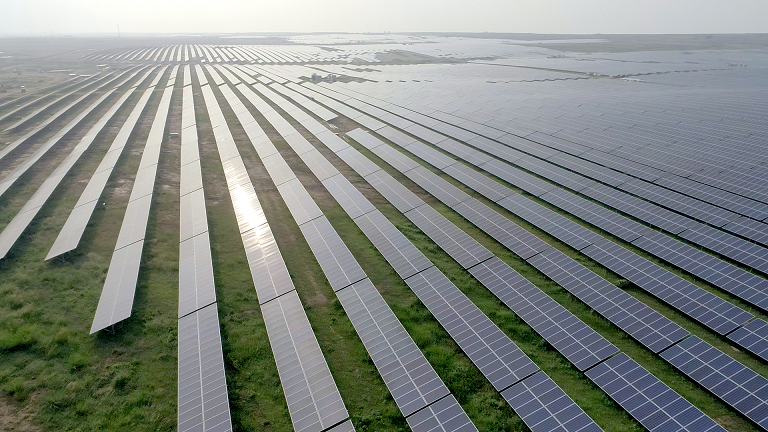
India’s utility-scale solar sector has a visible project pipeline of around 2.5 years, according to a report by Equirus Securities, the research division of Mumbai-headquartered Equirus Group.
Between fiscal year (FY) 2018 and FY26, developers secured letters of award (LoAs) for 174 GW of utility-scale solar projects. From this total, 118 GW have signed power purchase agreements (PPAs) and 60 GW have been commissioned, leaving 58 GW in the project pipeline.
Equirus’ report estimates that of the solar capacity awaiting PPAs, around 73%, or 42 GW, falls under standard solar and hybrid tenders, where signing probability remains low as distribution companies increasingly prioritize firm power supply during both solar and non-solar hours. The remaining 15 GW comprises round-the-clock (RTC), firm and dispatchable renewable energy (FDRE), and solar-plus-battery energy storage system (BESS) projects, where PPA signing probability is significantly higher.
The report notes that new tenders are shifting decisively toward firm power formats, with focus on BESS and FDRE/RTC structures, adding that integrated independent power producers (IPPs) with storage and firm supply capabilities are the structural winners.
Equirus estimates that data centres, green hydrogen and night-time connectivity could add 15-20 GW of incremental solar demand annually from FY29. It says this demand is not reflected in CEA forecasts or analyst models, meaning annual solar installations could rise from around 50 GW in FY27 to nearly 85 GW by FY30.
The report also notes that more than 300 data centre projects are planned across India, with major investments announced by AWS, Microsoft and Google. It says each 100 MW data centre would require around 250 MW of solar, 150 MW of wind and nearly 450 MWh of battery energy storage to operate entirely on renewable power.
Elsewhere, the report highlights India’s 5 million tonne annual production target by 2030 for green hydrogen under the National Green Hydrogen Mission. Equirus estimates that each one million tonne of hydrogen production would require about 20 GW of dedicated solar capacity.
The report also projects India’s BESS demand to increase from 34.7 GWh during 2022-27 to 236.2 GWh during 2027-32, driven by renewable energy integration, grid stability requirements and policy support through storage mandates.
This content is protected by copyright and may not be reused. If you want to cooperate with us and would like to reuse some of our content, please contact: [email protected].

Please login to comment