Dutch researchers present power management system for PV, batteries, heat pumps, EVs

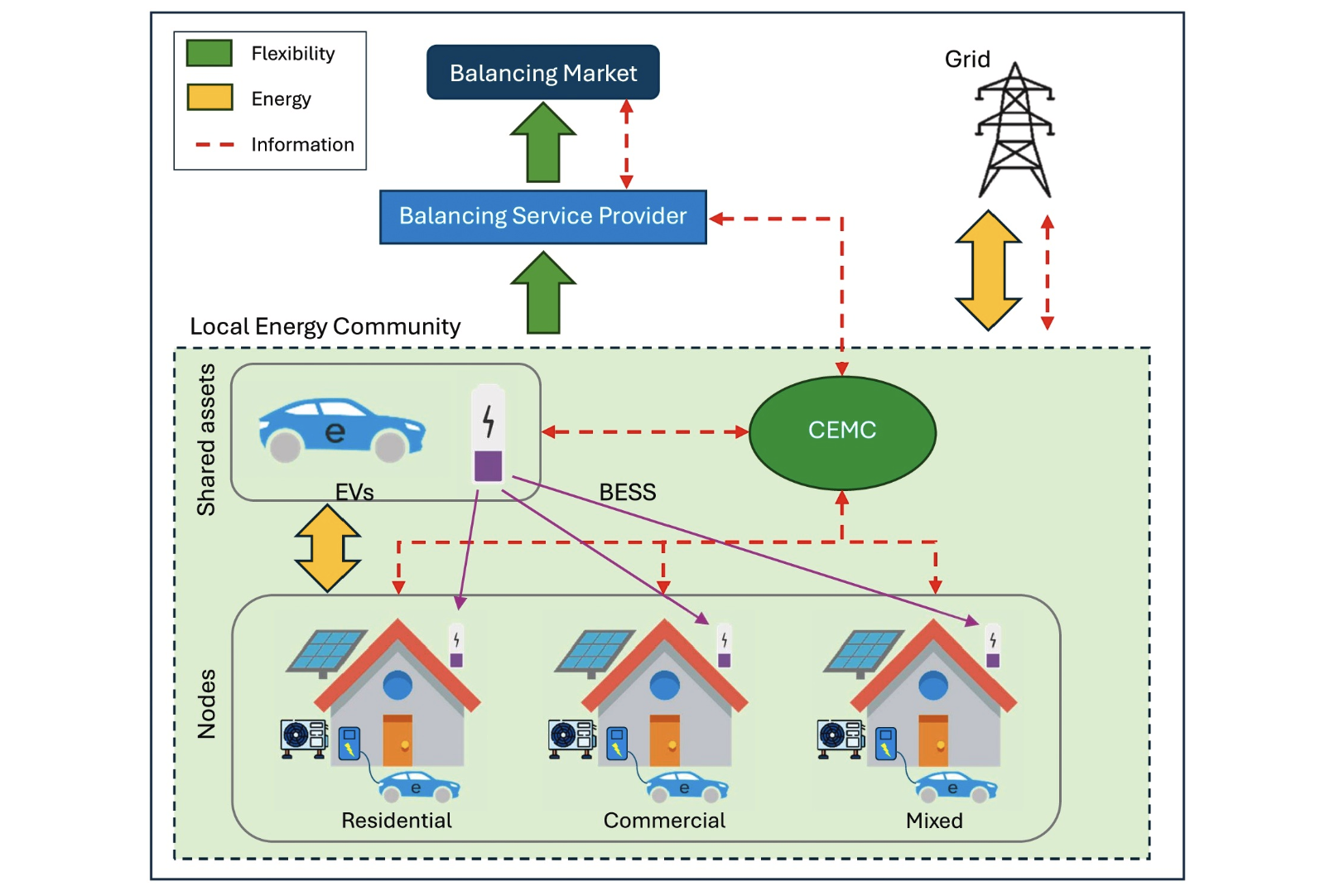
Researchers at Delft University of Technology (TU Delft) in the Netherlands have developed a novel power management system that jointly optimizes photovoltaic systems, battery energy storage systens (BESS), electric vehicles (EVs), and heat pumps. The model also participates in energy arbitrage markets, provides automatic frequency restoration reserve (aFRR) services, manages congestion through direct load control (DLC), and allocates battery capacity across a distribution grid.
The model is presented in the research paper Battery storage integration in power systems of PVs, and flexible loads for frequency reserves provision and direct load control, published in Sustainable Energy, Grids and Networks.
Corresponding author, Nikolaos Damianakis, told pv magazine the novelty of the paper is twofold.
“Methodologically, it provides a mixed-integer quadratic programming (MIQP) optimization problem that not only co-optimizes cost savings, charging and thermal comfort, and PV curtailment, but also participation in the reserve market and BESS capacity allocation within an aggregation of load locations,” Damianakis explained.
“Moreover, regarding its analysis, it investigates separately the provision of two ancillary services, one local (DLC) and one system-wide (aFRR provision) together with energy arbitrage. In continuation, it investigates how the findings of the analysis are affected by several influencing factors: low-carbon technology (LCT) synergies, load types, power losses, price profiles, seasons, etc.”
The proposed deterministic power management system is designed to optimally coordinate distributed energy resources within a community energy management controller (CEMC) and operates through a two-level optimization framework.
The first level uses day-ahead scheduling that leverages forecasts of electricity prices, PV generation, weather, occupancy and EV availability to determine optimal energy trading, battery dispatch, EV charging schedules, heat pump operation, and ancillary service bids. The second level employs a real-time rolling-horizon optimization stage that continuously updates in response to changing conditions. The optimization is formulated as an MIQP.
The power management system was evaluated through two separate case studies targeting different grid services – DLC and aFRR. In the first case, DLC was used to manage distribution grid congestion, with the distribution system operator (DSO) issuing real-time requests to increase or decrease electricity demand. The PMS responded by optimally coordinating battery dispatch, EV charging and heat pump operation while satisfying user comfort and system constraints. Simulations were performed for rural and urban distribution grids under both summer and winter conditions.
In the aFRR case, the power management system co-optimized energy arbitrage with participation in the frequency reserve market while determining the optimal placement of battery storage across residential, commercial, and mixed-load nodes. Four operating scenarios were investigated, progressively enabling battery-based aFRR, EV reserve participation and vehicle-to-grid (V2G) operation to assess their effects on system flexibility, battery profitability, and optimal storage deployment.
“Our results show that stationary BESS use is still not favorable only for energy arbitrage,” Damianakis said. “A power management system needs to use it in combination with ancillary services provision to have substantial benefits against the CAPEX and OPEX costs of the BESS. This didn’t suffice in the past, but with the current energy and reserve price volatility, the increase in earnings is considerably higher.”
Another interesting result, Damianakis added, was that while previous studies typically allocate BESS across multiple locations in the distribution grid, the new optimization framework found that installing a single large BESS near the main grid connection yields greater overall benefits. The research attributes this to the system-wide nature of frequency regulation, which favors centralized storage while reducing both power losses and capital costs.
This content is protected by copyright and may not be reused. If you want to cooperate with us and would like to reuse some of our content, please contact: [email protected].

Please login to comment