China wafer prices hold steady as market weighs early signs of upstream stabilization
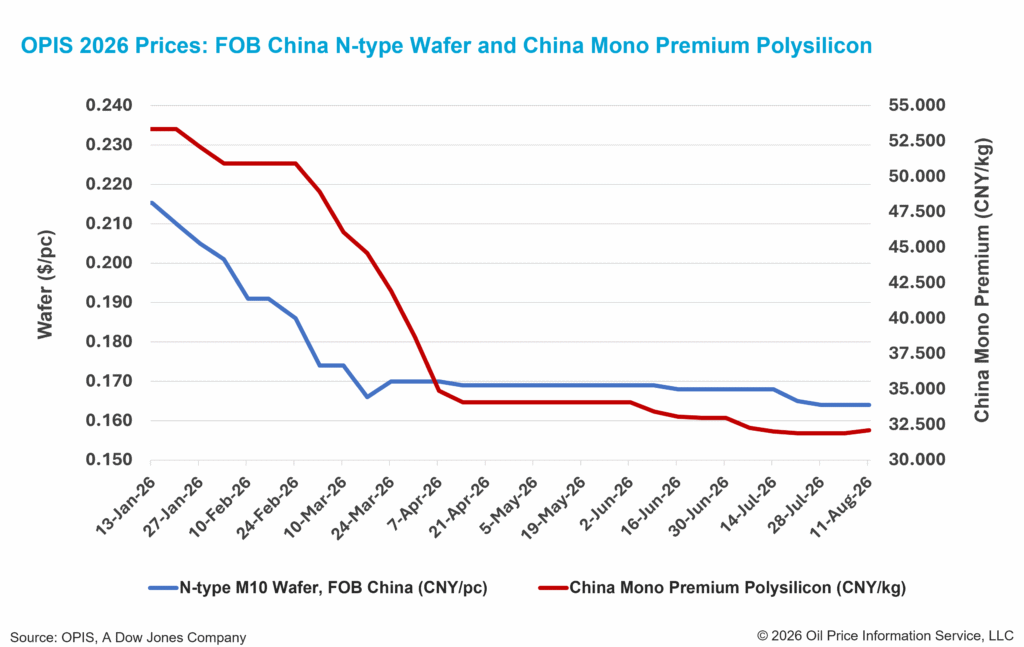
According to the OPIS Global Solar Markets Report released on Aug. 11, Free-On-Board (FOB) China M10 and 210R wafer prices were unchanged week on week at $0.121/pc and $0.134/pc, respectively.
Wafer prices held steady this week as market participants closely monitored early signs of stabilization in the polysilicon market following an Aug. 7 joint initiative by major Chinese producers.
Months of policy efforts targeting low-price competition and overcapacity culminated in the initiative, under which eight major Chinese polysilicon producers—accounting for over 90% of national capacity—pledged strict adherence to full-cost sales requirements and energy-consumption standards, according to the Silicon Branch of the China Nonferrous Metals Industry Association.
Under the initiative, manufacturers pledged to calculate cash, production and full costs in line with the China Photovoltaic Industry Association’s push for a standardized production-cost benchmark across the sector. Signatories also committed to voluntarily phasing out inefficient, energy-intensive capacity under newly enacted national energy-consumption limits.
Polysilicon prices recorded their first increase of 2026, reflecting improved sentiment around new orders amid the recent series of policy efforts. China Mono Premium polysilicon—OPIS’ assessment for mono-grade polysilicon used in N-type ingot production—increased 0.67% week on week to CNY32.100 ($4.76)/kg, according to the OPIS report.
For wafer producers, however, the cost-accounting framework emphasized in the initiative has limited direct relevance, according to an industry source. Because OEM manufacturing is prevalent in wafer production, the industry already relies on mature, standardized formulas for OEM terms, processing fees, and production costs. The critical task for wafer producers is determining how to position themselves amid tentative upstream market recoveries and persistent downstream demand weakness, one source noted.
A trade participant said wafer manufacturers are operating at lower utilization rates and facing deeper losses than polysilicon producers, with production increasingly concentrated among integrated companies and a smaller group of specialized manufacturers running at reduced capacity.
The participant cautioned that a premature rebound in wafer prices following polysilicon’s recovery could slow the industry’s ongoing capacity rationalization. Without additional local-government protection or subsidies, the source said, the approaching maturation of medium- to long-term bank loans would naturally force uncompetitive capacity out of the market.
Beyond wafer manufacturing, China-based PV equipment suppliers are encountering headwinds in international markets.
Unconfirmed industry reports indicate that a major U.S. PV manufacturing expansion project, which had reportedly been sourcing ingot and cell manufacturing equipment from Chinese vendors, has begun a broader compliance audit across its current and prospective global suppliers.
A source familiar with the matter revealed that previous equipment orders placed with Chinese vendors encountered some export shipment hurdles, while remaining unexecuted orders faced regulatory approval bottlenecks.
However, the source noted that the recent U.S. Section 232 determination—which established a minimum import price of $100/kg for ingots and wafers alongside a 15% ad valorem duty on polysilicon derivatives—is expected to accelerate the development of U.S. ingot-pulling and wafer production, historically the primary bottleneck in the domestic supply chain. The source added that the $100/kg floor price equates to approximately $0.10/W, bringing import price thresholds in line with domestic U.S. production costs.
OPIS, a Dow Jones company, provides energy prices, news, data, and analysis on gasoline, diesel, jet fuel, LPG/NGL, coal, metals, and chemicals, as well as renewable fuels and environmental commodities. It acquired pricing data assets from Singapore Solar Exchange in 2022 and now publishes the OPIS APAC Solar Weekly Report.
The views and opinions expressed in this article are the author’s own, and do not necessarily reflect those held by pv magazine.
This content is protected by copyright and may not be reused. If you want to cooperate with us and would like to reuse some of our content, please contact: [email protected].
Please login to comment