Plug & play electrolyzer for green hydrogen production from Germany

From pv magazine Germany
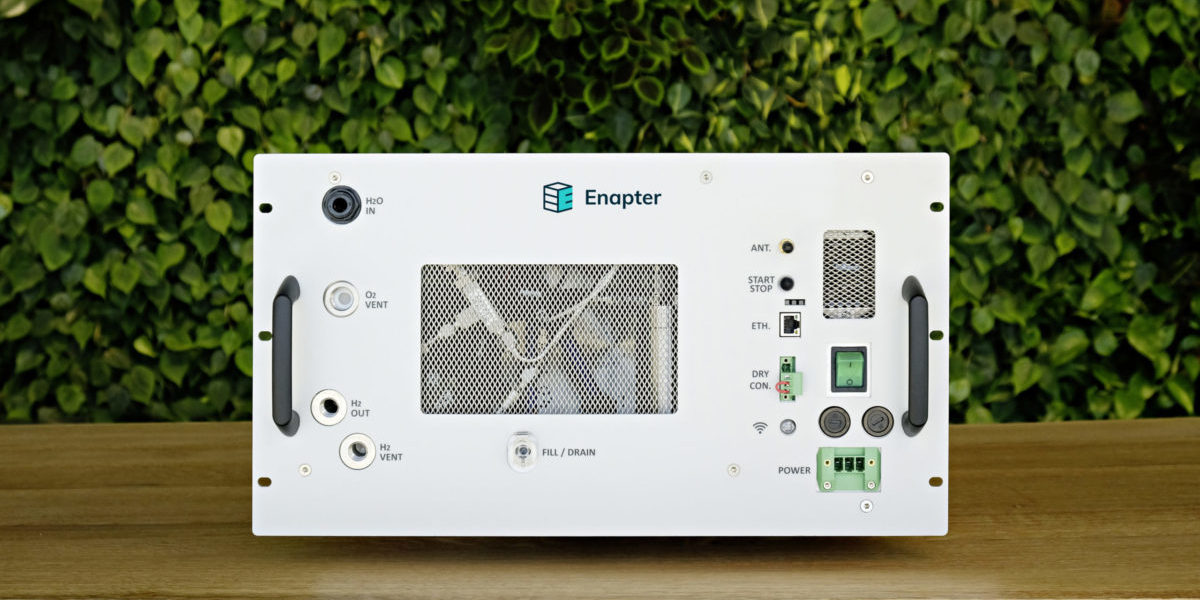
Germany-based electrolyzer manufacturer Enapter has unveiled a new electrolyzer that is said to be suitable for projects of all sizes via “plug-and-play” operation.
The EL 4.0 electrolyzer is the fourth generation of the patented anion exchange membrane (AEM) electrolyzer that the company has been developing since 2017. According to the manufacturer, its technology relies on cheaper materials than the competing proton exchange membrane (PEM) electrolyzers. Enapter’s new product is lighter and smaller than previous models and is ISO 22734 certified. The standardized modules could be plugged together for projects of any size.
The AEM electrolyzer is available in four versions – AC, DC, air-cooled, or water-cooled. It is claimed to enable the production of 1.0785kg of high-purity hydrogen per day. The maximum power consumption is 3.0kW with water consumption of 0.4 liters per hour. The device measures 482x635x266mm and has a weight of 38kg.
In response to an inquiry from pv magazine about the cost of the electrolyzer, Enapter said that the new electrolyzer is not yet in mass production but can already offer a price reduction of up to 35% compared to the price of its previous module.” With the ramp-up of mass production in Germany, the costs for the production of green hydrogen would then fall below those for hydrogen from fossil fuels,” the spokesperson from the company stated.
The plug-and-play products could be used in a wide variety of applications, thus promoting decarbonization in the energy, transport, industry and building sectors. In addition, it is quick to install. “The EL 4.0 will be a building block for system integrators, enabling them to quickly introduce hydrogen production and realize the market ramp-up needed globally. We are sure that the future mass production of these AEM electrolyzers will fundamentally change the production of green hydrogen,” said Sebastian-Justus Schmidt, co-founder and CEO of Enapter.
*The article was amended to reflect that the maximum power consumption of the electrolyzer is 3kW and not 3W, as we previously reported.
This content is protected by copyright and may not be reused. If you want to cooperate with us and would like to reuse some of our content, please contact: [email protected].

Please login to comment

So, what can I do with 1 kg. of H? How is it stored? Does this unit include a compressor and storage tanks? What are the efficiencies of current H fuel cells?

Something doesn’t add up with this report.
1kg hydrogen contains about 33 kWh of usable energy.
If this device is only using 3W of power, then over 24 hours it’s using 3×24 = 72 Wh.
in other words, it would be creating 458 times more energy than it uses – which is impossible.
Perhaps the device is using 3kw of power? that would give a more realistic answer of 72kWh of electricity to produce 33.33 kwh worth of hydrogen – an efficiency of about 46% which does not compare very favourably compared to say, steam reforming which can be closer to 80% efficient.
Water consumption of 0.4 litres per hour = 9.6 litres (also 9.6 kg) of water in 24 hours. Hydrogen makes up about 2/18 of the weight of water by weight, so this is about 1.06kg of hydrogen, which is very close to the figure in the report, so the hydrogen yield / water consumption figures figure looks like they are correct.

You broke everything down…..I love this😅

3.0 Watts producing 1 kg a day would be a miracle!
3.0kW would make more sense, but given 72kWh produces only 1 kg a day, it’s only about 54% efficient.

Hello,
I read the first report which stated 3W/hr, but recall since then reading another, almost identical report, citing 3.0kw/day? If that is correct then the energy consumption is only 125w/hr.
What do the manufacturers say? And therefore, what do the buyers of the first 400 sold believe they are getting?
Many thanks

True, although 54% is a lot better than the 20% is was reading simewhere else. If the electricity is coming from solar ir wind it might be a nice way to store energie for the winter instead if batteries
I produce about 20kWh of energy per day from my solar. Most of this is given to government at 5cents / kWh which I am not interested in. May be this will help. I wonder how to store hydrogen?