Pseudo-planar heterojunction organic solar cell achieves world record efficiency of 20.21%

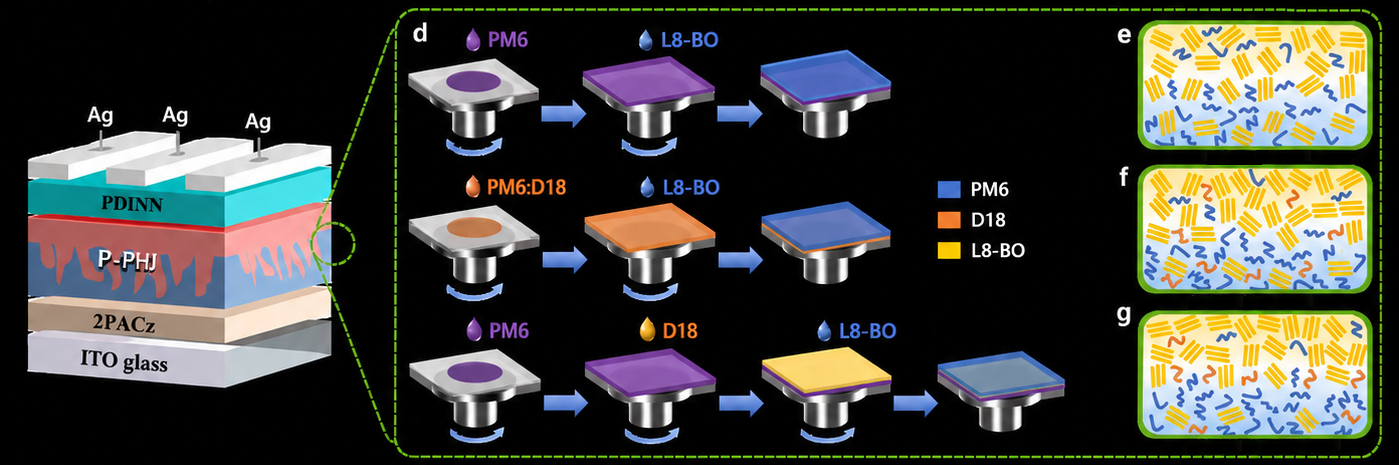
A research team from China has proposed a novel interfacial buffering strategy for pseudo-planar heterojunction (PPHJ) organic solar cells (OSCs), aiming to improve device stability and fabrication reliability. PPHJ architectures, which combine features of both planar and bulk heterojunction designs, are widely used in high-performance OSCs because they enable efficient charge separation while maintaining relatively well-defined donor–acceptor interfaces.
PPHJ cells are typically fabricated via layer-by-layer (LBL) deposition, in which donor and acceptor materials are sequentially deposited. This creates a favorable vertical phase separation that promotes charge transport and exciton dissociation. However, during acceptor deposition, the solvent can swell or partially dissolve the underlying donor layer, causing excessive intermixing, degraded morphology, increased recombination, and reduced device performance. The proposed interfacial buffering strategy introduces a protective layer that minimizes direct solvent–donor interaction, preserving film integrity and enabling more controlled and reproducible interface formation.
“Here, a simple approach for incorporating a highly crystalline polymer as a buffer layer between the donor and acceptor layers is proposed,” the researchers said.
The group incorporated a highly crystalline polymer called D18 as a buffer layer between the donor and acceptor layers in three different cell designs: PM6/L8-BO, PM6:D18/L8-BO, and PM6/D18/L8-BO.
To create the PM6/D18/L8-BO architecture, they first spin-coated a PM6 donor layer onto a 2PACz-coated indium tin oxide (ITO) substrate. Next, a thin D18 layer was deposited on top of the PM6, forming a crystalline solvent-resistant barrier. The L8-BO acceptor layer was then spin-coated onto the D18 layer, followed by post-treatment and thermal annealing. Finally, a electron-transport layer made of a n-type interfacial layer material knonw as PDINN and a silver electrode were deposited, resulting in a device structure of ITO/2PACz/PM6/D18/L8-BO/PDINN/Ag.
The PM6/L8-BO and PM6:D18/L8-BO devices were fabricated as reference cells. The PM6/L8-BO structure represented a conventional LBL device without protection against solvent erosion, whereas PM6:D18/L8-BO was used to assess the effect of directly blending D18 into the donor layer. These active layers were incorporated into the same device architecture, resulting in ITO/2PACz/PM6/L8-BO/PDINN/Ag and ITO/2PACz/PM6:D18/L8-BO/PDINN/Ag devices, respectively.
The PM6/D18/L8-BO-based device was found to achieve a superior power conversion efficiency of 19.80%, surpassing both the conventional PM6/L8-BO device (18.53%) and the PM6:D18/L8-BO architecture (19.21%), where D18 was directly blended into the donor phase. According to the team, the optimized morphology enhances exciton generation and separation while simultaneously reducing interfacial trap states and suppressing non-radiative energy losses. It also facilitates faster hole transfer kinetics and extends carrier lifetimes, indicating improved charge transport and reduced recombination.
Building on these results, the researchers further incorporated a non-fullerene small-molecule acceptor (NFA) known as BTP-eC9 into the PM6/D18/L8-BO active layer by pre-blending it with the L8-BO acceptor prior to deposition. This additional modification led to a further increase in device performance, reaching an efficiency of 20.21%, which the authors highlight as one of the highest reported efficiencies for pseudo-planar heterojunction (PPHJ) organic solar cells.
“Overall, this work highlights a simple yet effective approach to simultaneously regulate the active layer morphology and enhance the device performance, offering practical insights for the scalable fabrication of high-performance PPHJ OSCs with precisely controlled vertical phase separation (VPS) morphology,” the academics concluded.
The cell design was described in “Erosion-immune Layer-by-layer Deposition Enabled by Interfacial Buffering toward 20.21%-Efficient Pseudo-Planar Heterojunction Organic Solar Cells,” published in the Chinese Journal of Polymer Science. Researchers from China’s Jiangxi Normal University, Zhejiang University, Chinese University of Hong Kong, Changzhou University, and Gannan Normal University have contributed to the research.
This content is protected by copyright and may not be reused. If you want to cooperate with us and would like to reuse some of our content, please contact: [email protected].

Please login to comment