France faces grid bottlenecks, with 10% of territory already saturated


The connection of renewable energy projects to France’s electricity grid has accelerated sharply in recent years, with 6.6 GW of new capacity connected to the distribution network of Enedis in 2025, up from 5.5 GW in 2024 and 4.2 GW in 2023. The growth has been driven largely by solar installations.
“We are seeing development primarily in photovoltaics, mostly in rural areas,” said Cédric Boissier, Enedis’ director of grid connections, during a joint press briefing with French transmission system operator RTE.
Rural areas, where electricity consumption is often lower than in urban centers, have accounted for “roughly two-thirds of renewable energy development” in recent years. This geographic imbalance is creating new challenges for grid management, particularly when it comes to transporting and distributing locally generated electricity, Boissier said.
Enedis has published a map identifying “constrained zones” where grid capacity is becoming limited. These areas, highlighted in red, include parts of the Centre-Val de Loire region, as well as several departments in southwestern and northeastern France.
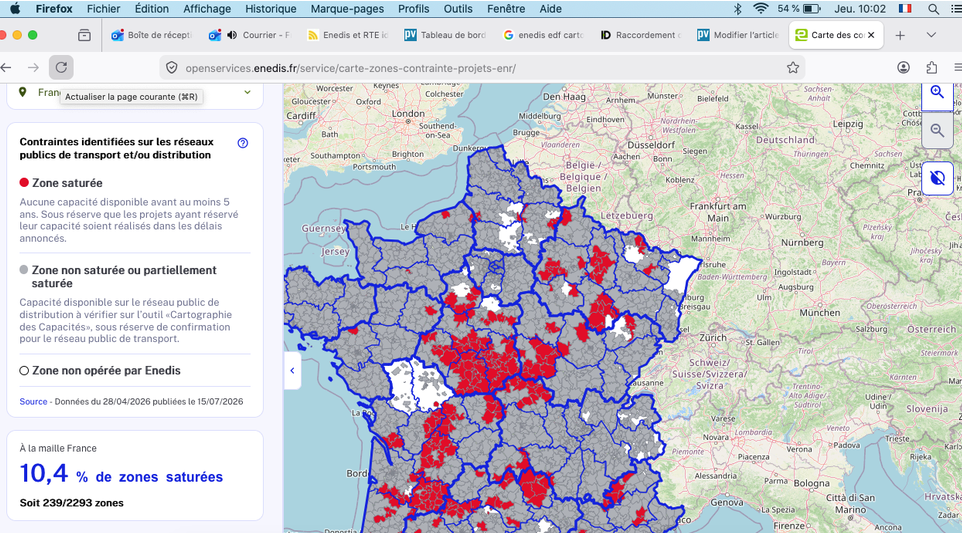
In the Lot-et-Garonne department, for example, the amount of renewable energy capacity connected to the grid has more than tripled over the past six years.
In these constrained areas, connection delays can exceed five years due to saturation at primary substations. These facilities connect the high-voltage transmission network operated by grid operator RTE with Enedis’ distribution grid by stepping down electricity from extra-high voltage to high voltage.
Enedis currently operates around 2,300 primary substations across France and plans to build approximately 100 additional facilities by 2030. Around two-thirds of these new substations will be dedicated to accommodating renewable energy projects.
Despite growing pressure in certain regions, Enedis said France still benefits from a comparatively well-developed electricity network. The distribution system operator estimates that 90% of French territory still has available capacity for renewable energy connections, unlike neighboring countries such as Spain and the Netherlands, where grid congestion has become more widespread.
This content is protected by copyright and may not be reused. If you want to cooperate with us and would like to reuse some of our content, please contact: [email protected].

Please login to comment