Argentina’s electricity demand fell by 1,700 MW during World Cup semifinal against England


The World Cup semifinal between Argentina and England, in which Lionel Messi’s team secured a 2–1 victory, caused electricity demand fluctuations of up to 1,700 MW during the first half, according to an analysis published by the Wholesale Electricity Market Management Company (CAMMESA).
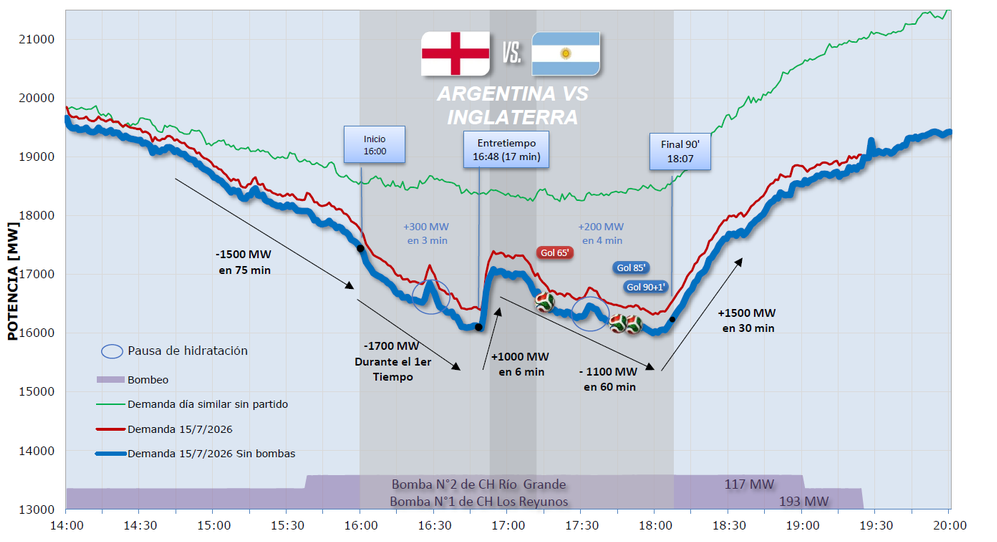
The grid operator’s graph compares actual demand on July 15 with consumption recorded on a similar day without a match. Before kickoff, scheduled for 4:00 p.m., electricity demand had already fallen by around 1,500 MW over a 75-minute period.
Once the match began, the decline became more pronounced. Demand, excluding electricity consumed by pumped-storage facilities, dropped from nearly 17,500 MW to slightly above 16,000 MW by halftime. CAMMESA calculated the cumulative reduction during that period at 1,700 MW.
Compared with a typical day, the difference was even larger. While the reference curve remained close to 18,300 MW, demand excluding pumping stayed around 16,000 MW, creating a gap of approximately 2,300 MW. This represented nearly 13% of projected demand for that time.
Halftime produced the sharpest change of the day. Between 4:48 p.m. and 4:54 p.m., demand increased by almost 1,000 MW. The pattern is typically linked to the simultaneous use of household appliances, lighting, and other residential loads during the broadcast break.
Demand fell again during the second half. CAMMESA recorded a decrease of around 1,100 MW over 60 minutes, although the curve showed several short-lived spikes. Hydration breaks triggered increases of 300 MW over three minutes and 200 MW over four minutes.
Goals were also reflected in demand patterns. The graph identifies goals scored in the 65th minute by Gordon for England, in the 85th minute by Enzo Fernández for Argentina, and in stoppage time by Lautaro Martínez for Argentina, each accompanied by minor consumption fluctuations. However, the overall downward trend continued until the match ended at 6:07 p.m.
After the final whistle, demand recovered rapidly, rising by 1,500 MW within half an hour and continuing to increase throughout the afternoon. It eventually exceeded 19,000 MW at around 7:30 p.m.
During the match, one generating unit at the Río Grande hydroelectric plant and another at Los Reyunos operated in pumping mode. In this configuration, the facilities consume electricity to move water to an upper reservoir, storing energy for later generation.
Total demand, represented by the red line, remained above demand excluding pumping, shown in blue, due to the electricity consumption of these units. The difference between the two curves illustrates how pumped-storage operations helped absorb part of the generation surplus caused by the decline in consumption.
The graph shows reductions in pumping demand of 117 MW and 193 MW after the match, as the recovery in electricity consumption reduced the need for this balancing resource. Pumped storage helped partially smooth the fluctuations that the rest of the generation fleet had to manage.
For the 2026 World Cup, CAMMESA has introduced dedicated demand monitoring during matches involving Argentina’s national team. The agency notes that these events generate rapid consumption changes at kickoff, halftime, and the end of games, requiring additional planning for generation scheduling and system regulation.
The semifinal load curve shows that the main operational challenge was not the total amount of electricity consumed, but the speed of demand variations. The power system had to respond to a 1,000 MW increase within six minutes during halftime and a subsequent 1,500 MW recovery within half an hour.
This content is protected by copyright and may not be reused. If you want to cooperate with us and would like to reuse some of our content, please contact: [email protected].

Please login to comment