Spain launches national map of agrivoltaic projects

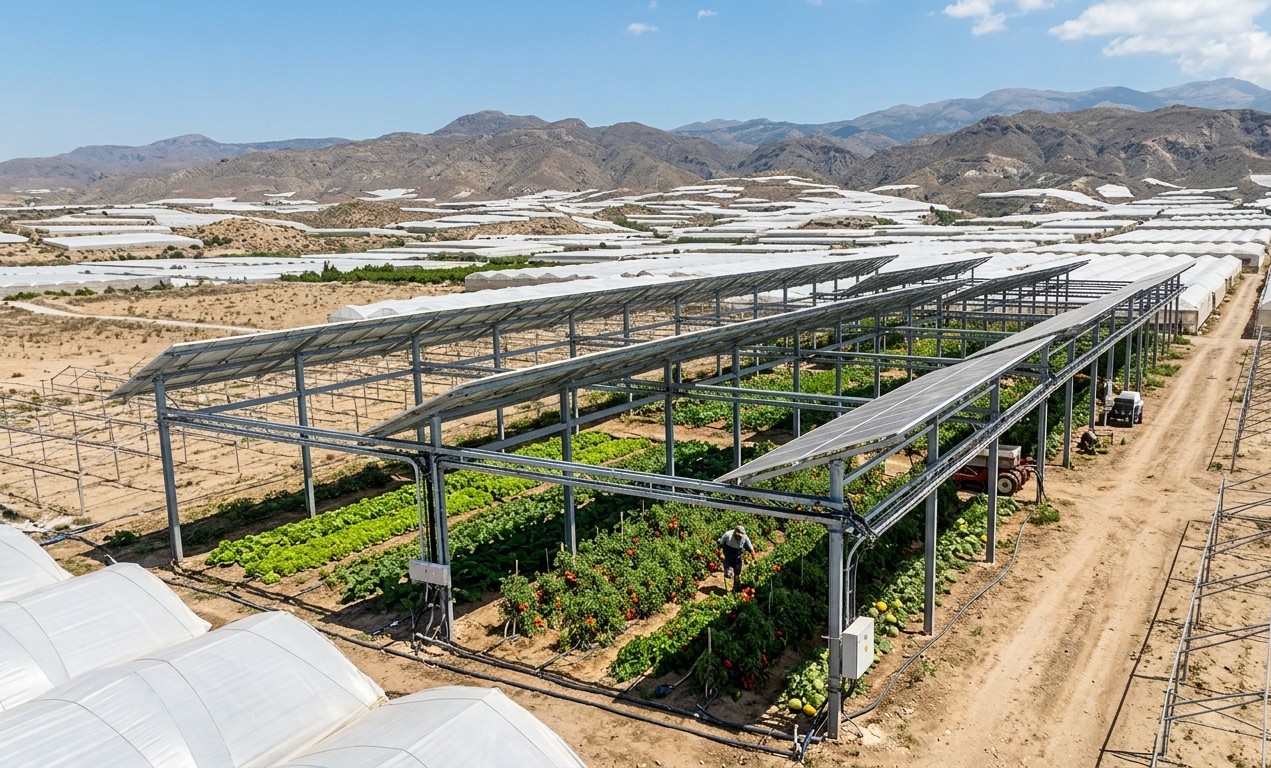
The development of a map of agrivoltaic installations across Spain will be one of the central pillars of the AURA Platform, an initiative funded through a multi-regional Operational Group with support from the Spanish Ministry of Agriculture, Fisheries and Food (MAPA). The purpose of this mapping and information tool is to facilitate the effective deployment of agrivoltaic systems in rural areas.
In addition to the national map, the project will take the form of a collaborative digital platform featuring a knowledge repository as well as in-person training and demonstration activities. Its goal is to connect all stakeholders across the agrivoltaics value chain, including farmers, livestock producers, installers, energy companies, and industry associations.
The project is being developed and implemented by a multidisciplinary consortium comprising CTAEX, Fundación Ayesa, the Spanish Photovoltaic Association (UNEF), ASAJA, BayWa r.e., and Fundación Cooprado.
According to the initiative’s promoters, the platform is the first of its kind in Europe. It brings together agrivoltaic projects that are either operational or under development through a geolocation system that provides information on each project’s location, installed capacity, land area, associated crops, technologies used, and developer type. The map aims to provide standardized information for public authorities, farmers, developers, researchers, and investors while improving transparency and supporting territorial planning for the deployment of agrivoltaic systems.
The database will be continuously updated through voluntary contributions from developers and project owners. Submitted information will undergo validation before being incorporated into the platform.
Since 2025, agrivoltaic projects in Spain have been eligible for Common Agricultural Policy (CAP) funding. However, the country still lacks a national legal definition of agrivoltaics, unlike several other European markets.
Catalonia became the first Spanish region to establish an official definition of agrivoltaics. In 2024, the Department of Climate Action, Food and Rural Agenda (DACC) of the Government of Catalonia published a technical directive regulating agrivoltaic installations on agricultural land.
Before this measure, Spain had no standardized administrative definition of agrivoltaics, in contrast with countries such as Germany, France, and Italy.
The Catalan directive defines agrivoltaics as a combined farming system that integrates agricultural production and electricity generation on the same plot of land. Both activities must be maintained throughout the project’s lifetime.
Among the directive’s key requirements is the obligation to ensure that agricultural output after installation remains at least 60% of the original crop yield. It also prohibits permanent alterations to the natural soil structure through concreting, except for limited and localized infrastructure such as transformer stations.
The regulations further restrict permanent land occupation by structures, access roads, buildings, and auxiliary infrastructure. Depending on the type of system deployed — elevated or low-profile structures — the area rendered unavailable for agricultural use must not exceed 15% or 20% of the total project area, respectively.
In November 2024, SolarPower Europe published technical guidelines aimed at establishing a common definition of agrivoltaics and providing recommendations for project design, operation, and evaluation.
The guidelines state that agricultural production should remain the primary land use and propose objective indicators to assess whether farming activity retains its economic and productive viability throughout the lifetime of an installation.
The European solar association also emphasizes the importance of adapting structures to specific crops, maintaining agricultural machinery access, minimizing permanent soil occupation, and continuously monitoring agronomic performance.
In 2025, SolarPower Europe launched the AgriSolar Policy Map, a tool tracking agrivoltaic regulations and public policies across European countries.
The platform allows users to compare national approaches, including incentives, technical requirements, permitting procedures, and financial support mechanisms. It is intended to support the exchange of best practices and encourage greater regulatory alignment for agrivoltaics across the European Union.
This content is protected by copyright and may not be reused. If you want to cooperate with us and would like to reuse some of our content, please contact: [email protected].

Please login to comment