




The price of Brent oil futures for July in the ICE market showed a sharp drop in the middle of last week, settling on Friday at $68.69/bbl, which represented a difference of $3.52/bbl with respect to seven days earlier. In that market, U.S. sanctions on Iran and Venezuela continued to have an impact, along with the OPEC production cuts, which put pressure on supply-side prices. However, concerns related to demand and economic growth as a result of commercial tensions between the United States and China and an increase in U.S. crude reserves had a greater impact last week on the tension experienced by the market, causing the price to fall.
The TTF gas futures in the ICE market for next month settled on Friday at €12.25/MWh, 4.7% lower than on the previous Friday. That market continued the downward trend seen since April 9.
The price of API 2 coal futures for June in the ICE market settled on Friday below $57/t as the market continued trading with historical lows, having declined more than $4/t in just two weeks.
The price of CO2 emission rights futures in the EEX market for the reference contract of December 2019 settled on Friday at €25.47/t, 1.8% higher than seven days earlier. Despite volatility over the past week, prices remained within the €24.70-27.54/t range. The odds of a no-deal Brexit rose after the resignation of British prime minister Theresa May and it is expected the market will remain unstable with a likelihood the price will fall.
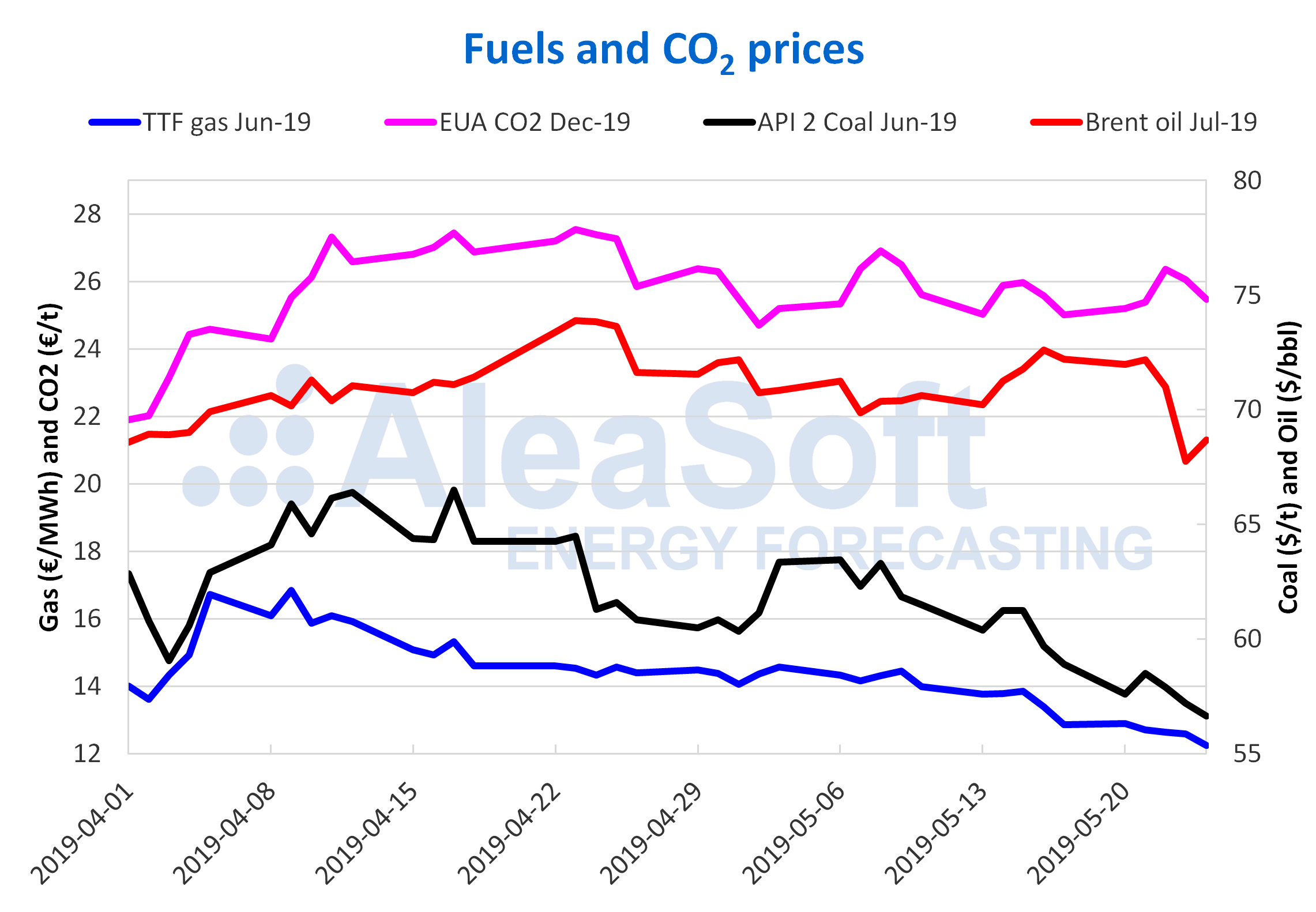
Sources: Prepared by AleaSoft using data from ICE and EEX.
European electricity markets
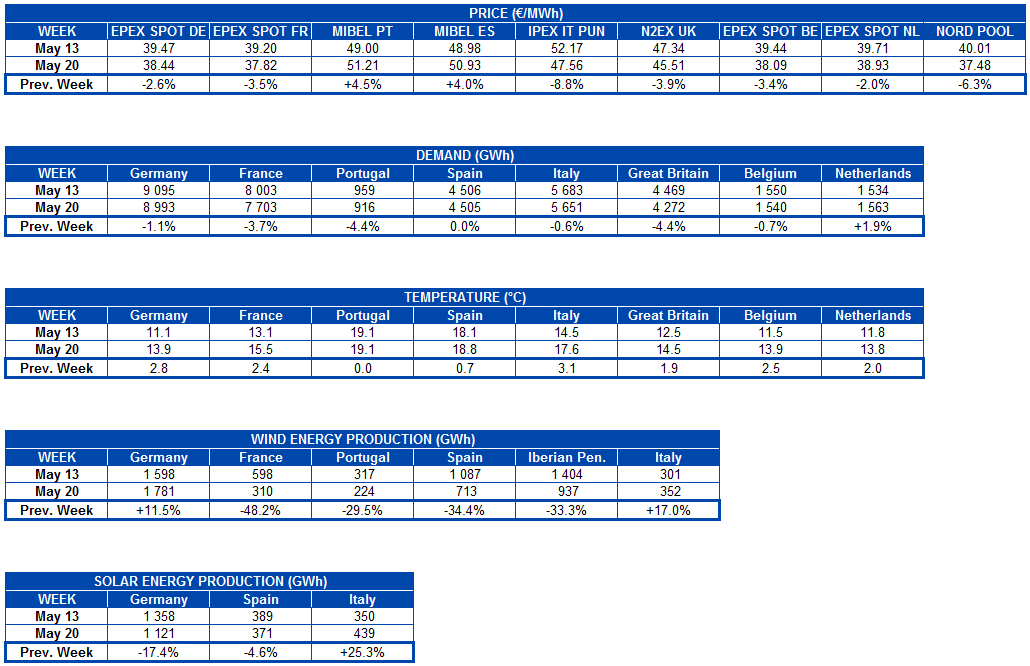
Last week, the price of most European electricity markets fell against the values registered in the previous week, from a 2% decline on the Netherlands’ EPEX SPOT market to 8.8% on the Italian IPEX. Temperatures were higher than in the previous week, prompting electricity demand to fall at European level. The market prices on Sunday had negative values between 2pm and 4pm in the EPEX SPOT markets of Germany, France and Belgium, making the average daily price of those markets around €21/MWh. High renewable energy production in Germany – wind and solar – together with the fact demand falls on Sundays, were the fundamental causes for the price falls.
The only European market in which prices increased last week was the MIBEL of Spain and Portugal, which rose more than 4% for an average weekly price of around €51/MWh. Although electricity demand was lower, as in the rest of Europe, a fall in renewable energy production in the Iberian peninsula compared to the previous week – of 4.6% in solar power and 33% in wind – as well as the reduction in nuclear power due to the scheduled shutdown for refuelling of the Ascó II and Trillo power plants, were the main causes.
Last week, the European markets continued to fall into two price groups. In the group with the highest prices were the MIBEL, which led the European electricity price ranking for most of last week, the IPEX and the N2EX market of the U.K.
In the markets with lower prices of around €40/MWh or less for most of the week, were the Nord Pool market of the Nordic countries and the EPEX SPOT markets.
Electricity futures
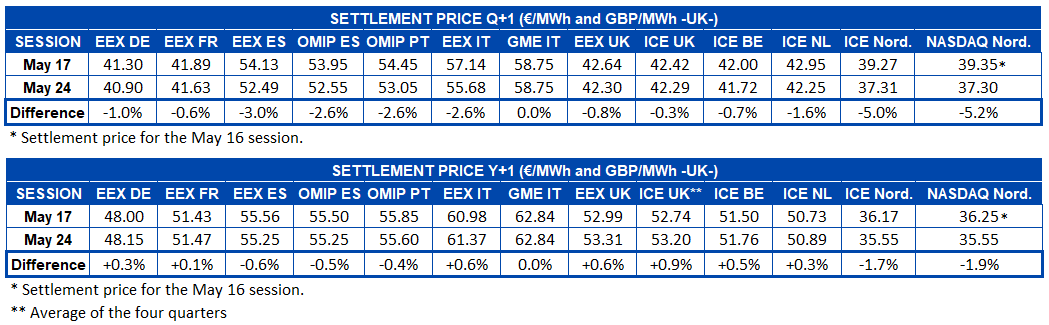
The European electricity futures prices for the third quarter returned to settle on Friday with a generalized drop compared to the previous Friday, except for the MTE market operated by GME, that remained unchanged. The Nordic ICE and NASDAQ markets stood out in the fall, for which the decrease was close to 5%. For the rest of the markets, the decrease was between 0.3% and 3%.
However, in the case of European electricity futures for next year, although in some markets the prices fell – as in Spain and Portugal that had a reduction of around 0.5% and the Nordic countries that dropped 1.8% – in the rest of the markets prices rose between 0.1% and 0.9%. The price of Italian futures on the MTE market for 2020 remains unchanged, as do the futures for the third quarter of this year.
Wind and solar energy production
Wind energy production fell last week for the second consecutive week in France, this time by 48%, and also in Spain, by 34%. In Portugal wind power also dropped, by 30%. In Germany and Italy wind energy production recovered 11% and 17%, respectively. Production was expected to rise in France, Spain and Italy this week but fall in Germany and Portugal.
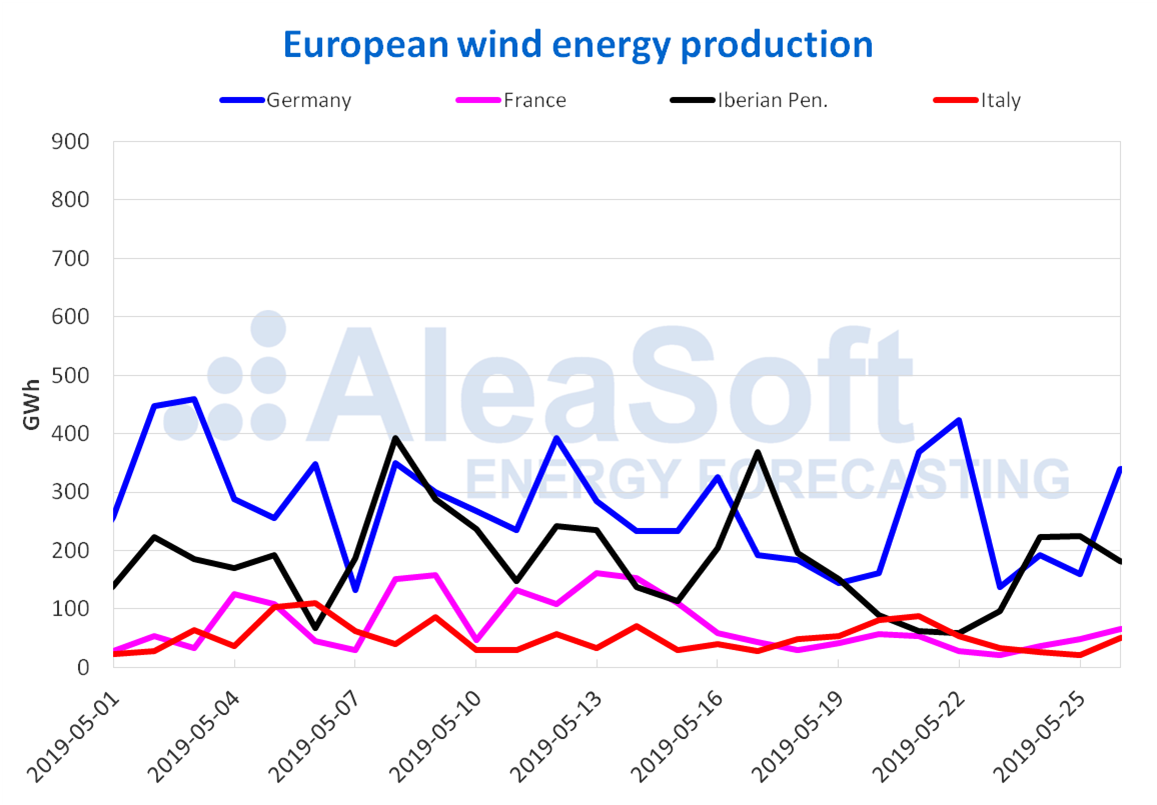
Sources: Prepared by AleaSoft using data from ENTSOE, RTE, REN, REE and TERNA.
Last week solar energy production – PV and solar thermal – suffered reductions of 17% and 5% in Germany and Spain, respectively, but increased in Italy, by 25%. This week AleaSoft expects solar power generation will have a slight increase in Germany and Spain and a small decrease in Italy.

Sources: Prepared by AleaSoft using data from ENTSOE, REE and TERNA.
