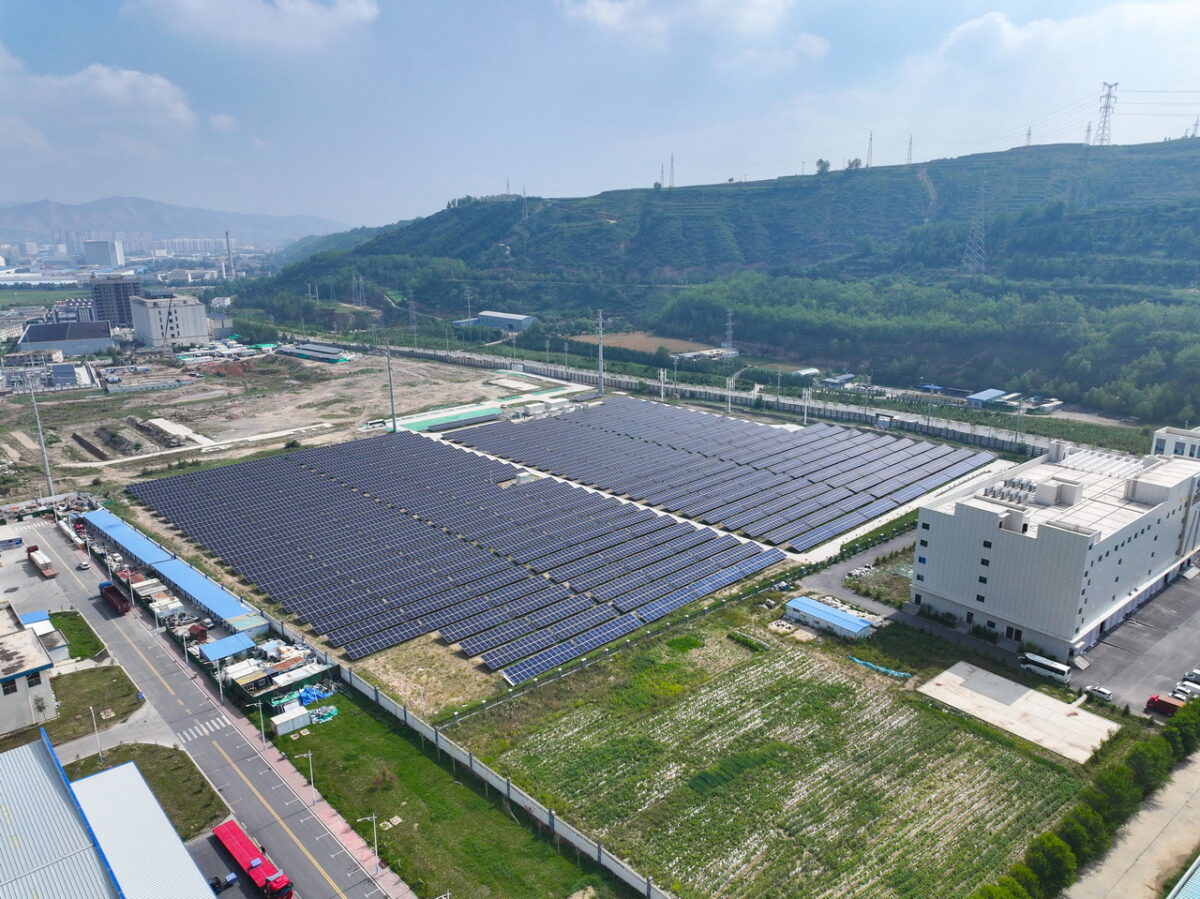





Pioneering Integrated Solutions in Harsh Environments
On August 13–14, Trinasolar, together with industry partners, visited the Hainan One-Gigawatt Source-Grid-Load-Storage Project, jointly developed with China National Nuclear Power (CNNP) Rich Energy and the Sanjiangyuan Green Power & Intelligent Computing Microgrid Demonstration Project, co-developed with China Unicom.
Leveraging its Vertex high-efficiency modules, intelligent energy storage systems, and integrated scenario-based solutions, and empowered by Trina’s proprietary smart scheduling platform, the company has successfully overcome extreme challenges including high altitude, freezing temperatures, strong solar radiation, and fragile ecosystems. These achievements have led to the pioneering implementation of two transformative models: “Wind-Solar-Storage for Desertification Control” and “Green Power for Computing Power.” Together, they provide replicable solutions for ecological restoration and digital infrastructure, showcasing the power of technology in driving a sustainable energy revolution.
Desertification Control with Clean Energy in Hainan
At an altitude of 3,150 meters in the gobi desert of Gonghe, Qinghai, Trinasolar has redefined the ecological energy landscape through its “wind-solar-storage collaborative sand control” solution. The world’s first national large-scale base project featuring multi-energy complementarity integrates:
- 800 MW of Vertex PV modules
- 200 MW of wind power
- 150 MW / 300 MWh of intelligent energy storage
Together, these elements form a high-efficiency, coordinated clean energy matrix that delivers 1.83 billion kWh of green electricity annually—a benchmark project of Trinasolar’s desertification-control solution.

The project’s eco-integrated design stands out as a core innovation. Trinasolar’s unique “elevated mounting + dual-spiral pile foundation” raises PV modules more than 1.5 meters above ground, ensuring stability under extreme cold and high winds while creating a natural barrier against sand erosion. This design also enables dual land use, reserving space for livestock grazing and pioneering a sustainable “pasture-PV complementary” model.
A hybrid system combining central and string inverters, alongside an intelligent O&M platform, ensures optimal performance with the project’s first-year utilization hours reaching 1,720 hours. Despite challenges such as sandstorms and hypoxia, Trinasolar’s project team completed grid connection in just eight months, setting a new benchmark in the Qinghai-Tibet Plateau.
Green Power Driving Computing in Sanjiangyuan
Transitioning from desert to plateau, in the core zone of the Sanjiangyuan National Ecological Protection Area, Trinasolar has built the world’s highest-altitude zero-carbon computing lighthouse project, applying its “Source-Grid-Load-Storage-Computing” five-dimensional solution.
By integrating PV, wind, storage, and data computing, and enabled by Trina’s smart scheduling system with a “dual charge–dual discharge” strategy (storing solar by day, supporting computing by night), the project secures 100% green power supply, exceeding 10 million kWh annually.

The system employs N-type dual-glass bifacial modules, renowned for durability, negligible PID degradation, and bifacial power gain, perfectly adapted to intense radiation, UV exposure, and sandstorms on the plateau. An innovative mounting system enables multifunctional land use for generation, parking, and charging, significantly reducing land requirements. The storage system guarantees safe, reliable, efficient, and intelligent performance, providing a solid foundation for green-powered AI computing.
Special design measures, such as 0.3-meter clearance between module supports and grassland, facilitate natural vegetation recovery. Supported by Trina’s National Key Laboratory technology, the project has achieved 20% O&M cost reduction, further validating the feasibility and value of zero-carbon computing in supporting China’s “East-to-West Computing” strategy.
Empowering National Strategies, Illuminating a Zero-Carbon Future
Wang Dawei, General Manager of Trinasolar’s Centralized Solutions for North China, emphasized the strategic significance of these projects. He noted that the Hainan One-Gigawatt Source-Grid-Load-Storage Project represents not only a model for large-scale clean power generation but also a new path for integrated ecological restoration and industrial collaboration. Meanwhile, the Sanjiangyuan Green Power & Intelligent Computing Microgrid Project pioneers a new model for green electricity-driven high-load computing, proving the feasibility and immense value of zero-carbon computing.
As Trinasolar strives to become a global leader in smart solar-storage energy, these successful highland projects offer replicable models for regions worldwide, from Central Asia to the Middle East. By addressing challenges in energy supply, ecological restoration, and zero-carbon development, Trinasolar is delivering China’s green solutions to global sustainable development, illuminating the path toward a brighter, carbon-free future.
