





Wanbang Digital Energy is repositioning itself from a charging pile operator into a global integrated energy solutions provider by combining independently developed storage systems with its existing charging network and virtual power plant (VPP) capabilities.
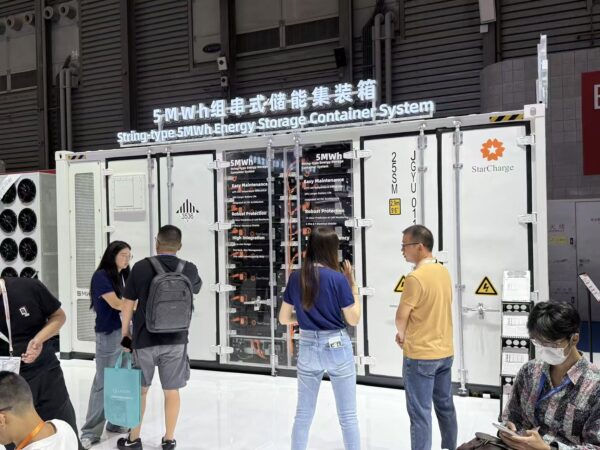
At the 2025 SNEC ES+ storage exhibition in Shanghai, the company avoided flashy displays, instead showcasing a sectional model of its 2.5MW/5MWh energy storage system featuring dual cooling circuits, modular PCS units and a proprietary EMS interface, reflecting a transition from infrastructure builder to energy orchestrator.
Founded in 2014, Wanbang became widely known under the “Star Charge” brand as an early pioneer of China’s charging pile industry. By June 2025, it had deployed 702,000 charging points, dominating over 90 per cent of the private installation market and ranking second in the public charging segment.
However, the company is now pursuing what system engineer Du Jilin describes as a structural evolution: “Integrating storage and VPPs with our charging network transforms us from a simple intermediary of electricity flows into an active participant in grid dispatch and energy allocation.”
This strategy has materialised into large-scale deployments. Wanbang has launched 476MW storage projects across China’s renewables-rich regions such as Inner Mongolia and Xinjiang, while securing overseas orders exceeding 1GWh in Europe, North America, India and the Middle East.
The company has set an internal “g80” shipment target, while planning to expand its storage asset base to 3–4GWh by 2026 in preparation for a potential REITs listing. Its technological edge lies in a vertically integrated architecture: except for battery cells, key modules including PCS, BMS and EMS are either independently designed or deeply customised. “This gives us cost and reliability advantages,” Du says. “In a market where price competition is intense, in-house systems reduce intermediary costs while ensuring consistency across projects.”
The liquid-cooled system on display embodies this approach. It employs dual-loop cooling, one for the cabinet and another specifically for PCS components, supported by low-friction centrifugal pumps that keep noise at 74 decibels, below industry averages. An AI-driven thermal control algorithm maintains temperature differentials between battery clusters within 2°C, improving charging efficiency and cycle lifespan. “A 1°C variance can translate into millions of kilowatt-hours in lifecycle efficiency losses for large projects,” Du notes.
Wanbang’s competitiveness lies in full-stack integration of storage, charging networks and VPPs. Its self-developed P4, SBM and EMS modules form the digital backbone of its VPP, enabling unified coordination of charging stations, storage sites and distributed solar microgrids. A recent project with COSCO Shipping exemplifies this closed-loop model, where all components from PCS to EMS are sourced from Wanbang’s own platform.
“Integration and control over core modules allow more flexible energy dispatch and response strategies,” Du says. International expansion forms the company’s second strategic pillar. In May 2024, Wanbang signed a joint venture framework agreement with Schneider Electric to enter the European market. Its products now reach 66 countries, supported by factories in Vietnam and the US, and a settlement centre in Singapore.
However, globalisation brings regulatory constraints. Du points to the EU’s upcoming Battery Passport regime, which mandates full traceability of cell materials, supply chains and carbon footprints. “We must ensure compliance not only in product design but across our management systems,” he acknowledges.
To accelerate overseas deployment, Wanbang promotes a pre-assembled “Olympic-man design” concept, completing system-level joint commissioning before export to minimise on-site installation time and labour. “We aim for a plug-and-play delivery model abroad,” Du explains.
Looking ahead, the company is developing 5–20MW large-scale storage containers and collaborating with semi-solid battery manufacturers on titanium-alloy-based products to enhance safety. “We will deepen integration and validation on reliability and safety,” Du says. Financial data indicates the transformation’s impact: the company’s net profit margin reached 23.7 per cent in the first half of 2025, compared to 3 per cent in 2024, driven by high-margin storage and VPP services. Wanbang’s valuation has reached CNY 18bn, and it has revived its A-share IPO process.
As global energy systems undergo structural realignment, Wanbang illustrates a broader shift: competition is moving from isolated hardware towards holistic ecosystems combining systems, software and services. “Control over core modules determines control over future iterations,” Du argues.
For the Changzhou-based unicorn, the primary test now lies in balancing technological leadership with the operational demands of global expansion. Yet its trajectory suggests that Chinese digital energy companies are no longer merely building charging infrastructure—they are laying the intelligent foundations of tomorrow’s electricity grids.
