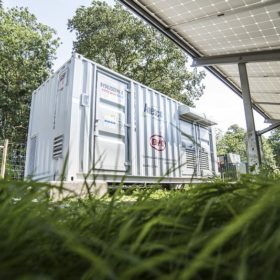
UK could reach 12 GW storage capacity within five years, report finds
Lessons learned from solar failures could propel battery storage market to 12 GW by 2021, argues report by All-Party Parliamentary Group on Energy Storage, which implores government to be “on the front foot” when it comes to seizing ways to ensure energy security for the nation.

Singulus develops new diamond wire multi wafer texturing process
The German tooling firm announces the development of a new texturing process for multicrystalline wafers using diamond wire sawing on its LINEX inline system. Company believes process can boost multi wafer market in 2018.
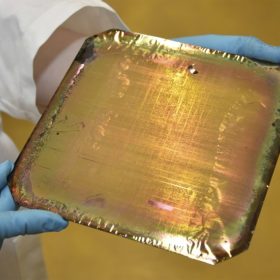
RENA leans on solar knowledge to develop mass etching process for lithium-ion batteries
German PV equipment manufacturer to team with Kiel University to develop scalable production of silicon anodes to boost lithium-ion battery performance.

Comtec cancels wafer supply agreement with Mission Solar
The Chinese solar company has terminated the agreement to supply wafers to the U.S. producer after repeated failures by Mission Solar to purchase the required quantities of wafers outlined in the contract.

Tenaga wins contract to build 30 MW Malaysian solar farm
The large-scale PV project will be built in Malaysia’s Kedah state in the northwest of the country. Tenaga Nasional Berhad was awarded the development rights following a competitive bidding process overseen by the Energy Commission.
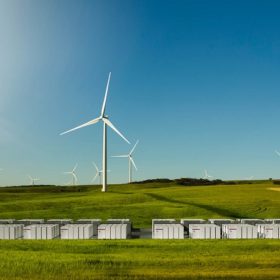
Elon Musk comes good on 100-day, 100 MW South Australia battery promise
The Tesla chief laid down the gauntlet earlier this year, confidently tweeting that his team could have the world’s largest battery online within 100 days of signing the contract. The lithium-ion South Australia project was actually completed in 60 days.
BNEF summit: Low solar prices spreading spending doubt among Tier-1 firms
Trina Solar may scrap planned Indian PV fab amid tumbling prices driven by solar auctions, reports Bloomberg New Energy Finance during its Shanghai summit. Demand for lithium, meanwhile, poised to reach record high on back of expected EV growth.
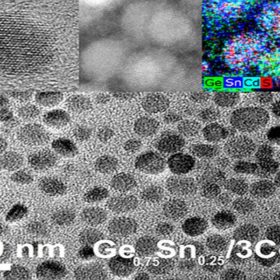
Tin makes nanoparticles better at absorbing sun’s rays, researchers find
Addition of tin in germanium nanoparticles helps to improve their photoluminescence thanks to better matching of lattice structures that boost structural characteristics, aiding light absorption, says Ames Laboratory in U.S.

UK government backs national battery facility to tune of £80m
Partnership between Coventry City Council, University of Warwick’s WMG and Warwickshire Local Enterprise Partnership to receive sizable investment from British government to build and maintain world-leading storage research and production facility.

The weekend read: Will duties ADD doubt to India’s solar growth?
The threat of India’s government imposing anti-dumping duties (ADD) against solar cells and modules from China, Taiwan and Malaysia is very real, and runs counter to its own ambitions of hitting 100 GW of solar by 2022. Or does it? Could duties help to boost India’s solar industry in other ways? And does the ongoing political uncertainty create opportunity or trepidation for industry?
