
The International Solar Energy Society’s Solar World Congress 2025 in Brazil
The International Solar Energy Society’s (ISES) Solar World Congress (SWC) has been held biennially since the 1970s, and in November 2025 will take place in Brazil. With the sharp and continuous drop in PV costs, photovoltaics has become the lowest-cost solution in Brazil and worldwide, and this is reflected in the number of articles accepted for presentation at the SWC. The Solar World Congress program has traditionally been dominated by presentations on solar radiation and solar thermal applications, but this year, photovoltaics is the focus of most of the accepted papers. In Brazil, where large-scale hydropower plants have traditionally dominated the electricity generation mix, PV is now the second-largest generating source, and the country is adding every year the equivalent of its largest hydropower plant Itaipu, which took more than 10 years to build and reach installed capacity.
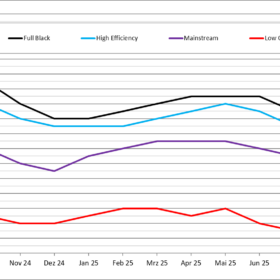
Don’t put off until tomorrow …
… what you can do today. PV and installation professionals should act now as module prices drop to new lows despite efficiency revisions.
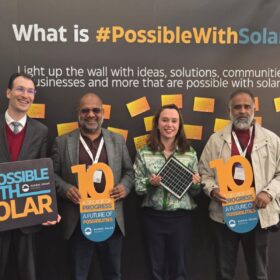
Solar can deliver growth, competitiveness, and resilience all over the world
Solar is so scalable, so versatile, that every single country in the world, every single human on the planet from the frozen North to the deepest rainforests, from the dry, arid plains of the Atacama to the buzzing metropolises of New York, Paris, São Paulo, Shanghai and Tokyo can benefit from it.

Solar module certification is broken. Here’s how to fix it
Is the solar industry’s focus on cutting costs undermining module reliability, safety and lifecycle economics?
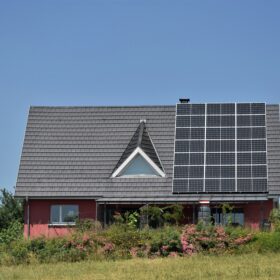
Residential solar shifts from surge to strategy: EUPD report spotlights market leaders
Europe’s residential solar market takes a strategic turn as EUPD Research unveils its third edition of the Market Leadership Study Europe©, highlighting the continent’s top installers, emerging business models, and key sector trends.
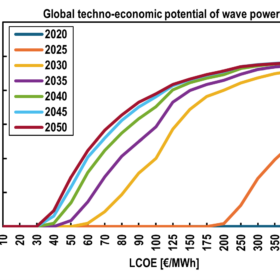
Wave power poised to complement solar PV in future global energy mix
Wave power may emerge as a valuable renewable energy source given recent economic and technical projections indicating a substantial potential of wave energy, particularly in coastal and island regions. Wave and solar resources are complementary around the world and thus may lead to energy systems combining solar PV with wave power. Islands may benefit most from wave power added to solar PV.

The urgent call to transform leadership in the face of solar slowdown
This week, WiSEu Network – Women in Solar+ Europe reflects on SolarPower Europe’s forecast of a 1.4% drop in EU solar growth for 2025, the first decline since 2015, and why this signals more than just a market slowdown. To meet 2030 targets, we don’t just need better strategies; we need a transformation in leadership itself. That means dismantling centuries-old biases that equate leadership with dominance and detachment, and embracing a fuller spectrum of qualities: empathy, collaboration, and emotional intelligence, now recognised as essential for navigating complexity and driving the energy transition.
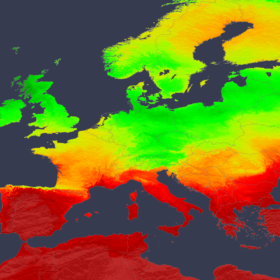
Record-warm July boosts solar in North, dampens South and East
In a new weekly update for pv magazine, Solcast, a DNV company, reports that persistent high‑pressure over Scandinavia delivered significantly elevated irradiance up to 30 % above normalin July, while central and eastern Europe faced reduced solar generation under increased cloud cover and rainfall.
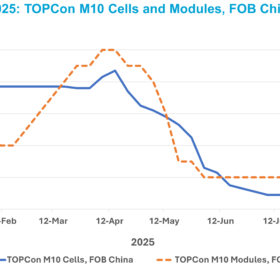
China solar cell rally stalls amid worsening margin squeeze
In a new weekly update for pv magazine, OPIS, a Dow Jones company, provides a quick look at the main price trends in the global PV industry.
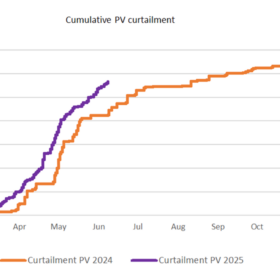
Remedies for PV curtailment in Poland
Solar curtailment is on the rise in Poland, with around 600 GWh of PV capacity reduced during the first six months of 2025. The Warsaw-based Institute for Renewable Energy (IEO) suggests one solution is to support the electrification of Poland’s heating sector with the surplus of PV power.
