
Batteries: The game has changed – and it’s not what you think
A single benchmark no longer exists. In some cases, charging speed is what matters; in others, it is energy density, and in still others, cost and scalability. In other words, the battery is ceasing to be a simple component. It is becoming the transversal energy infrastructure of the next industrial cycle. And those who can control not only the technology but also production, integration, and the grid will have an advantage that will be difficult to recover.

People, purpose and systems thinking: The leadership layer of the energy transition
Women in Solar+ Europe highlights this week the insights shared by industry leaders during the panel “Impact Leadership in Solar & Storage: securing the energy transition through people, purpose and systems thinking,” organised by the leadership ecosystem Solar+ Leaders at Solar & Storage Live London. Bringing together voices from across the value chain, the discussion explored how leadership is evolving in response to growing system complexity, skills gaps, and the need for greater alignment across the industry.

April ENSO shift lifts northern coastal irradiance while suppressing Brazil and northern Argentina
In a new weekly update for pv magazine, Solcast, a DNV company, reports that April 2026 brought mixed solar irradiance conditions across South America, with above-average GHI along Colombia’s Pacific and Caribbean coasts and parts of southern Argentina, while eastern and northern temperate regions — including Buenos Aires to Bolivia — saw reduced irradiance due to persistent cloud cover and wetter-than-average conditions.
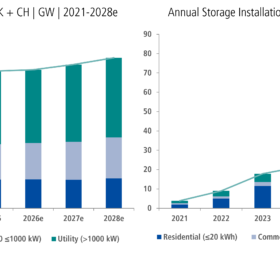
Europe’s solar and storage development: Selectivity amid rising global supply and returning energy shocks
Escalating Middle East tensions and global energy supply risks are accelerating Europe’s shift toward solar and storage, particularly in commercial, industrial, and utility-scale segments where energy security, resilience, and price stability are becoming central investment drivers. At the same time, expanding manufacturing capacity in China and India is redirecting surplus solar and storage supply toward Europe, creating a highly competitive and increasingly selective market where long-term success depends on quality, reliability, ESG alignment, and strategic market positioning.

Solar Manufacturing USA 2026 – production and technology at the heart of US solar
The upcoming Solar Manufacturing USA 2026 conference in Austin will focus on real U.S. solar manufacturing progress, shifting attention from capacity announcements to actual production, costs, yields, and technology choices across the full value chain. It will also examine how policy changes and tariffs are driving domestic expansion in ingots, wafers, cells, and modules, while highlighting competing technologies like back contact, heterojunction and TOPCon.

Resisting rust in solar
Over a 30-year asset life, corrosion can evolve into a structural, electrical, and fire safety issue. Corrosion drives up operations and maintenance (O&M) costs, reduces resilience to extreme events, and in some cases, can force premature decommissioning or complete structural replacement Intertek CEA’s Nicholas Hudson and Ankil Sanghvi advise on best practices.
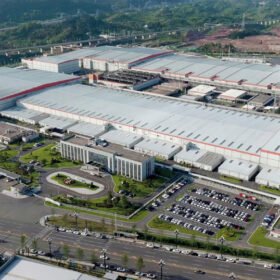
The battery cost disconnect
For years, the battery energy storage (BESS) story has followed a familiar script: costs fall, deployment accelerates, economics improve. Even when cell costs rose and system prices briefly flattened during the 2021-22 lithium price spike, the narrative largely held. Paola Perez Peña, senior principal analyst at S&P Global Energy, examines why the latest jump in lithium prices has only had limited impacts on overall BESS costs so far.

‘Breaking barriers is rarely a solo effort’
This week Women in Solar+ Europe gives voice to Sara Kapeller, CEO of Germany’s Twistor GmbH. She says building impactful careers in the renewable energy landscape requires courage, curiosity, and inclusion, turning setbacks into growth and empowering more women to lead technical innovation and shape the future.
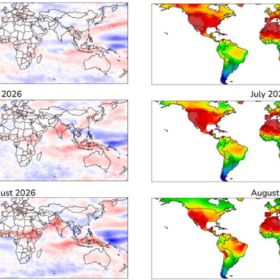
Developing El Niño points to stronger solar conditions across Australasia and South Asia
In a new weekly update for pv magazine, Solcast, a DNV company, provides a June–August 2026 outlook indicating mostly neutral to positive solar irradiance globally, with stronger gains in regions like Australasia, South Asia, West Africa, and Central America—patterns consistent with a developing El Niño. Negative anomalies are limited and mostly early-season, while Europe and the U.S. show modest or mixed signals, with improvements or neutrality dominating as the season progresses.
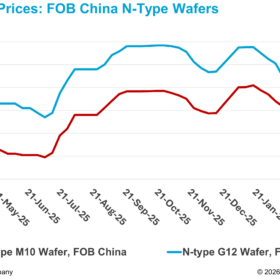
China wafer declines narrow as demand-side regulation lifts market sentiment
In a new weekly update for pv magazine, OPIS, a Dow Jones company, provides a quick look at the main price trends in the global PV industry.
