
Solar dimming and brightening, and PV power plant output performance
Reliable assessment of the local solar radiation resource is a major component of large-scale PV power plant project development and financing. This assessment is usually based on the assumption that the long-term average annual solar radiation from previous years is not significantly different from the expected future solar resource availability. In many areas of the globe, the solar radiation availability in 2023 was considerably higher (up to 10-12%) than the long-term average, and this might be overshadowing the fact that a large fraction of utility-scale PV power plants is undeperforming.

2024 Outlook: What could La Niña mean for US solar this year?
In a new weekly update for pv magazine, Solcast, a DNV company, describes the possible consequences for PV plan and grid operators of a possible switch to La Niña conditions in North America. These conditions lead to more hurricanes, convection and cloudiness in the Gulf of Mexico, resulting in decreased solar irradiance. In contrast, the Atlantic coast of the USA has historically seen up to 5-10% above-average irradiance during summer months in previous La Niña events.

‘I’m proud to work for a company led by a woman’
This week, Women in Solar Europe (WiSEu) gives voice to Aleksandra Gabryjalowicz-Watla, Head of Partnerships Wind & Solar Germanyat Statkraft Erneuerbare GmbH. She explains how being out “in the field” may mean more exposion to occasional opposition or bias, but she also says how to properly react to bias or even disrespect.

‘Addressing the gender gap requires a bottom-up approach, beginning with recognition and regulation’
This week, Women in Solar Europe (WiSEu) gives voice to Giorgia Epicoco, Senior EU Affairs Manager | Sustainability Lead at Huawei. She believes that the renewable energy sector is now poised to welcome a growing number of talented female professionals in technical, sales, marketing, operations, logistics, and public affairs roles. “However, reaching top-level positions isn’t feasible for everyone, and this is where skills development becomes crucial,” she warned.

Western Europe cloudy while East sees solar gains in May
In a new weekly update for pv magazine, Solcast, a DNV company, reports that, thanks to warm temperatures and relatively sunny skies, Finland and Sweden had irradiance up to 30%, which unusually resulted in higher total irradiance than the more southerly UK and France. On the other side of the Baltic Sea, Poland, the Baltic States, and neighbouring countries also experienced irradiance up to 30% above the long-term average.
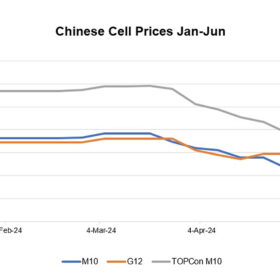
Solar cell prices hold steady in quiet market
In a new weekly update for pv magazine, OPIS, a Dow Jones company, provides a quick look at the main price trends in the global PV industry.

IEC lays ground for flexible silicon solar module standards
In its second monthly column for pv magazine, the IEC highlights the research on flexible crystalline silicon solar cells led by researcher Zhengxin Liu, the Vice Chair of IEC Technical Committee 82, which prepares standards for solar PV energy systems.

‘I worked in notably biassed teams, both in terms of gender and age’
This week, Women in Solar Europe (WiSEu) gives voice to María Santa María, Head of Projects at BayWa r.e. Iberia. She says that diversity and Inclusion are worth the central stage in a company’s hiring practices and board representation. She also claims that organizations and industry stakeholders have lots to gain by explicitly and outspokenly prioritizing equity and inclusion to create a more inclusive environment for women and other underrepresented groups.

Gulf heat dome and polar jet stream shape solar outcomes in May
In a new weekly update for pv magazine, Solcast, a DNV company, reports that a strong polar jet stream and a record-breaking heat dome in May resulted in a stark contrast in irradiance patterns across North America. The western and central USA, along with Mexico, experienced higher than normal irradiance, while the Gulf and East Coast regions faced lower irradiance.
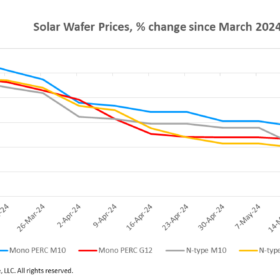
Solar wafer prices continue to soften, complex international trade situation sparks concerns
In a new weekly update for pv magazine, OPIS, a Dow Jones company, provides a quick look at the main price trends in the global PV industry.
