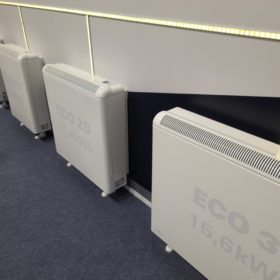
Solar-powered residential heating system based on storage heaters
Spanish heating specialist Elnur Gabarron offers a residential heating system that works with surplus solar power and storage heaters. The system can work as a backup solution, combined with existing conventional heating, or as a household’s main heating system, with minimal use of grid electricity.
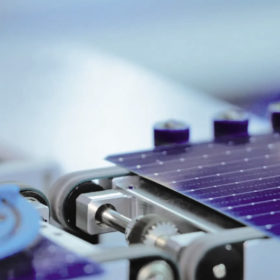
Perovskite-silicon tandem solar cell with TOPCon structure hits 27.6% efficiency
A research group led by Chinese manufacturer JinkoSolar has developed a tandem perovskite-silicon cell with a subcell based on TOPCon tech. The group succeeded in reducing voltage losses in the silicon sub-cell by minimizing the shunting probability during device fabrication.
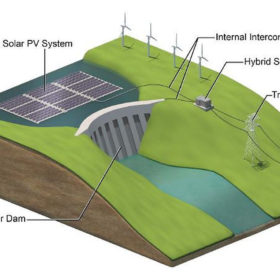
Hybridizing floating solar with hydropower
Scientists from the National Renewable Energy Laboratory (NREL) have said that the combination of floating solar with hydropower could reduce PV curtailment.
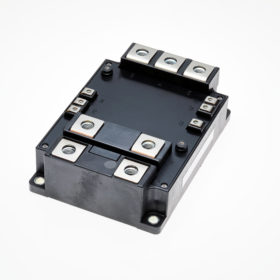
Mitsubishi Electric unveils power-switching transistor for solar
Mitsubishi Electric’s new 2.0kV LV100 semiconductor device is based on its insulated-gate bipolar transistor (IGBT) technology and Relaxed Field of Cathode (RFC) diodes. It is designed for industrial applications that need “middle-ground” power converters between DC1500 V and 3.3 kV.

Storing solar power via borehole thermal energy storage
A Chinese-Finnish research group has proposed the use of seasonal, soil-based thermal energy storage in combination with photovoltaics in residential districts. They have found that the hybrid concept could cover up to 58% of total heating demand.
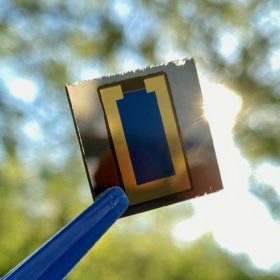
Perovskite-CIS tandem solar cell with 24.9% efficiency
A Dutch-German research team has developed a new PV cell with a certified efficiency of 23.5%, an open-circuit voltage of 1.59 V, a short-circuit current of 19.4 mA cm–2, and a fill factor of 75.5%. It reached maximum efficiency of up to 24.9%, due to the high quality of the subcells.
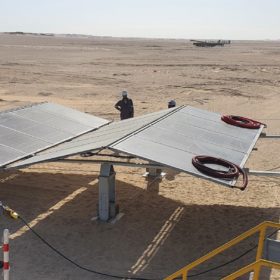
Mobile solar-plus-storage unit for offgrid applications
Enerwhere has designed a solar-plus-storage mobile unit for offgrid locations such as oil and gas fields and construction sites. It can be adapted to different needs and is scalable up to megawatt-scale projects.
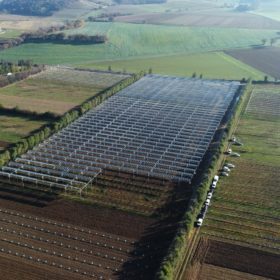
Romania introduces new rules for solar on agricultural land
Romania is set to put new solar regulations into force through the end of 2026. The rules will allow PV, wind, biomass, bioliquid, biogas, storage projects, and transformer stations to be built directly on land in several previously prohibited fertility classes.
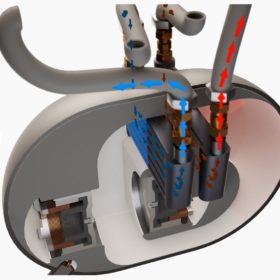
Thermo-acoustic heat pump for residential applications
Dutch researchers have developed a heat pump that can be used in combination with rooftop solar generation, due to its modulating capabilities and temperature flexibility. It measures 55 cm x 55 cm x 55 cm and has an output of 6 kW.

Glass pyramid concentrator for solar cell applications
Stanford University scientists have built an optical concentrator that purportedly harvests more than 90% of the light that hits its surface.
