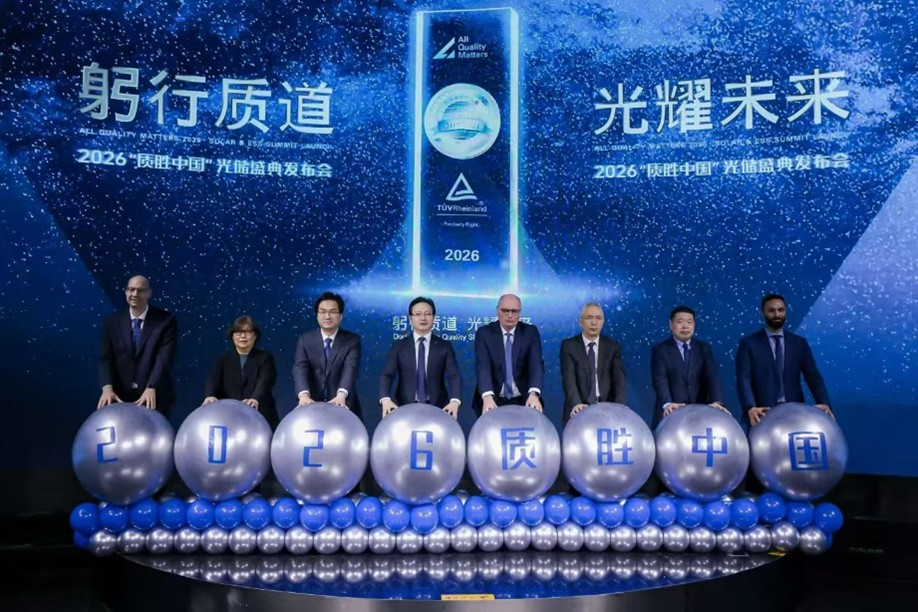





On March 31, TÜV Rheinland Greater China, an international independent third-party testing, inspection, and certification organization, held the launch event for the 12th “All Quality Matters” Solar & Energy Storage System (ESS) Summit in Shanghai. TÜV Rheinland announced that this year's Solar & ESS Summit will take place in September in Suzhou, and revealed the award categories and selection criteria for this year's “All Quality Matters” Award.
Li Weichun, Senior Vice President of Solar and Commercial Products Services at TÜV Rheinland Greater China and Senior Vice President of Global Power Electronics Business Segment, pointed out that multiple uncertainties—including the global situation, policy orientation, and industry cycles—are currently intertwined, yet the transition to clean energy is imperative. Meanwhile, “Made in China” is rising comprehensively, achieving a leap from scale-focused development to quality and efficiency parity, with enterprises progressing from importing to exporting, from going global to independent innovation, continuously advancing to higher levels. Although the photovoltaic and energy storage industry faces short-term fluctuations, it remains a “golden track” in the long term. The key code for the industry's transition from “uncertainty” to “certainty” lies in the path of high-quality, sustainable, and healthy orderly development.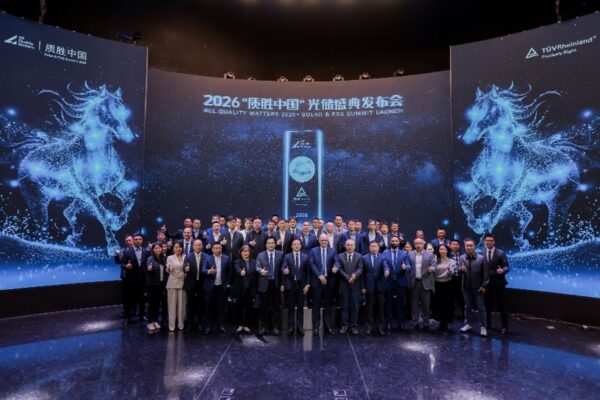
“All Quality Matters” Award Selection Criteria Revealed
At the event, TÜV Rheinland unveiled the award categories and selection criteria for the 2026 “All Quality Matters” Award. This year's competition is divided into three groups: Photovoltaic Products, Solar-Storage-Charging Products, and Power Plant and Supply Chain Services. The award system has been systematically upgraded, with unified evaluation of photovoltaic products and solar-storage-charging products across five dimensions: safety, performance, reliability, environmental adaptability, and comprehensive quality. This provides the industry with comprehensive, quantifiable technical benchmarks ranging from individual to integrated metrics and from short-term indicators to long-term grading. This not only incentivizes enterprises to benchmark and improve, but also provides more scientific data support for industry standardization, policy formulation, and investment decision-making.
Meanwhile, the Power Plant and Supply Chain Services group has added a new category for “Best Return on Investment for Commercial and Industrial Distributed Photovoltaic Projects.” This marks the transformation of the distributed photovoltaic industry from “scale expansion” to “quality and efficiency,” while also providing important references for establishing return evaluation standard systems, risk control, and investment strategies under new policies.
TÜV Rheinland to Release “Global Grid Structure and Grid Connection Technology Development White Paper”
TÜV Rheinland announced that it will release the “Global Grid Structure and Grid Connection Technology Development White Paper” at this year's Solar & ESS Summit. Based on TÜV Rheinland's extensive accumulation in the new energy sector and combined with market research, this white paper systematically reviews global grid structures and provides detailed interpretation of global grid connection technical requirements, offering the industry a technical roadmap and compliance guide for the transition from “grid-following” to “grid-forming.”
At the same time, TÜV Rheinland also released key technical data on precise measurement of photovoltaic modules, providing in-depth analysis of electrical characteristic testing and reliability for mainstream technology routes including TOPCon, HJT, and xBC. This provides scientific basis for photovoltaic enterprises' product R&D and process optimization, promoting technological progress and product performance improvement in the industry.
The global photovoltaic and energy storage market is currently at a critical juncture of transitioning from scale expansion to quality improvement. Technological innovation, cost control, and localized operational capabilities will become core competitive advantages for enterprises. TÜV Rheinland remains committed to its mission of “Making the World Safer,” helping enterprises enhance product reliability and global competitiveness through product certification, performance testing, system evaluation, supply chain auditing, and digital quality management services, safeguarding the healthy and sustainable development of the industry.
