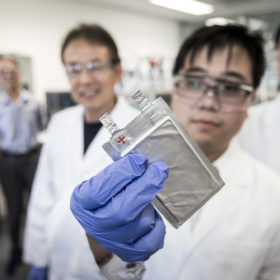
Australian researchers unveil new sodium-ion battery design
Scientists from the University of Wollongong in Australia have developed battery cells based on sodium-ion technology, which the university says can achieve excellent cycling stability and easily be scaled up for mass production.
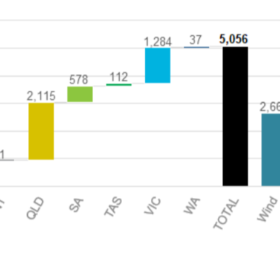
Australian large-scale renewables under construction passes 5 GW
5,056 MW of large scale solar and wind are currently being built in Australia. The latest figures from Green Energy Markets shows that the total passed the 5 GW milestone for the first time in February.
Solar on tap: Australia’s Carlton Breweries signs PPA with BayWa r.e. for PV supply
The Melbourne-headquartered brewer will receive solar energy from a 112 MW solar farm located in the state of Victoria, and owned and operated by Germany firm BayWa r.e. The move is part of Carlton’s drive to become 100% renewable.

Varta enters Australian residential storage market
German energy storage producer, Varta Storage has entered the Australian market. It is introducing the pulse 3 and pulse 6 models, sized at 3.3 kWh and 6.5 kWh.
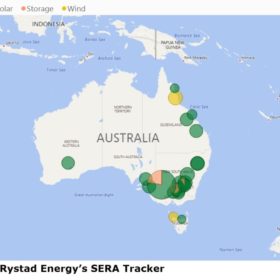
Australia: Global oil and gas companies step into large-scale solar – SERA
Oil and gas giants Total and BP are entering the Australian large-scale solar segment. Rystad SERA made the observation in its latest report.

Big weekend: What will happen at the International Solar Alliance Summit?
The International Solar Alliance (ISA), now registered under the United Nations, is organizing its first summit to be held this Sunday, March 11. It is also set to host a founding ceremony of the ISA in the presence of French President, Emmanuel Macron, Indian Prime Minister, Narendra Modi and Bangladeshi President, Abdul Hamid. Government dignitaries of member countries are joining, and 51 solar projects will be signed.
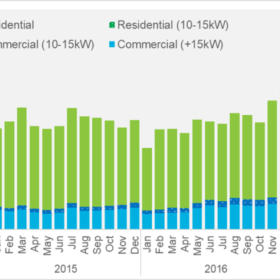
Australia’s rooftop installations above 2017’s record-breaking year
February rooftop solar installations exceeded 115 MW, well above the less-than 80 MW installed in the same month 2017 – itself a record-breaking solar year in Australia. Green Energy Markets’ latest STC figures reveal the “extraordinary” installation rates.
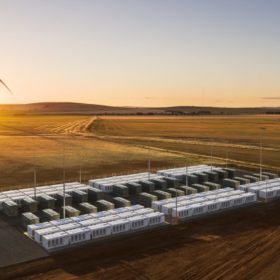
Neoen’s 50 MW hydrogen electrolyser at proposed wind, solar facility in Australia receives grant
French firm Neoen has begun development on a hydrogen electrolyser to be colocated alongside a 150 MW wind project and 150 MW solar farm. The project has been awarded a grant of AU$1 million by the South Australian Renewable Technology fund, with more funding yet to be approved.

Australian researchers demonstrate first working proton battery
Scientists at the Royal Melbourne Institute of Technology (RMIT) have demonstrated the first working example of a “proton battery”, which utilizes a carbon electrode and a reversible hydrogen fuel cell for the storage of energy. The scientists say their small prototype has already demonstrated similar storage capacities to commercially available lithium-ion batteries, with plenty of potential for further optimization.
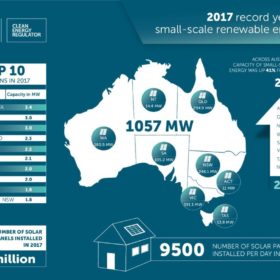
Australia: record 1.07 GW small-scale solar installed in 2017
It’s official: 2017 was a record year for rooftop PV in Australia. The Clean Energy Regulator announced today that over 1070 MW of small-scale solar was installed by Australian homeowners and businesses in 2017 – representing 41% growth over 2016.
