Belgium: Flemish regulator challenges smart meter residential PV agreement
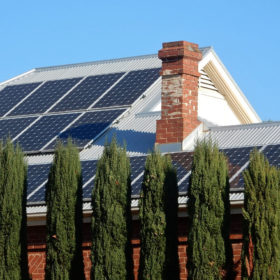
The deal introduced a 15-year grace period for household PV system owners, during which they could choose whether to take net metering payments based on assumed energy use or a potential new system based on actual use and measured by smart meters.
Belgium sees the biggest PPA-driven solar installation commissioned since 2013
With a capacity of 2,2 MW, the rooftop array is at the industrial plant of Belgian company Ontex, which will buy almost all the electricity generated from project developer Menapy under a 15-year power supply deal.
Belgium: Flemish government grants feed-in premium of €0.078 to megawatt-scale floating project
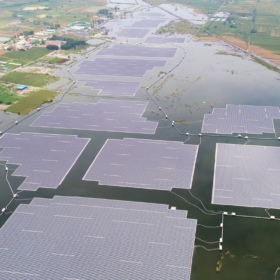
The electricity produced by the floating array will power the Cable Park aquatic park, with surplus power injected into the grid. The project is part of a series of floating plants the Flemish government has been supporting since October.
Wallonia’s grid fee for prosumers will apply only to new systems
The controversial charge for residential PV systems will apply only to installations connected to the grid after July 1, and will come into force from 2020. Wallonia has around 1.1 GW of installed solar capacity, most of it residential PV systems.

Belgium’s PV capacity tops 4.25 GW
Most of the nation’s solar is in Flanders, which at the end of December had more than 3 GW of grid-connected PV. Wallonia and Brussels account for the remaining 1.1 GW and 83 MW, respectively. Although Belgian solar is still dominated by residential PV, a stronger stimulus for the market may come from the large-scale segment in the years ahead.
Utility-scale PV all set for growth in Belgium
The energy regulator of Flanders has set a provisional feed-in premium of €0.02595/kWh – to be added to the spot market price – for a 1.35 MW solar project under development in the region. That is considerably more affordable for public support than the feed-in premium of €0.078/kWh the VEA set a year earlier for a 100 MW project under development by Engie.
Wallonia’s controversial residential PV fee may only apply to new systems
The energy regulator of Belgium’s French-speaking region has announced the fee for residential PV will come into force next year and may apply only to installations grid-connected after July 1 this year, as proposed by the regional government.
Belgium preps for energy transition with blockchain, AI and other innovations
Belgian grid operator Elia has published a vision paper explaining how it intends to link consumers’ behavior at lower voltage levels with price signals in the wholesale electricity market, thus also enabling better integration of renewables.
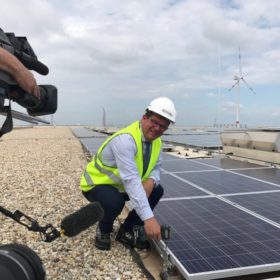
Engie to build Belgium’s largest solar park
Construction on the 100 MW Kristal Solar Park is set to start in October. The facility will be located near the town of Lommel, in the Flemish province of Limburg. The project developer, local investment agency, Limburgse investeringsmaatschappij (LRM) said the project will be 34% cheaper than expected.
Belgium: Flanders to allow direct lines for solar, RE starting from 2019
A new amendment to the region’s energy law allows enterprises to sell power to one other through the so-called direct line model, starting from 2019.
