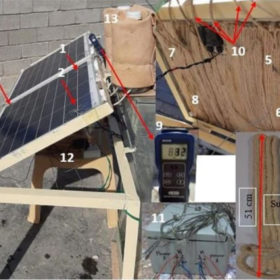
Cooling down solar modules with cotton wicks immersed in water
The novel technique consists of attaching cotton wicks immersed in the water (CWIWs) to the backside photovoltaic module. The water is supplied to cotton wicks from top to bottom by gravity which the scientists said helps the effective absorption of cotton and reduces water consumption.
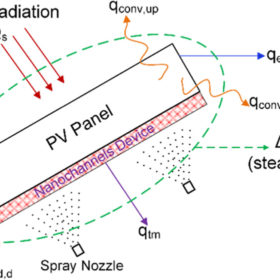
New solar module cooling tech based on porous nanochannels
US scientists have utilized a nanochannels device to cool down the operating temperature of a commercial PV module and have found that the proposed technique is able to improve power yield by up to 32.8%. Spray droplets are dispersed over the nanochannels device in order to eliminate the need for a continuous supply of a coolant.
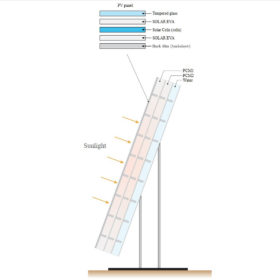
Two-layer phase change materials for solar module cooling
Researchers in Iran have tested four different two-layer PCMs across several cooling system configurations and have found that the payback time of the proposed cooling tech is still far from reaching commercial viability. The system, however, was able to improve PV power generation by more than 3% and produce hot water with a temperature of up to 48 Celsius degrees from the solar module’s excess heat.
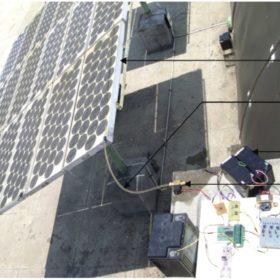
Spraying water system for solar module cooling
A British-Indian research group has developed an active cooling technique that is claimed to improve a PV system’s yield by around 0.5%. The system could be used in residential solar arrays and the water heated by the PV modules may be fed into a solar water heating system.
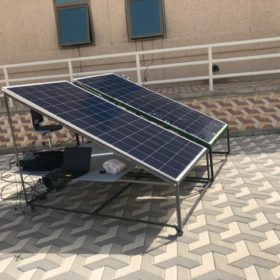
Solar module cooling techniques for the desert
Saudi scientists have tested several cooling technologies for solar panels and have found that active techniques work better than passive ones under harsh climatic conditions. The most effective one consists of a system based on four heat pipes immersed in a box of liquid, as liquid bulk, integrated with the back of the solar panel.
Compressed air tech for solar module cleaning, cooling
British scientists have developed an experimental compressed air system for the simultaneous cleaning and cooling of PV modules. The system was built with a compressed-air unit which was made of a compressor, an air tank, and an airflow regulation valve, and a series of nozzles. The technique was tested on a PV system located in northwestern India.
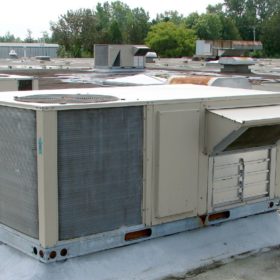
Cooling PV panels with HVAC system exhaust
A French-Lebanese research group has proposed a way to cool down PV modules by using air exhausted from heating, ventilation, and air conditioning (HVAC) systems. They showed that array performance improves when the cooling load rises.
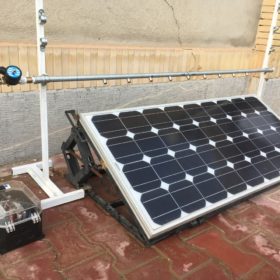
Pulsating spray cooling system for PV modules
Iranian scientists have assessed a new active approach for solar module cooling based on water spraying. Water sprayed from different angles can reduce the operating temperature of PV modules, with limited water consumption. However, the team noted that they have yet to assess the economic viability of the system.
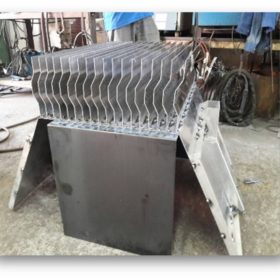
Solar module passive cooling with lapping fins
Malaysian researchers have proposed a new passive technology for solar module cooling based on fin heat sinks. The tech ensures lower PV system payback times and reduces operating module temperatures by up to 26 C.
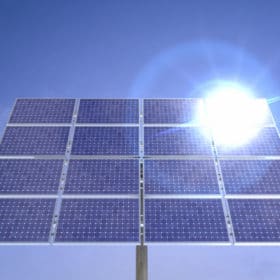
Cooling PV panels with shallow geothermal energy
Iraqi researchers have demonstrated the technical and economical feasibility of using shallow geothermal energy to cool PV systems. They tested two different techniques – a closed-loop system and an open-cycle system – to reduce power losses from 30% to up to 4.1%.
