IEA leads governments off the Paris Agreement track, report states
In a new report out today, Oil Change International and the Institute for Energy Economics and Financial Analysis (IEEFA) have taken the International Energy Agency (IEA) to task for misleading governments on climate policy through its energy forecasts.
Energy demand growth doubles in 2017; wind, solar see a banner year – IEA
As global energy demand went up by 2.1% in 2017, more than twice that of 2016, renewables saw the highest growth rate of any energy source, meeting a quarter of global energy demand. According to preliminary estimates from the IEA, solar PV accounted for 27% of the growth in renewables-based power output last year.
China the global leader in 2017 clean energy investment, at over $44 bn
China was the global leader in 2017 clean energy investment, says a new report. On the solar front, the country accounts for 60% of all cell production; and will continue to lead installation developments for at least the next five years. New 2020 targets are expected to be set. In the battery arena, Chinese companies are also set to dominate.
IEA: Solar PV set to lead capacity additions to 2040
In its annual flagship report, the International Energy Agency (IEA) highlights that fast-declining costs will turn solar into the cheapest source of new energy generation over the next 25 year.
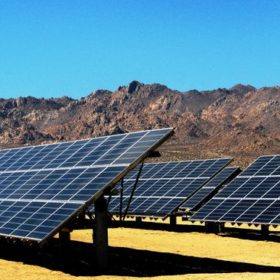
IEA: Solar, wind power rapid cost reduction may enable new options for greening industry
Highlighting the potential for greening the industrial sector amid rapid decline of solar PV and wind power costs, a newly published report by the International Energy Agency (IEA) shows that generation directly serving companies and public is dominated by commercial-scale PV, which made up 10% of all new additions in 2016.
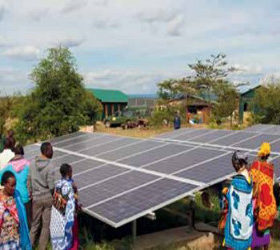
Growing political will and falling costs make universal energy access possible by 2030, IEA finds
The report, published in Energy Access Outlook: from Poverty to Prosperity, is the first instance of this sort of historical analysis, with this particular study looking at 140 countries and showing that the number of people without electricity fell to 1.1 billion in 2016, down from 1.6 billion in 2000.
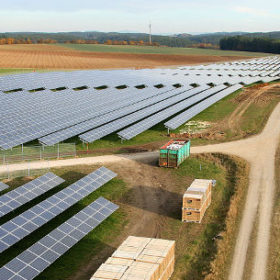
Solar fastest growing energy source in 2016, finds latest IEA report
The International Energy Agency’s Renewables 2017 report finds that solar PV capacity grew 50% last year, underpinning a 12% increase in this year’s renewables forecast and prompting the IEA to forecast 1,000 GW of clean energy by 2022.
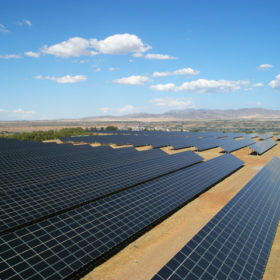
Clean energy spending in 2016 hits 43% share of total supply investment, finds IEA
The International Energy Agency’s World Energy Investment report sees global spending on energy fall by 12% overall in 2016, marking the second-consecutive year that investment has dropped as less money is poured into costly gas and oil infrastructure. Clean energy spending, meanwhile, is on the up.
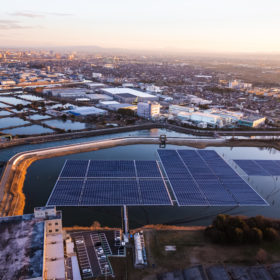
Spending less, getting more: renewables more cost-effective than ever in 2016, finds UN report
The latest Global Trends in Renewable Energy Investment 2017 report by the UN Environment, Bloomberg New Energy Finance and the Frankfurt School-UNEP Collaborating Centre finds that while investment in clean energy fell last year, annual installations rose, revealing the cost-competitiveness of the sector.
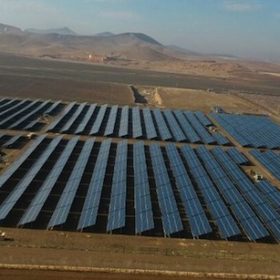
IEA, IRENA join forces to prompt redesign of energy markets
Berlin Energy Transition Dialogue 2017 will see the presentation of a joint report by International Renewable Energy Agency (IRENA) and International Energy Agency (IEA), their first ever collaboration with an eye on decarbonization of global energy system.
