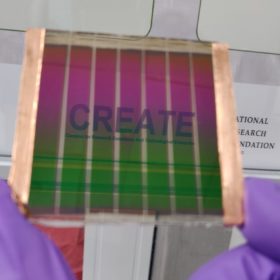
Large-area semitransparent perovskite PV module with 9.5% efficiency
Singaporean researchers have developed a semitransparent perovskite solar panels for applications such as building-integrated PV, vehicle-integrated solar, and smart glasses. They built it with a highly transparent and conducting transparent conductive oxide layer via tin-doped indium-oxide sputter deposition.
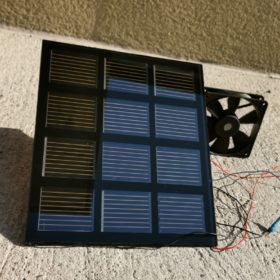
Titanium oxide nanoparticle-based perovskite PV cell with 24.05% efficiency
A new perovskite PV cell based on titanium dioxide nanoparticles exhibits low efficiency losses when scaled up from cell to module.
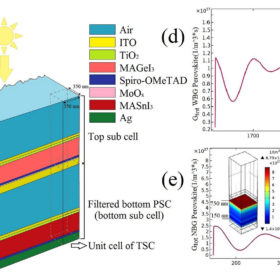
Four-terminal tandem perovskite solar cell design with 30.14% efficiency
The lead-free solar cell was modeled via a three-dimensional finite element method by an Iranian research group. The cell was designed without the buffer layer and with the addition of anti-reflection layer (ARL) strategies, as well as the use of periodic nano-texture patterns.
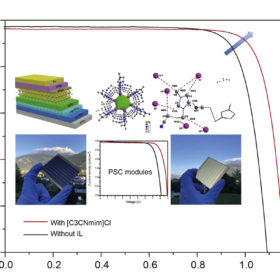
Ionic liquid-based perovskite solar cell with 22.86% efficiency
A Swiss-Japanese research group has used ionic liquids doping to improve the efficiency and stability of perovskite solar cells. Their champion device showed an open-circuit voltage of 1.16 V, a short-circuit current of 24.03 (mA cm−2), and a fill factor of 0.818. It was also able to retain around 95% of its initial efficiency after 1,000 hours of operation.
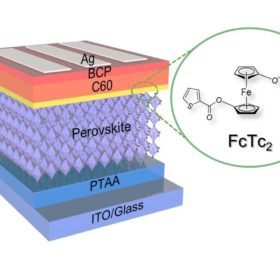
Inverted perovskite solar cell with 25% efficiency
The cell is based on ferrocene and is claimed to retain more than 98% of its initial efficiency after continuously operating at the maximum power point for 1,500 hours under standard illumination conditions.
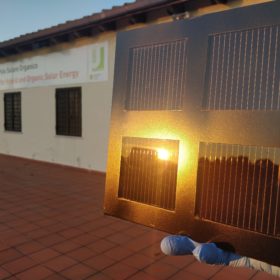
Mini perovskite solar module with 11.9% stabilized efficiency
An international research group has developed a perovskite solar panel on a 192 square-centimeter surface. The researchers claim the panel has one of the highest efficiencies reported at this size to date.
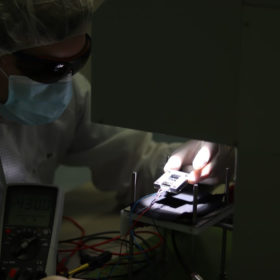
Ultra-thin perovskite-organic tandem solar cell with 24.0% efficiency
Researchers in Germany have built a perovskite-organic solar cell with low interfacial losses and a high open-circuit voltage. The device achieved an open-circuit voltage of 2.15 V, a short-circuit current of 14.0 mA cm−², and a fill factor of 80%.

AI method learns from experienced staff on perovskite solar production lines
Academics from MIT and Stanford who have posited a new production method for perovskite solar cells have also developed a machine learning system which benefits from the experience of seasoned workers – and they’ve posted it online for anyone to use.
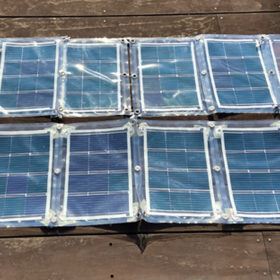
NGK Insulators enters perovskite PV module business
NGK Insulators has invested an undisclosed sum in Enecoat, which develops perovskite solar cells via a wet process based on organic chemistry, a low-temperature coating process, and roll-to-roll printing.
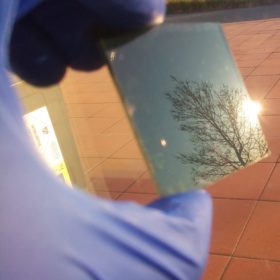
Low-temperature perovskite solar module with 19.1% efficiency
Researchers have developed a PV module with with an efficiency of 20.72%, based on tin oxide (SnO2) as an electron transport layer, an organometal halide perovskite layer, organic halide salt phenethylammonium iodide (PEAI) as a passivation agent, and Spiro-OMeTAD as the hole transport layer (HTL).
